For most of the past decade, artificial intelligence sat comfortably inside the technology department. IT teams evaluated tools. Developers built integrations. Executives received quarterly updates and approved budgets. The assumption was that AI was a technical discipline managed by technical people.
That assumption has expired.
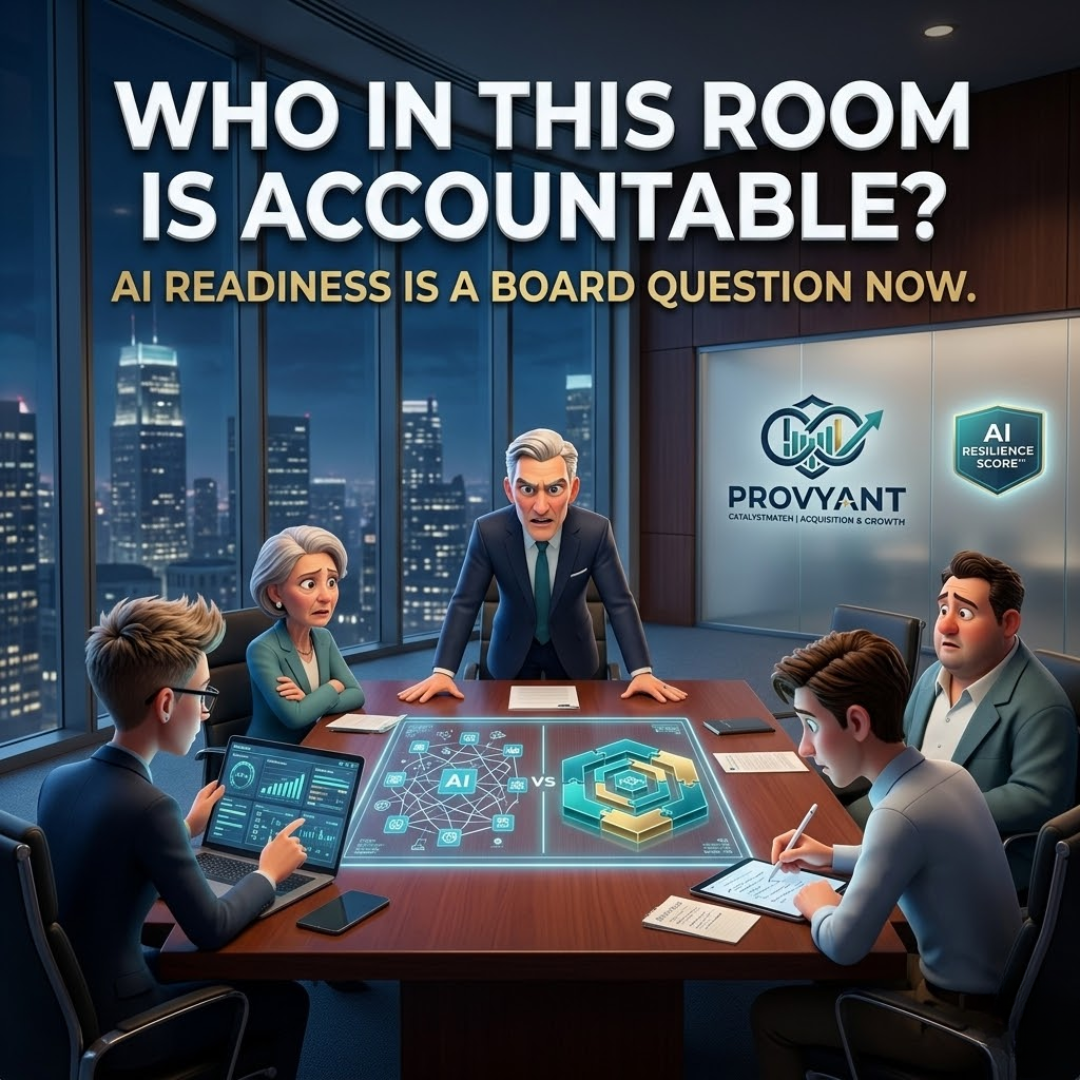
AI is now embedded in operations, decision-making, workforce structure, compliance exposure, and business valuation. Its risks and opportunities are no longer contained within a technology function. They cut across every layer of the organisation. And that means the people responsible for governing the organisation, its board and executive leadership, must own the AI readiness conversation directly.
The Governance Gap Most Organisations Have Not Closed
Only a minority of boards have adopted formal AI governance frameworks or established clear metrics for oversight, even as state AI regulations proliferate and courts are increasingly called upon to adjudicate matters involving AI risk.
The gap between AI adoption and AI governance is wide. Over 88% of organisations now use AI in at least one business function, yet the structures needed to govern that use at the leadership level remain underdeveloped in most. Teams are experimenting faster than leadership can guide them. Regulators are moving faster than many anticipated. And boards are beginning to feel the weight of decisions that carry significantly more risk than they did two years ago.
AI governance is now both a legal and strategic imperative across all industries. Boards that assess governance structures and elevate AI literacy now will be better positioned to meet their fiduciary obligations. Those that do not are accumulating exposure they have not yet quantified.
Why This Cannot Stay in the IT Department
When AI governance sits exclusively within a technology or compliance function, it loses the organisational context it needs to be effective. Deloitte’s AI governance framework is explicit on this point: when governance is isolated from strategy, innovation, and people operations, it becomes a parallel structure rather than an embedded discipline.
The consequences are predictable. AI tools proliferate across business units without visibility. Risk accumulates in functions that have no escalation path. Leadership makes operational decisions without understanding the AI dependencies embedded in them. And when something goes wrong, accountability is unclear.
ISACA research is direct on this point: AI outcomes should not be treated as the responsibility of algorithms, vendors, or technical specialists alone. Business leaders must retain accountability for how AI is used and how decisions are made. Risk, compliance, legal, and security functions need to be engaged early, not after problems surface.
What Board-Level AI Readiness Actually Looks Like
Effective AI governance at the board level does not require directors to become technical experts. It requires them to ask the right questions and ensure the right structures exist to answer them.
According to WTW, effective boards achieve AI proficiency through structure, education, and access to expertise. They designate clear leaders for strategic AI implementation. They maintain consistent decision-making models across functions. And they ensure that escalation paths exist for high-risk or high-impact use cases.
The questions that matter at the board level include: Does management have a clear position on how AI is currently being used across the organisation? Is there a documented strategy for AI adoption that accounts for workforce impact, third-party dependencies, and operational risk? How are AI-driven decisions being monitored and reviewed? What happens when AI outputs are unreliable or harmful?
These are not IT questions. They are governance questions. And they belong in the boardroom.
The Regulatory Environment Is Accelerating the Urgency
The governance gap is not just an internal risk. It is becoming an external liability. Several U.S. states have introduced or enacted AI-specific legislation requiring risk management programs, public disclosure of high-risk AI uses, and bans on discriminatory AI decisions in employment and education. Executives who have not yet built governance frameworks are already behind the compliance curve in several jurisdictions.
Courts and regulators increasingly expect directors to understand how and where AI is used in their organisations, to demonstrate that risks have been considered, and to show that governance structures exist to manage them. The organisations building those structures now are creating operational resilience. Those waiting are creating legal exposure.
Connecting Governance to Business Value
AI governance is not just a risk management exercise. It is directly connected to business value, acquisition positioning, and operational continuity.
A business that can demonstrate structured AI governance, documented operational processes, and clear leadership accountability for AI-related decisions is a fundamentally more attractive asset. It is more transferable to a new owner, more defensible under scrutiny, and more resilient to the disruptions the Invisible Recession is already creating across industries.
As Provyant’s analysis of the AI and Silver Tsunami convergence makes clear, the organisations best positioned to hold their value through this transition are the ones with governance structures that go beyond adoption and address durability, transferability, and risk accountability directly.
The Readiness Question Belongs at the Top
AI readiness is not a project to be delegated. It is a leadership responsibility that determines how an organisation adapts, competes, and survives the transition already underway.
The AI Resilience Score provides the structured framework boards, executives, and advisors need to assess where their organisation actually stands across operational durability, AI exposure, and strategic preparedness. Visit provyant.com because the boardrooms having this conversation today are the ones still in control tomorrow.