Every year, organisations run the same ritual. Months of data gathering, SWOT analyses, budget negotiations, and polished presentations, culminating in an annual strategic plan that sets the direction for the twelve months ahead. It is a process that has anchored corporate management for decades, and it once made sense. The trouble is that the world it was designed for no longer exists.
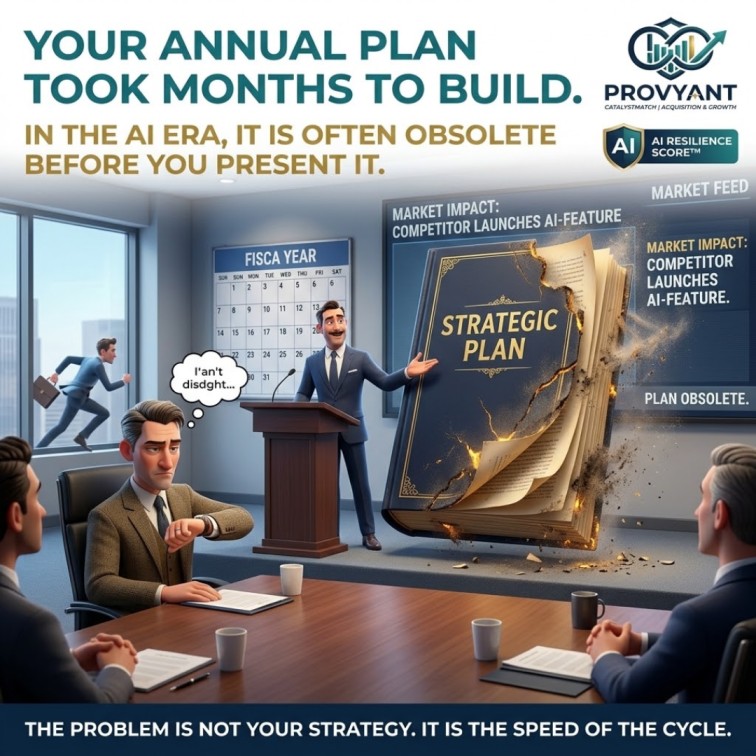
In the AI era, the annual plan is frequently obsolete before it is even presented. As Provyant has outlined in its analysis of the AI strategy gap, the disconnect between how organisations plan and how quickly reality now moves has become one of the most significant and least examined risks in modern management. The planning cycle itself, not the quality of the strategy inside it, is the problem.
Why the Annual Cycle Made Sense and No Longer Does
The annual planning cycle was built on a specific assumption: that the future was predictable enough that a direction set once a year would hold for the year. For most of corporate history, that assumption was reasonable.
Most planning frameworks were designed decades ago for a slower, more predictable world. They assume you can collect information, analyse it, and set a direction that holds relatively steady for some period of time. AI has broken that assumption. What used to be a solid year-long strategy window has shrunk to quarters, or even weeks.
The mechanics of the traditional process reveal why it cannot keep pace. The traditional annual planning process is a massive, once-a-year event that usually starts halfway through the prior year, with organisations spending five to six months gathering data and navigating layers of management just to reach the budget. By the time the fiscal year begins, the world has already changed. One executive at a large financial institution noted that by the end of the first quarter, half of what they planned to do had been abandoned, and half of what they were doing was not even in the initial plan.
How AI Compressed the Timeline
The reason the annual cycle has failed is not that planning is unimportant. It is that AI has compressed the timeline on which competitive advantage forms and erodes.
The market signals that strategy depends on now shift far faster than any annual cycle can accommodate. Executives face a new reality in which quarterly planning cycles are too slow and traditional models of competitive advantage are becoming obsolete. AI accelerates market dynamics and introduces algorithms as both collaborators and rivals, changing the pace at which a business must sense and respond.
The consequences of moving at annual speed are concrete. Static plans quickly become obsolete in volatile markets, capital remains locked in initiatives that no longer deliver growth, and plans that exist on paper fail to translate into operating discipline. AI accelerates all three problems simultaneously. Demand signals shift rapidly, advantages erode quickly, and new opportunities appear unpredictably, none of which a leader can afford to wait a full cycle to address.
The scale of the compression is stark. In one illustrative account, six quarters of careful planning were rendered obsolete in six weeks when a competitor shipped an AI feature that reshaped the market. Even the largest AI companies are not immune. When a well-resourced organisation with an early market lead has to declare an internal emergency in response to a competitor’s move, it is clear the annual cadence has stopped protecting anyone.
The Answer Is Not Constant Replanning
Faced with the failure of the annual cycle, many leaders assume the solution is continuous planning, replanning constantly in real time. That instinct is understandable, and it is mostly wrong.
If annual planning is too slow, the assumption that the answer is continuous planning runs into a practical wall. In an organisation of any significant size, constant replanning is a fever dream. It takes real time to communicate strategy and coordinate activity across complex business units and data silos. An organisation that tries to replan every week generates churn, not agility, and exhausts the teams responsible for execution.
The workable middle ground is a faster, disciplined rhythm. The sweet spot for strategic alignment is quarterly planning, a cadence that gives teams enough time to execute and see results without waiting a full year to pivot. But there is a critical distinction. Most organisations claim to do quarterly reviews when they are really just running status updates on the annual plan. A genuine quarterly steering event is one where leaders have the courage to reallocate resources based on real results, alter direction to account for market shifts, and kill projects that are no longer delivering value.
Strategic Metabolism, Not Strategic Prediction
The most useful reframe for the AI era shifts the goal of planning entirely, from predicting the future accurately to responding to it quickly.
The winning trait is not foresight but speed of response. Leaders need to shift their mental model from planning to what one framework calls strategic metabolism, the rate at which an organisation converts information into action. A low-metabolism organisation notices a competitor’s move in week one, meets about it in week three, scopes a response in week six, and deploys in the following quarter. A high-metabolism organisation notices, decides, and deploys in days. The difference is not the technology, since both have the same AI tools. The difference is the human operating system around the technology.
This connects directly to the distinction Provyant has drawn in its analysis of organisational adaptability. The organisations that thrive are not the ones with the most accurate annual forecast. They are the ones built to sense change and act on it faster than their competitors, treating adaptability as a permanent operating capability rather than an annual event.
Why This Matters for Business Value
The speed of an organisation’s planning cycle is not only an operational concern. It is increasingly a determinant of business durability and value.
A business locked into slow annual cycles is a business that adapts too late to the disruptions reshaping its market, which makes it more fragile and less valuable than one built for faster response. This matters particularly in the context of ownership transitions. As Provyant has outlined in its analysis of what makes a business AI-resilient, the capacity to adapt quickly is now a component of how businesses are evaluated by buyers and lenders. A business that cannot adjust course faster than its market is a business carrying hidden risk, whatever its current financials suggest.
Build for Speed Before the Market Sets the Pace
The annual planning cycle is not going to survive the AI era intact, and the organisations clinging to it are the ones adapting too slowly to the disruptions already reshaping their markets. The answer is not to abandon planning or to replan constantly, but to build a faster, disciplined rhythm: genuine quarterly steering, real reallocation of resources, and a strategic metabolism fast enough to convert information into action before the opportunity closes.
The organisations that make that shift are the ones that stay ahead of disruption rather than reacting to it after the fact. The AI Resilience Score at provyant.com gives leaders the structured framework to assess where their organisation’s adaptability and operational responsiveness actually stand. Because in the AI era, the winner is not the organisation with the best annual plan. It is the one fast enough to change it when reality does.