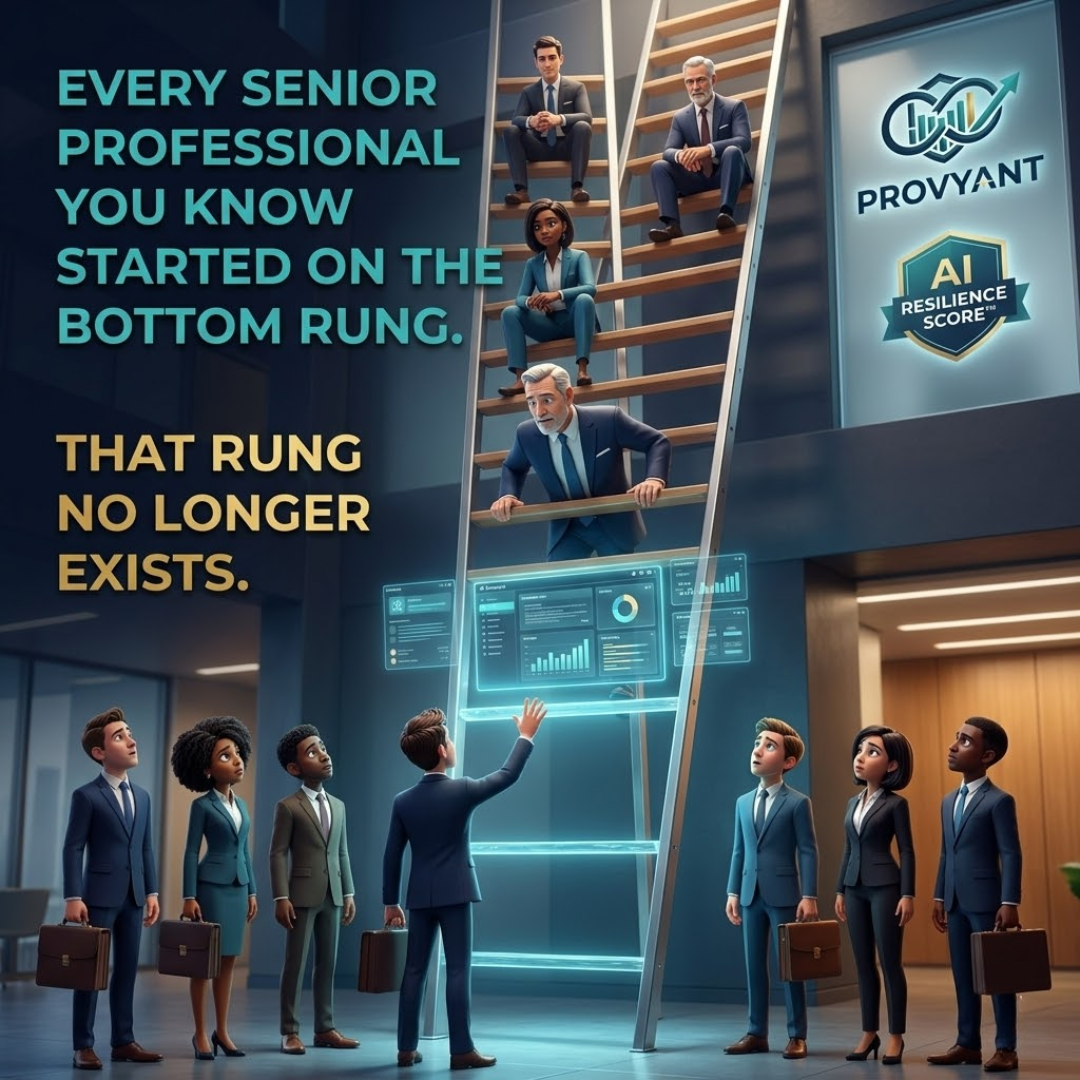
Every senior professional in every knowledge-work organisation today got their start the same way. They took an entry-level role. They did the research, the drafting, the data entry, the meeting notes, the first drafts that nobody loved. They learned the craft by doing the work that experienced colleagues no longer had time for. That pipeline built careers, organisations, and industries for generations.
AI is closing that pipeline. And the consequences extend far beyond the graduates who cannot find jobs. They reach into the talent structures, leadership pipelines, and long-term operational capacity of every organisation that depends on experienced human judgment at the senior level.
What Is Actually Happening to Entry-Level Roles
The disappearance of entry-level knowledge work is not a projection. It is already measurable in hiring data across multiple industries and geographies.
In the UK, tech graduate roles fell by 46% in 2024, with projections for a further 53% drop by 2026. In the United States, entry-level postings in software development and data analysis have dropped sharply, with some data indicating a 67% decrease in junior tech postings. Employers’ rating of the job market for college graduates is now at its most pessimistic since 2020, according to the National Association of Colleges and Employers Job Outlook 2026 survey.
Unemployment among recent graduates has climbed to nearly 6%, rising twice as fast as the rest of the workforce since 2022. The cohort most affected, graduates of 2024, 2025, and 2026, is entering the workforce during what one prominent recruitment executive described as a period of profound and structural uncertainty unlike anything the professional job market has previously produced.
The decline is concentrated in knowledge economy sectors: finance, law, consulting, software, marketing, and professional services. These are precisely the fields that historically absorbed the largest volume of entry-level talent and produced the most senior leadership over time.
Why AI Is Replacing the Entry Rung, Not the Whole Ladder
The mechanism behind this shift is specific and worth understanding clearly. AI is not replacing senior professionals. It is replacing the work that junior professionals used to do on the way to becoming senior professionals.
AI agents are now handling the grunt work, including code generation, financial modelling, document drafting, research synthesis, and data processing, that entry-level hires used to perform. Organisations are discovering that a senior professional equipped with AI tools can produce the output that previously required a team of juniors to generate. The ROI calculation that once justified hiring entry-level staff has changed, and most organisations have responded by slowing or stopping entry-level hiring rather than by redesigning those roles.
Harvard Business Review’s analysis is direct: eliminating entry-level jobs is short-sighted. These roles are crucial for developing future leaders, fostering innovation, enriching organisational culture, and maintaining the human capacity that AI cannot replicate at the senior level. The organisations eliminating entry-level roles today are not just cutting costs. They are depleting the talent pipeline that their own future leadership depends on.
The Missing Rung Problem
The career ladder in knowledge work was always built on the same logic. Entry-level roles provided the learning environment in which professionals developed the judgment, context, and domain expertise that made them valuable at higher levels. That progression was not just good for individuals. It was the mechanism through which organisations built institutional knowledge, cultural continuity, and senior capability.
The traditional deal of entry-level work, trading routine labour for mentorship and career development, is breaking down. The learning curve is being automated, leaving early-career professionals stranded between AI agents that handle the tasks and senior workers who no longer need support to produce them.
The WEF has identified that the career ladder itself is being reshaped, with entry-level roles at risk and traditional structures being redefined. The concern is not only about employment. It is about whether organisations will have the experienced mid-level and senior professionals they need in five to ten years if the entry pathway that produced them no longer exists.
What This Means for Organisations Right Now
The near-term consequence is visible in hiring freezes, graduate programme cuts, and the consolidation of junior roles into broader positions that carry titles but lack the developmental structure that made those roles produce senior talent over time.
The medium-term consequence is less visible but more significant. The organisations that eliminated entry-level roles in 2024 and 2025 will face a talent gap at the mid-level in 2029 and 2030. The professionals who would have been ready for senior responsibilities by then never received the foundational experience that would have prepared them. Senior roles will compete for a smaller pool of qualified candidates. Institutional knowledge will thin. Leadership pipelines will narrow.
Anthropic CEO Dario Amodei has predicted that AI could eliminate roughly 50% of entry-level white-collar jobs within the next few years. Whether that number proves precise or not, the directional shift it describes is already underway and already carrying consequences that most workforce planning frameworks have not yet accounted for.
The Opportunity Inside the Disruption
The closing of the traditional entry pathway does not only create risk. For organisations willing to redesign rather than simply eliminate, it creates an opportunity to build more effective early-career development structures.
HBR’s position is that companies should redesign entry-level roles to leverage AI for routine tasks while humans focus on judgment, creativity, and collaboration, rather than cutting those roles entirely. The apprenticeship model, pairing early-career professionals with senior mentors in structured learning environments, is being revisited as a more durable alternative to the junior role structures that AI is dismantling.
For displaced professionals navigating forced transitions, the convergence of entry-level closure with the Silver Tsunami of Boomer business exits is creating an ownership pathway that did not exist at this scale before. As Provyant has outlined in its analysis of the Invisible Recession, the economic restructuring underway is closing some pathways while opening others, and the organisations and individuals who see both sides of that equation are the ones best positioned to act on it.
Preparing for the Talent Landscape That Is Already Building
The organisations navigating this shift most effectively are not waiting for the talent gap to become a crisis before responding. They are mapping their pipeline vulnerabilities now, redesigning early-career pathways around the realities of an AI-augmented operating environment, and connecting their workforce strategy to their business continuity and succession planning frameworks.
What makes a business AI-resilient is not simply about tools and governance. It includes whether the organisation has the human capital depth to sustain its operations, its culture, and its leadership pipeline through a transition that is already reshaping the workforce it will depend on in five years.
The AI Resilience Score at provyant.com gives organisations the structured framework to assess where their workforce preparedness and talent pipeline resilience actually stand. Because the last generation of entry-level knowledge workers may already be here, and the organisations that planned for that reality will be the ones that come out with the strongest teams on the other side.