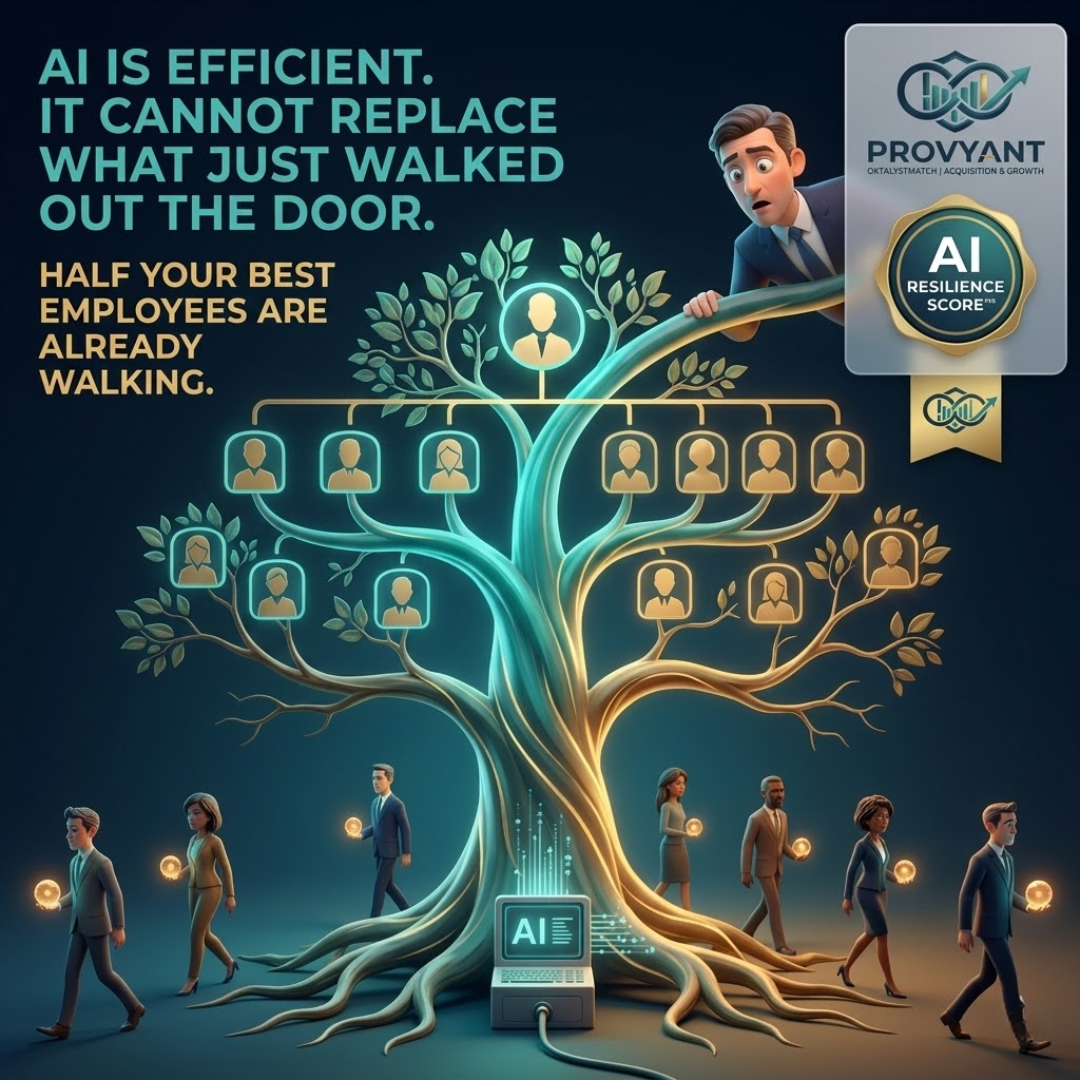
The talent problem most organisations are focused on is the wrong one. The conversation is about layoffs, headcount reductions, and AI-driven efficiency. What is not being discussed with nearly enough urgency is the parallel movement happening in the other direction.
The best employees, the ones with options, clarity, and the operational experience that organisations cannot afford to lose, are watching how their employers handle AI disruption. And a growing number of them do not like what they see.
According to a November 2025 Gallup survey, half of all employees are watching for or actively seeking a new job. More than half of U.S. workers report that self-described “I might leave” rate is the highest it has been in nearly a decade. The organisations that assume workforce stability because voluntary quit rates have slowed are misreading the signal. People are not staying because they are committed. Many are staying because the external market is uncertain. That is a different thing entirely.
What Is Actually Driving the Exit Mindset
The factors pushing high-performing employees toward the door in 2026 are specific and consistent across industries.
Top performers are leaving roles amid stalled career mobility, with promotions down in 10 of 11 industries and internal hiring down by 8% according to Workday’s 2025 report. Experienced employees are also reporting anxiety and disconnection due to AI in the workplace and unclear strategies for the future. The message from leadership that AI will be managed responsibly, that careers are not at risk, that the transition will be navigated with transparency, is not landing. Employees are watching what actually happens, not what is communicated in town halls.
43% of workers fear automation may replace their job within the next two years, an increase of 5% from 2025, according to ManpowerGroup’s 2026 Global Talent Barometer. Regular AI usage among workers jumped 13% to 45%, while confidence in using technology fell sharply by 18%. Workers are adopting AI faster than ever, but that adoption is not translating into certainty about what their role looks like in 18 months. The confidence gap is real, and it is widening.
40% of employees report that their organisation or their manager does not provide them with information on the skills they need to advance. In an environment where AI is reshaping what every role requires, the absence of a credible career development conversation is not a passive failure. It reads as an indication that the organisation does not see a long-term place for this person.
The Coasting Problem Nobody Is Measuring
There is a category of employee behaviour that is more damaging than active exit and harder to detect: the deliberate decision to disengage while staying put.
Forrester identifies a growing segment it calls coasters: disengaged workers who do not think their employer deserves their energy. This group accounted for 27% of the workforce in 2024, 25% in 2025, and is projected to rise to 28% in 2026. Employees watch colleagues laid off for AI that never materialises, see entry-level positions eliminated so new talent cannot join, and observe what looks like efficiency disguised as innovation. The response is to withdraw discretionary effort.
According to Forrester, when a quarter of the workforce is actively withholding discretionary effort, no amount of AI will compensate for the productivity loss. The organisations chasing AI-driven efficiency gains while simultaneously eroding the engagement of the people responsible for executing them are building on a foundation that is quietly collapsing.
Replacing an employee costs roughly 33% of their annual salary. The organisations that are cutting retention investment while simultaneously managing AI disruption are making the mathematics of talent loss significantly worse than they appear on any single line item.
What the Best Employees Are Actually Looking For
The data on what retains high-performing employees in the AI era is consistent and does not require significant complexity to act on.
A lack of growth opportunities is among the top reasons people quit. Employees want clear career paths, visible investment in their development, and a credible answer to the question of what their role looks like as AI takes on more of the tasks that currently define it. They do not expect organisations to have perfect answers. They expect organisations to be having the conversation honestly.
Job security has emerged as an increasingly important factor in both attraction and retention, not because employees are expecting immunity from change, but because they want specificity. Where will responsibilities shift? When will changes happen? How will workloads be managed during transition? The organisations answering those questions clearly are the ones retaining the talent capable of executing the transition.
Companies spending $4,700 per employee on retention programmes report 87% higher retention rates and 4.2x ROI. The investment case for deliberate retention strategy in an AI disruption environment is not marginal. It is substantial.
The Connection to Operational Continuity and Business Value
Talent flight in the context of AI disruption is not just a human resources problem. It is an operational continuity problem and a business valuation problem.
An organisation that is simultaneously deploying AI and losing its most experienced operators is not becoming more efficient. It is becoming more fragile. The institutional knowledge, client relationships, and operational judgment that leave with departing talent are not things AI can reconstruct on a short timeline. And the businesses that arrive at an ownership transition, whether a sale, a succession, or a capital event, with a hollowed-out talent base are the ones that face the steepest discounts and the most difficult due diligence conversations.
As Provyant has outlined in its analysis of what makes a business AI-resilient and why buyers look beyond revenue, workforce stability and human capital depth are increasingly central to how businesses are evaluated in acquisition and financing contexts. A business with strong AI adoption and deteriorating talent retention is not a more valuable business. It is a more exposed one.
The Invisible Recession Provyant tracks is already surfacing in talent markets in ways that standard economic reporting is not capturing. The organisations feeling it earliest are the ones where the connection between AI disruption and talent flight was never explicitly managed.
Building the Retention Strategy That the AI Era Requires
The organisations retaining their best people through this transition are not doing it with pay raises alone. 19.5% of employers gave pay raises in an attempt to keep employees from leaving and found it did not work. What works is clarity, investment, and honest communication about where the organisation is going and what role each person plays in getting there.
That means connecting AI strategy to people strategy at the leadership level, not treating them as separate workstreams. It means creating visible development pathways that account for an AI-augmented operating environment. And it means treating workforce resilience as a component of operational continuity planning, because the organisations that lose their best people during a transition are the ones that find out the hard way how much of their operational capacity walked out the door with them.
The AI Resilience Score at provyant.com assesses workforce preparedness as a core dimension of business durability, because the businesses that hold their value through disruption are the ones that held onto the people who made them valuable in the first place.