Middle management has survived every previous wave of disruption. It survived downsizing in the 1990s, offshoring in the 2000s, and digital transformation in the 2010s. In each case, predictions of its demise proved premature. The proportion of middle managers in the U.S. workforce actually grew from 9.2% in 1983 to 13% in 2022, defying the forecasts that consistently called for its elimination.
The current wave is different. And the organisations that are treating it as another false alarm are the ones accumulating the most structural risk.
The Great Flattening Is Already Underway
Gartner predicts that through 2026, 20% of organisations will use AI to flatten their organisational structure, eliminating more than half of current middle management positions. This is not a projection about what AI might eventually do. It is a description of what is already happening across industries.
Revelio Labs reports a 40% drop in middle management job postings since 2022. 44% of U.S. professionals say their company has cut back on manager-level roles. Amazon CEO Andy Jassy issued a direct mandate requiring each organisation to increase the ratio of individual contributors to managers by at least 15%, explicitly describing the goal as removing layers and flattening structures. Amazon, Microsoft, Meta, and Google collectively eliminated tens of thousands of middle management positions in 2024.
The term being used inside organisations for this shift is the Great Flattening. It is a global wave of restructuring triggered by AI adoption that is primarily hitting the layer between senior leadership and individual contributors.
What AI Is Actually Replacing in the Middle Management Role
Understanding the restructuring requires understanding what middle managers actually do, and what AI can now do instead.
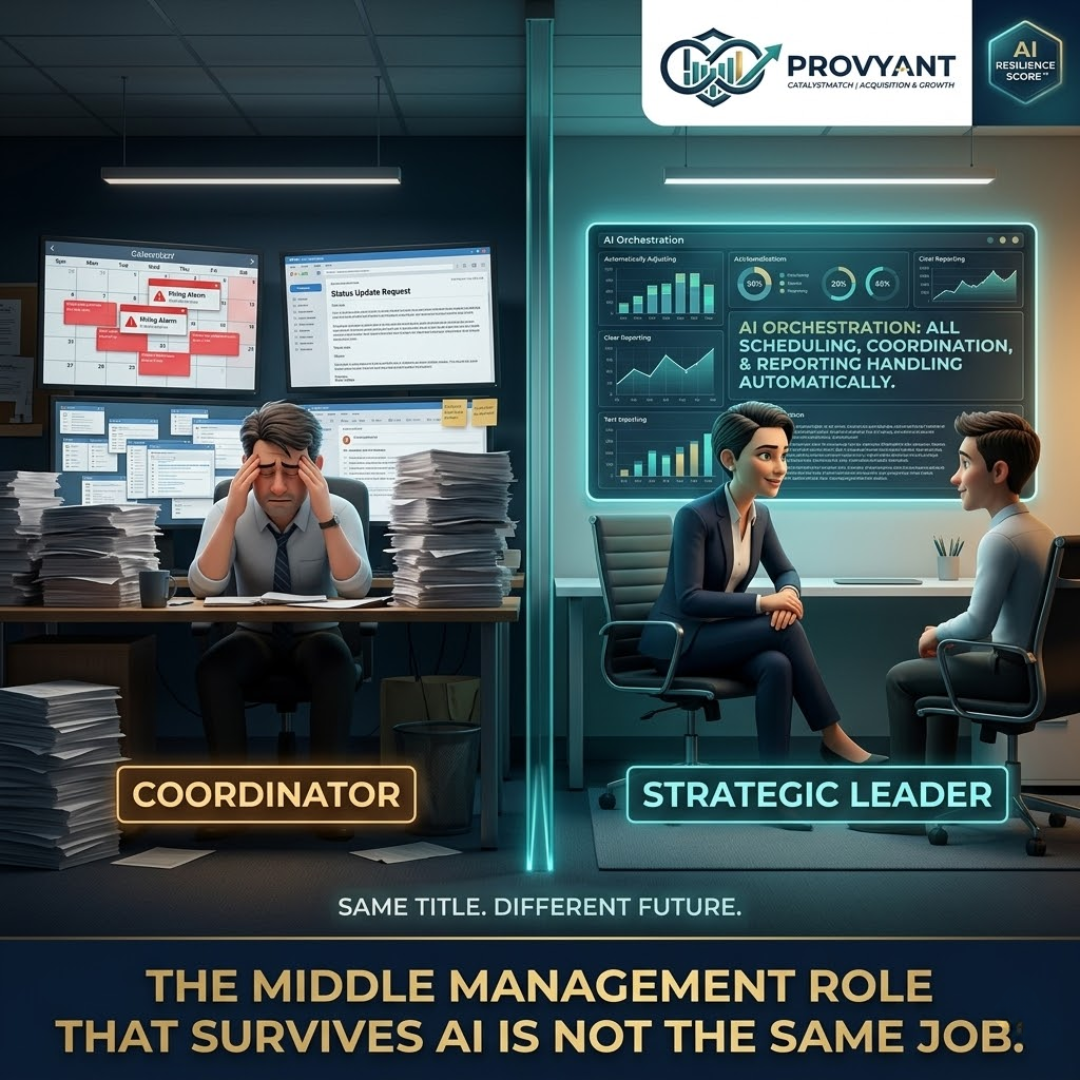
The traditional middle management function bundled several distinct activities: coordinating work across teams, monitoring performance, synthesising information upward to senior leadership, translating strategy downward to individual contributors, managing scheduling and resource allocation, and handling the administrative overhead that keeps teams functional.
The rise of agentic AI, autonomous tools capable of executing complex workflows, managing data streams, and generating predictive modelling for decision-making, has automated a significant portion of that bundle. Status reports, performance dashboards, project coordination, scheduling, and basic decision routing are now handled faster, cheaper, and without the bandwidth constraints that human managers face.
What that leaves for the human layer is the work AI cannot do: coaching, navigating interpersonal complexity, exercising contextual judgment in ambiguous situations, building the team culture that determines discretionary effort, and maintaining the organisational relationships that execute strategy in practice. Those are not small things. But they are a fundamentally different job than what most middle managers were hired to do.
The Pipeline Problem Nobody Is Solving
There is a structural consequence of middle management elimination that is receiving far less attention than the restructuring itself.
Gartner predicts that atrophy of critical-thinking skills due to AI use will push 50% of organisations to require AI-free skills assessments by 2026. The deeper problem is this: if entry-level roles are disappearing because AI handles the tasks they were hired for, and middle management roles are being eliminated because AI handles the coordination they were hired for, the organisational pipeline that produced senior leaders is being dismantled at both ends simultaneously.
Senior leadership has historically been built by professionals who moved through junior contributor roles, into management, and developed the judgment, pattern recognition, and business acumen that comes from navigating those transitions. That development pathway is being compressed or removed entirely in organisations moving fastest toward AI-first structures.
The question nobody is answering clearly is where the next generation of leaders develops those capabilities when the roles that built them no longer exist. It is not a hypothetical future problem. Organisations that are currently eliminating middle management layers will face it concretely in three to five years when they need experienced leaders and find the pipeline thinner than expected.
What Remains After the Flattening
The organisations navigating this most effectively are not the ones eliminating middle management wholesale. They are the ones redesigning it.
Rather than being eliminated, the middle management roles with a durable future are evolving from supervisors into strategic change agents and digital stewards who bridge communication, guide employee development, and drive innovation through collaboration and cross-functional influence. The coordination and reporting functions are moving to AI. The judgment, coaching, and culture functions remain human, and they become more valuable as the organisations around them flatten.
Remaining managers must shift to strategic and value-add activities, while organisations face the challenge of maintaining leadership pipelines when entry-level and middle management roles simultaneously shrink. The organisations that identify which aspects of the traditional management function are genuinely durable and build new role structures around them are the ones that come out of this restructuring with operational capacity intact. The ones that simply cut layers to reduce headcount are the ones that will feel the capability gap most sharply when conditions require experienced human judgment at scale.
What This Means for Business Value and Continuity
Middle management restructuring in the context of AI adoption is not just a workforce question. It is a business continuity and valuation question.
A business that has eliminated significant layers of operational management without replacing the governance, coaching, and knowledge-transfer functions those roles performed is a more fragile business than it appears on an org chart. The institutional knowledge that middle managers carry, the client relationships they hold, the team dynamics they maintain, and the operational judgment they apply are not automatically transferred to an AI system when the role is eliminated.
For businesses approaching an ownership transition, this fragility carries a direct commercial cost. As Provyant has outlined in its analysis of what makes a business AI-resilient and from founder-dependent to buyer-ready, operational durability and the ability to sustain performance through a transition are central to how businesses are evaluated and what they command in acquisition conversations.
The Invisible Recession and the broader AI displacement convergence Provyant tracks are already surfacing in organisational structures in ways that standard performance reporting does not capture. The businesses feeling it earliest are the ones where the speed of AI adoption outran the governance and capability structures designed to support it.
Designing for What Comes After the Restructuring
The organisations that navigate middle management disruption most effectively are not asking whether to flatten. They are asking what they are building after the flattening, and whether the structure they are creating can sustain operational performance, develop future leaders, and hold its value through the transition.
Those are strategic design questions. They require leadership attention at the board and executive level, connected to continuity planning and talent strategy in the same conversation. The AI Resilience Score at provyant.com provides the structured framework to assess where an organisation’s operational durability and workforce resilience actually stand, because the org chart that looks efficient today is only valuable if it can still perform tomorrow.