
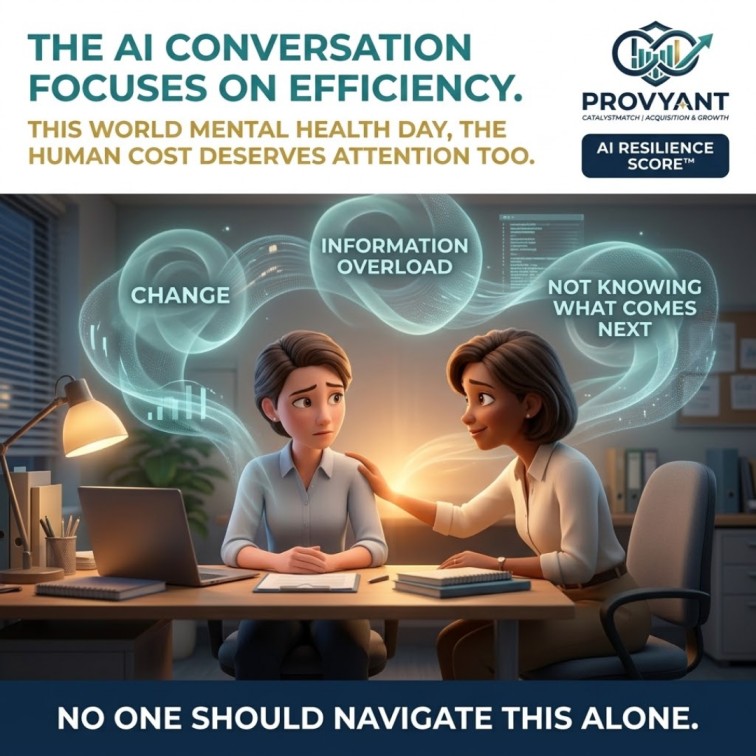
The conversation about AI and work is usually conducted in the language of economics. Productivity gains. Efficiency. Displacement figures. Automation rates. These are the metrics that dominate boardroom discussions and headlines alike. What that language leaves out is the human experience underneath the statistics, and specifically the psychological weight that the AI transition is placing on the people living through it.
This World Mental Health Day is a fitting moment to acknowledge that weight directly. The uncertainty AI has introduced into working life carries a real and measurable psychological cost, and it is one that most organisations have not yet learned to address. As Provyant has explored in its analysis of why your best employees are already planning their exit, the human response to AI disruption is not a side effect of the transition. It is central to how organisations will navigate it.
The Anxiety the Data Reveals
The psychological impact of AI disruption is not anecdotal. It is showing up clearly and consistently in workforce research.
Nearly 7 in 10 workers believe AI will lead to layoffs at their company within the next three years, while almost half fear personally losing their jobs to AI tools and automation. This is not distant, abstract worry. It is a persistent background anxiety that a large share of the workforce now carries into their working day.
The pattern is corroborated across multiple studies. A significant body of research has documented rising anxiety around job security, with AI disruption, financial insecurity, and always-on work cultures identified as drivers of sustained burnout across both the Canadian and broader North American workforce. The emergence of AI as a source of workplace anxiety, rather than only a technological tool, is one of the defining wellbeing developments of the year.
A New Kind of Stress
What makes AI-related anxiety distinct is that it is not simply fear of a single event. It is a complex psychological response to rapid, systemic change, and it operates differently from the workplace stressors organisations are used to managing.
Employees describe the effect in specific terms. In the past year, the emergence of AI has worsened mental health through information overload and reduced people’s sense of control over the future. That loss of control is central. AI anxiety is less about a specific pink slip and more about a pervasive uncertainty regarding one’s long-term employability and relevance, a worry that does not resolve because the underlying change does not stop.
There is also a counterintuitive dynamic in the data worth naming. Workers are adopting AI faster than ever, yet their confidence is falling, not rising. As Provyant has outlined in its analysis of the quiet exodus of senior talent, the combination of accelerating adoption and declining confidence produces a specific strain: people using tools they do not fully trust, for work that matters to their livelihoods, inside organisations that have not clearly explained what the transition means for them.
The Strain on Managers
One of the most striking findings in the recent research concerns the people expected to hold everyone else together: managers.
Senior managers are reporting some of the highest levels of AI anxiety, with nearly three-quarters expecting AI to lead to layoffs in their organisation within three years and more than half personally fearing for their own roles. Beneath a surface of reported satisfaction, 40% of managers received a new mental health diagnosis in the past year, more than three times the rate of non-managers.
The difficulty is compounded by a preparation gap. A large majority of managers say the role is harder than it has ever been, yet only a minority feel strongly equipped to identify burnout in their teams. The people organisations are relying on to support their workforce through the AI transition are, in many cases, struggling under the same pressure and without the tools to help others carry it. This is a structural wellbeing risk, not an individual failing.
The Erosion of Trust
Underlying much of the anxiety is a quieter but consequential shift: a decline in employee trust that AI disruption has accelerated.
Confidence in employer support has been eroding measurably. The share of employees who strongly agree that their employer values their mental health has fallen sharply, even as many report having adequate mental health coverage on paper. The gap between having benefits and believing the organisation genuinely cares is where trust breaks down, and AI-related uncertainty has widened it. When people watch colleagues displaced, entry pathways closed, and change communicated as inevitability, the message they absorb is that the organisation’s priorities lie elsewhere.
This connects directly to the operational risks Provyant tracks. The organisations that erode trust while deploying AI are the ones most likely to lose their most capable people, precisely when institutional knowledge and stability matter most.
What Leaders Can Actually Do
The encouraging part of the research is that the psychological cost of AI disruption is not fixed. How organisations manage the transition shapes whether it increases or erodes workforce stability, and the levers are within reach.
The advantage in 2026 belongs to organisations that deploy AI responsibly, reducing information overload, restoring employees’ sense of control, and supporting adaptation psychologically rather than only technically. The most consistent finding across the wellbeing research is that AI should be treated as a change-management initiative, not merely a technology rollout. That means clear communication about what is changing and why, honest answers about how roles will shift, visible investment in helping people adapt, and equipping managers to recognise and respond to strain rather than absorb it alone.
None of this requires an organisation to have perfect answers about an uncertain future. It requires treating the human experience of the transition as something that deserves the same attention as its operational and financial dimensions.
Carrying People Through the Transition, Not Just the Technology
This World Mental Health Day, the most important recognition is a simple one. The AI transition is not only an economic event. It is a human one, and the people living through it are carrying a psychological weight that rarely appears in the productivity statistics.
The organisations that navigate this well will be the ones that treat workforce wellbeing as central to their AI strategy rather than incidental to it. The AI Resilience Score at provyant.com assesses workforce preparedness and human capital as core dimensions of business durability, because an organisation’s resilience is inseparable from the wellbeing of the people who make it work.
This is a sensitive subject, and the pressures of workplace change can affect anyone. If you or someone you know is struggling, reaching out to a doctor, a mental health professional, or a trusted person in your life is a genuine strength. Support is available, and no one should navigate this alone.