
Family businesses are built on trust, which is exactly why the hardest conversations get deferred. Raising succession can feel like predicting a parent’s decline or questioning a child’s commitment, so the topic gets pushed to a someday that rarely arrives on its own terms. Yet the data is unforgiving. Only a minority of owners have a formal succession plan, and the gap is widest exactly where emotion runs highest.
Why do families avoid the question of who actually wants it?
Families avoid it because the honest answer can disappoint someone. Owners often assume a continuity that was never confirmed, while children stay silent to avoid letting a parent down. The result is a plan built on a guess, which is the most fragile foundation possible for a transition.
Naming the truth early, however uncomfortable, is what allows a real plan to be designed rather than assumed. That includes the entirely valid option of selling to an outside buyer in today’s active acquisition market, which is often a better outcome than forcing a reluctant heir into a role they never wanted.
How do families avoid the conversation about value?
Families avoid the value conversation because the number in their heads rarely matches the market. The gap usually exists because the business is deeply owner-dependent, and sentiment inflates the figure further.
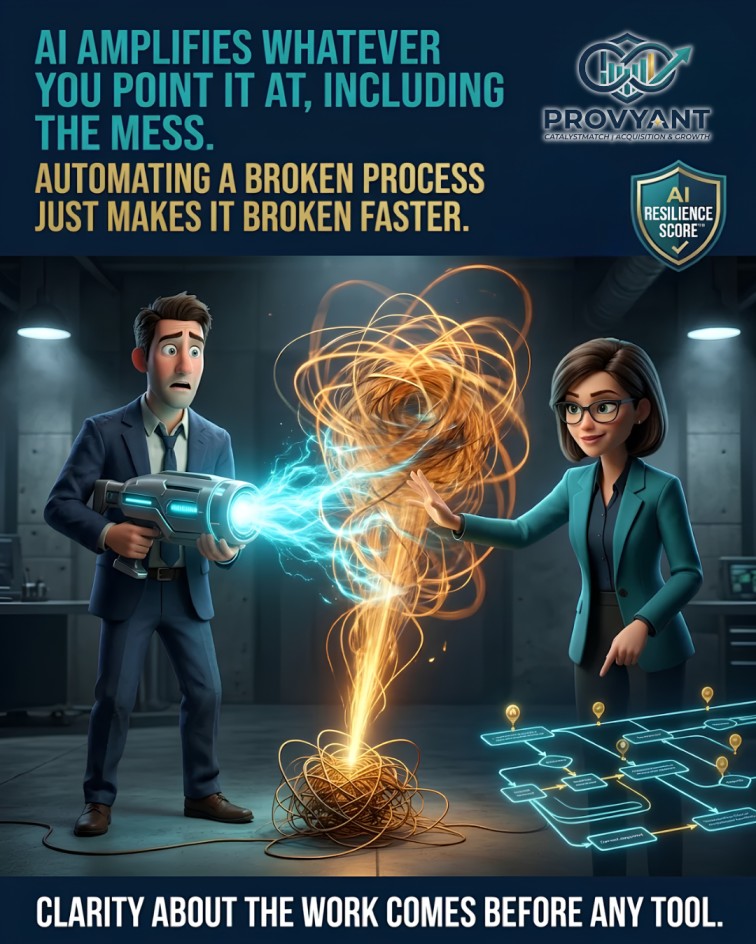
A frank assessment of transferability, the same ground the AI Resilience Score covers, turns a sentimental figure into a defensible one. AI adds urgency here, because a business that has not adapted to changing operations may be worth less each year it waits. The delay itself becomes a cost, quietly eroding the very value the family is trying to protect.
Why is readiness different from good intentions?
Readiness is different because wanting to hand over a business is not the same as the business being ready to be handed over. Intentions are emotional. Readiness is operational, and the two are often years apart.
Real readiness means documented processes, distributed knowledge, and workflow automation that keeps the enterprise running through a transition rather than collapsing into the gap. The Future of Jobs Report describes how fast the required skill base is shifting, which means a successor inherits an adaptation challenge alongside the business. Preparing them for that is part of the conversation too.
Why is the timeline the most avoided subject of all?
The timeline is the most avoided subject because it forces a confrontation with mortality and change. Succession done well takes years, not weeks, yet families routinely treat it as something that can be arranged quickly when the moment comes.
Families that start early get to shape the outcome deliberately. Families that wait for a health event or a sudden offer get whatever circumstance hands them, usually at a discount and under stress. A structured starting point, such as a strategy call, can break the inertia that keeps the topic in permanent deferral.
Frequently Asked Questions
When should a family business start succession planning?
As early as possible, ideally five to ten years before a planned transition. Succession touches ownership, management, taxes, and family dynamics, all of which take time to align. Early planning turns a high-stakes event into a gradual, manageable process and protects the business value that a rushed handover often destroys.
What if none of the children want to take over the business?
That is a common and entirely workable outcome. It simply means the right path is an external transition, such as a sale to an employee, a competitor, or an outside buyer. Naming this early is far better than forcing an unwilling successor, which tends to harm both the family and the business.
How does AI change family succession planning?
AI raises the stakes on readiness. A business that has not adapted its operations may lose value each year, which shortens the comfortable planning window. It also means a successor must be prepared to lead through ongoing change, so succession planning now includes building adaptability, not just transferring ownership.
Have the Conversation With Provyant in the Room
The conversations families avoid do not become easier with time. They become more expensive and more rushed, and Provyant helps families replace that silence with a plan. Begin with a clear view of where the business actually stands through the AI Resilience Score, and let the facts make the hard talk easier. The silence was never protecting anyone. A plan will.