For decades, the prevailing assumption was clear: automation displaces blue-collar work. Robots take factory jobs. Machines replace manual labour. Knowledge workers in fields like law, finance, and strategy would remain insulated by the complexity their roles required.
That assumption is no longer defensible.
The Myth of the Protected Knowledge Worker
Generative AI has collapsed the distinction between cognitive work and automatable work.
What was once the exclusive domain of trained professionals, including legal research, financial modelling, regulatory reporting, and content production, can now be executed in draft form in seconds. What once required a team of specialists can now be initiated by a single person with the right prompting framework.
This is not a productivity enhancement. It is a structural shift in how organisations resource and deploy human capital. The Stanford HAI AI Index identified knowledge workers as disproportionately exposed compared to manual labourers, directly flipping the conventional assumption that blue-collar roles faced the greatest automation risk first.
What Is Actually Being Displaced
The disruption is not uniform. AI is not replacing strategic leadership or complex negotiation. What it is replacing, with increasing effectiveness, is the cognitive middle layer: the processing, synthesising, summarising, and drafting work that has historically justified large professional headcounts.
Administrative and coordination roles have been among the first to consolidate. Calendar management, document processing, meeting summaries, and internal reporting are now handled by AI in a fraction of the time.
Junior and mid-level knowledge roles are under particular pressure. According to research tracking AI’s real impact on white-collar employment, workers in roles requiring moderate cognitive skill, above simple data entry but below senior strategic work, face the highest displacement exposure.
Research, synthesis, and content functions have seen sharp efficiency compression across industries. In 2024, Duolingo laid off approximately 10% of its contractor workforce, explicitly citing AI as the replacement for content creation roles.
Wherever professional value was anchored in cognitive throughput rather than strategic judgment, headcount requirements are shrinking.
The Scale Is No Longer Speculative
The IMF’s 2024 assessment found that roughly 40% of jobs globally face meaningful AI exposure, rising to approximately 60% in high-income, digitised economies.
According to data from Challenger, Gray & Christmas, AI was explicitly cited as the primary driver for over 50,000 job cuts in the United States in 2025 alone.
The U.S. Bureau of Labor Statistics recorded the lowest rate of professional services job openings since 2013, while hiring for positions paying over $96,000 annually reached a decade-low.
These are not projections. They reflect what is already happening inside organisations operating right now.
Why Leaders Are Underestimating the Speed
AI-driven consolidation does not always announce itself. Roles are restructured during planning cycles. Departments are asked to do more with less. Headcount freezes are framed as efficiency improvements. The restructuring is distributed, disaggregated, and rarely named for what it is.
Organisations are simultaneously experiencing significant workforce transformation while maintaining the narrative that the major disruption is still ahead of them. Understanding what makes a business AI-resilient requires honest assessment of where that exposure already exists, not where it might exist in three years.
The Displaced Professional and What Comes Next
A significant cohort of educated, operationally experienced professionals will be navigating forced transitions in the coming years. Many will look beyond traditional employment toward ownership.
This intersects directly with the other major economic force Provyant tracks. The retirement of millions of Baby Boomer business owners without succession plans in place is converging with AI displacement at exactly the same moment. Provyant’s analysis of the convergence of AI displacement and the Silver Tsunami outlines why this collision represents one of the most consequential and least discussed restructuring events of this decade, and why the Invisible Recession is already visible for those paying attention.
Understanding Where Your Organisation Stands
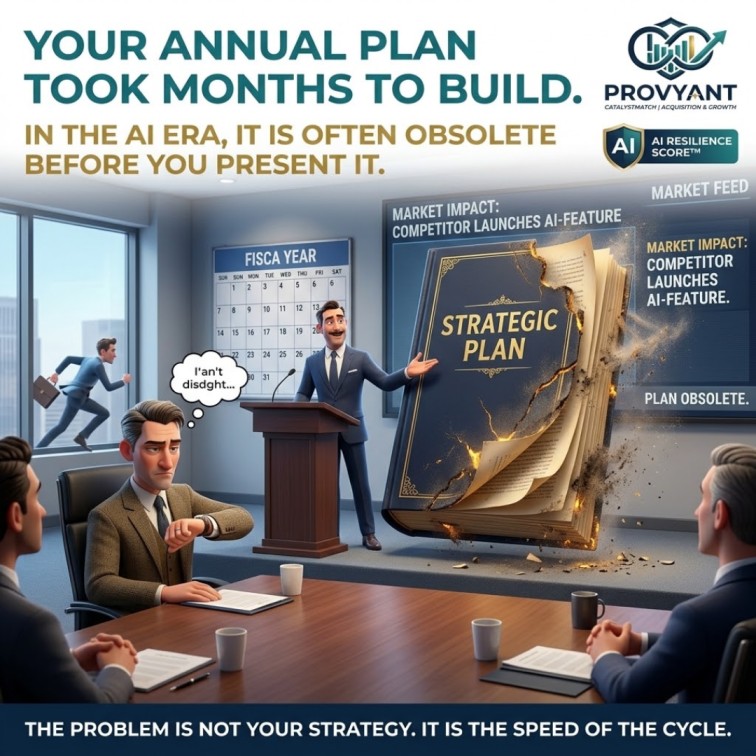
The white-collar reckoning is not a future event. It is an ongoing structural shift with measurable consequences for organisations that are unprepared. Leaders who treat it as a contingency, something to address when the disruption becomes undeniable, are already behind.
Provyant’s AI Resilience Score provides a structured framework for assessing preparedness across leadership readiness, operational adaptability, workforce resilience, and continuity planning. For executives who understand that measuring current exposure is the first step to managing it, provyant.com is the place to start.