
For most of the past century, the professional career followed a predictable arc. You built expertise, accumulated credentials, climbed an organisational ladder, and eventually retired from a role that rewarded your accumulated knowledge.
Artificial intelligence is disrupting that arc at the midpoint.
A growing cohort of experienced, educated professionals is being pushed out of knowledge work roles not because they underperformed, but because the economics of their function changed underneath them. The result is a class of transition-ready individuals with operational experience, financial literacy, and the capacity to lead, but no obvious place to land inside a workforce that is restructuring around them.
There is a landing place. Most of them have not found it yet.
The Professional in Transition
The displacement happening across knowledge work is not limited to junior roles, though those have absorbed the earliest pressure. It extends into mid-career and senior professionals whose work relied on cognitive throughput: analysis, synthesis, documentation, coordination, reporting, and advisory functions.
AI-induced displacement is already fuelling a measurable wave of entrepreneurship, with a 67% increase in venture launches following layoffs recorded in 2024. LinkedIn data shows a 69% increase in professionals adding “founder” to their profiles as displaced workers look for economic pathways outside traditional employment.
These are not impulsive decisions. They reflect a calculated response by people who understand they are navigating a structural shift, not a cyclical one. The question many of them face is not whether to pursue ownership, but how to find the right opportunity.
The Opportunity That Is Already There
At the same moment that AI displacement is generating a pool of transition-ready professionals, a separate but converging economic event is creating one of the most significant ownership transfer opportunities in modern history.
Millions of Baby Boomer business owners are retiring without formal succession plans and without a qualified successor in place. These businesses collectively employ more than 62 million Americans and represent decades of built operational value. Many are fundamentally sound, cash-flowing operations. They are not failing businesses. They are businesses without a next owner.
Provyant has outlined the full scope of this convergence in its analysis of the AI and Silver Tsunami collision and the broader Invisible Recession reshaping the economic landscape. The intersection of these two forces is not coincidental. It is structural, and it is creating an acquisition environment that has not existed before.
Why Displaced Professionals Are Well-Positioned for Acquisition
The instinct for many displaced professionals is to pursue re-employment in a role similar to the one they lost. That pathway is narrowing. Goldman Sachs projects that 6 to 7% of workers will be displaced during the AI transition, and the roles most affected are precisely the ones that educated professionals have built careers in.
Small business acquisition plays directly to the strengths of the professional in transition. Operational experience translates directly into business management. Financial literacy supports acquisition due diligence and post-close performance. Communication and leadership skills address the owner dependency problem that makes many of these businesses vulnerable in the first place.
Boomer sellers frequently prioritise legacy over maximum cash at close, creating favourable deal structures including seller financing, earn-outs, and equity rollovers that reduce initial capital requirements significantly. For a professional with savings, severance, or access to SBA financing, the barrier to entry is lower than most assume.
What to Look for in an Acquisition
Not every business coming to market is the right opportunity. The volume is high. The quality varies significantly. The ability to assess a business accurately before committing is what separates a successful acquisition from a costly mistake.
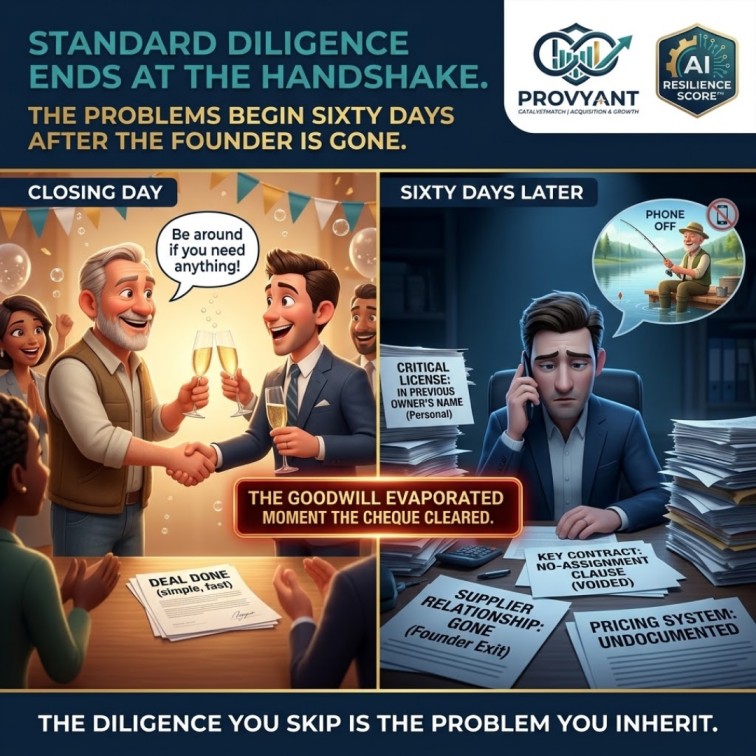
The most important questions a prospective buyer needs to answer: How dependent is this business on the existing owner? Are systems and processes documented well enough to survive a transition? What is the business’s exposure to AI disruption within the next ownership cycle? Is the revenue base diversified, or concentrated in relationships that leave with the founder?
Why buyers look beyond revenue to assess operational durability is central to this. So is understanding what makes a business AI-resilient before committing capital to it.
The Window Is Structural, Not Permanent
The conditions creating this acquisition opportunity are real, but they are time-sensitive. As more displaced professionals recognise the pathway, competition for quality businesses will increase. As more Boomer owners exit under pressure, the best opportunities will be claimed by those who moved earliest.
The professionals who navigate this transition most effectively will not be the ones who waited for the economy to stabilise before acting. They will be the ones who recognised that the disruption itself was the signal.
Provyant’s AI Resilience Score gives buyers, operators, and advisors the structured framework needed to evaluate business durability, transferability, and AI exposure before making a move. The displaced professional who becomes a business owner does not lose to AI. They get ahead of it. Start at provyant.com.