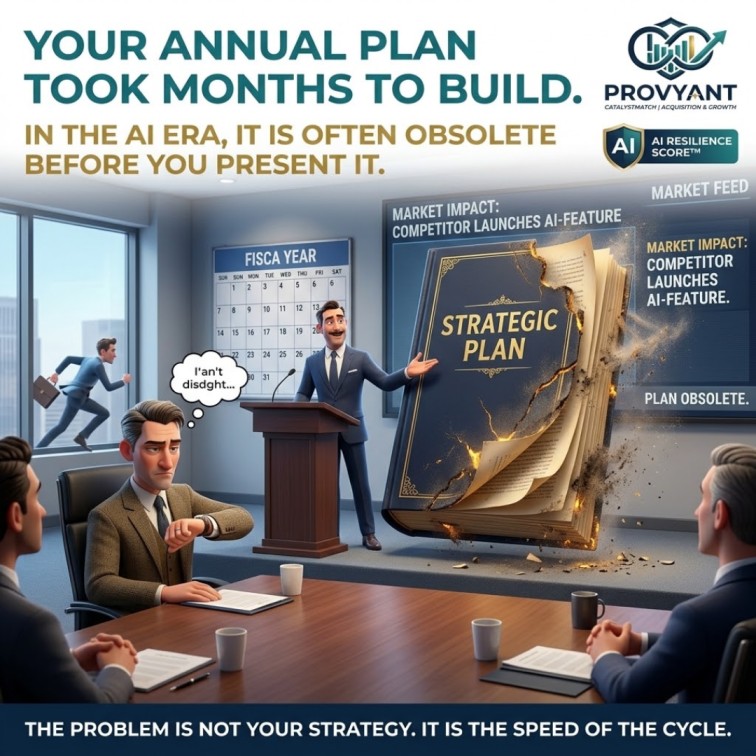

Most organisations know they should be thinking about AI. Far fewer have done the honest work of figuring out where they actually stand.
The AI Resilience Score is not a generic readiness quiz. It is not a checkbox exercise designed to produce a reassuring result. It is a structured diagnostic built to reveal something most business owners, executives, and potential acquirers genuinely need to know: whether a business is positioned to hold its value, maintain its operations, and remain attractive through the disruption that is already underway.
What the score reveals is often more specific, and more confronting, than people expect.
The Question Behind the Score
Every organisation adopting AI is being asked, implicitly or explicitly, the same question: is this business structured to survive a transition it did not design for?
Over 88% of organisations now report using AI in at least one business function, up from 78% the prior year. But adoption is not the same as readiness. An MIT study found that 95% of enterprise generative AI initiatives showed no measurable impact on profit and loss, primarily due to weak integration with existing workflows and a lack of organisational readiness.
The gap between using AI and being genuinely resilient to its disruption is where most businesses currently sit. The AI Resilience Score is designed to measure that gap honestly.
What the Score Actually Measures
The framework evaluates a business across three core pillars, each of which reflects a distinct dimension of durability in an AI-shaped economy.
AI Disruption Resilience examines whether AI is likely to weaken the core value proposition of the business within the next ownership cycle, or whether it can act as an amplifier instead of a threat. This is not simply a question of whether the business uses AI tools. It is a question of whether the business model itself is defensible as AI capabilities continue to expand across its sector.
Operational Durability assesses whether the business can keep running if the owner steps back. This pillar looks at systems, documentation, process repeatability, customer concentration, staffing structure, and technology integration. Research shows that organisations lacking documented processes and clear operational handoff structures face significantly higher transition risk, regardless of how strong their revenue looks on paper.
Economic and Market Resilience evaluates whether the business is essential, financeable, and positioned in a market that can withstand rate pressure, inflation, and broader economic disruption. A business can score well on AI adoption and still be fragile at the market level.
Together these three pillars produce a composite picture that goes well beyond what a standard financial review or generic readiness quiz captures.
What a Low Score Is Actually Telling You
A lower score is not a verdict. It is a diagnostic. And in most cases, the gaps it identifies are fixable.
The most common patterns in lower-scoring businesses are predictable: excessive owner dependency, insufficient documentation, limited use of systemised processes, and high exposure to AI automation within core revenue-generating functions. Nearly 67% of small businesses have data and processes scattered across multiple systems with no centralised strategy, making operational handoff difficult and buyer confidence low.
These are not catastrophic problems. They are operational gaps that, when addressed deliberately, produce measurable improvements in both business performance and acquisition positioning. Provyant’s analysis of founder-dependent businesses outlines how the path from vulnerable to buyer-ready is a structured one, and it starts with understanding exactly where the weaknesses are.
What a High Score Is Actually Telling You
A strong score signals something specific to buyers, lenders, and advisors: this business is transferable, durable, and less exposed to the disruptions already reshaping its competitive environment.
Buyers do not pay premium multiples for mystery. They pay for businesses that look transferable and defensible. A documented score demonstrating operational resilience, reduced owner dependency, and active AI positioning changes the acquisition conversation before diligence even begins. It shifts the business from a question mark to a known quantity.
Why buyers look beyond revenue to assess these qualities is increasingly well understood in acquisition circles. The AI Resilience Score gives both sellers and buyers a shared language for that conversation.
Why This Is a Board-Level Question, Not an IT Question
Boards and leadership teams are increasingly expected to understand how and where AI is used in their organisations, ensure appropriate governance, and demonstrate that risks including model failure, operational dependency, and third-party exposure have been considered and addressed.
AI resilience is not a technology deployment problem. It is a strategic governance problem. The organisations navigating this transition most effectively are the ones where leadership has taken direct ownership of the AI readiness question, connected it to business continuity planning, and treated it as an enterprise risk issue rather than a product roadmap item.
Provyant’s analysis of the Invisible Recession and the AI and Silver Tsunami convergence makes clear that the economic restructuring underway is already affecting business valuations, workforce structures, and acquisition markets in ways that most standard reporting has not yet caught up to.
Take the Assessment
The AI Resilience Score is designed for business owners who want an honest picture, buyers who need a reliable risk signal, and advisors who require a structured framework for valuation and transition conversations.
The score does not tell you what you want to hear. It tells you what you need to know. Take the AI Resilience Score at provyant.com, because the businesses that understand their exposure today are the ones still standing when everyone else is catching up.