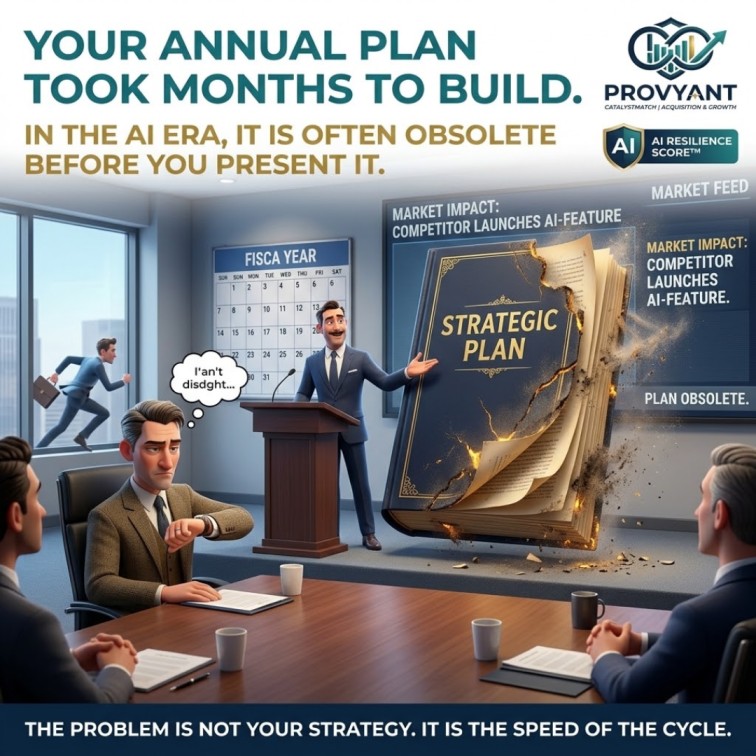

Confidence is not the same as readiness. In the context of artificial intelligence, that distinction is becoming one of the most consequential gaps in modern business leadership.
Ask most executives whether their organisation is prepared for AI disruption and the majority will say yes. They will point to tools deployed, budgets allocated, and pilot programmes underway. What the data consistently reveals is something quite different. The gap between how prepared leaders believe they are and how prepared their organisations actually are is wide, measurable, and carrying real commercial risk.
The Numbers Behind the Blind Spot
The evidence is unambiguous.
88% of B2B leaders indicate AI is integrated into their marketing strategy, yet only 21% express strong confidence in using it effectively. The core issue, as the research makes clear, is not access to AI tools. It is organisational readiness.
Grant Thornton’s 2026 AI Impact Survey found that 78% of business executives lack strong confidence that they could pass an independent AI governance audit within 90 days. Most organisations deploying AI cannot show how decisions are made or who is accountable for the outcome.
While 91% of organisations acknowledge that a reliable data foundation is essential for AI success, only 55% believe their organisation actually possesses one. Executives consistently overestimate data readiness while underinvesting in the governance, integration, and quality management that AI systems require.
The pattern is consistent across industries and organisation sizes. Leaders believe they are ready. Their organisations are not.
Why the Blind Spot Exists
The blind spot is not born from carelessness. It is born from a misunderstanding of what AI readiness actually means.
Most executives measure AI readiness by adoption. How many tools are in use. How many departments have access. How many processes have been automated. These are activity metrics, not readiness metrics. They measure what has been deployed, not whether the organisation can sustain, govern, and adapt around it.
Adobe’s 2026 research found that alignment between executives and day-to-day practitioners is consistently uneven, and enterprise-wide deployment remains rare. Executives have an incomplete view of what it will actually take to scale AI responsibly. Practitioners, who feel the impact most directly, are left without the support they need.
The result is a leadership layer that believes the work is further along than it is, and an operational layer that knows otherwise but lacks the channel to surface it.
What Genuine AI Readiness Actually Requires
Real AI readiness is not measured by tool adoption. It is measured by whether an organisation can answer the hard questions under pressure.
Can the business keep running if a key AI-dependent process fails? Is there documented accountability for AI-driven decisions? Does the leadership team understand which roles and functions are most exposed to AI displacement? Are there escalation paths when AI outputs are unreliable or harmful?
An MIT study found that 95% of enterprise generative AI initiatives showed no measurable impact on profit and loss, primarily due to weak integration and a lack of organisational readiness. An S&P Global survey found that 42% of companies abandoned most AI initiatives during the pilot stage, not because the technology failed, but because the organisation was not structured to carry them forward.
Readiness is an organisational discipline. It requires documented processes, clear governance, workforce preparedness, and leadership accountability. None of those things are produced by purchasing a software licence.
The Commercial Consequence of Getting It Wrong
The blind spot carries a direct commercial cost.
Organisations with fully integrated AI are nearly four times more likely to report revenue growth than those still in the pilot stage, 58% versus 15%. The difference is not the technology. It is accountability. Leading organisations can show how their AI makes decisions, who owns the outcomes, and what happens when something goes wrong.
For businesses approaching a sale, a succession event, or a capital raise, the stakes are even higher. A business that cannot demonstrate structured AI governance, documented operational processes, and clear leadership accountability is a less attractive and less transferable asset. As Provyant’s analysis of why buyers look beyond revenue makes clear, operational durability and AI resilience are increasingly central to how businesses are valued and how acquisitions are structured.
Closing the Gap Before It Closes You
The organisations navigating the AI transition most effectively are not the ones that adopted the most tools the fastest. They are the ones that built genuine readiness: governance structures, workforce preparedness, operational documentation, and leadership accountability that holds up under scrutiny.
The Invisible Recession and the AI displacement convergence Provyant tracks are already affecting business valuations, workforce structures, and acquisition markets. Leaders who mistake confidence for readiness are accumulating exposure they have not yet measured.
The AI Resilience Score at provyant.com is designed specifically for leaders who want an honest picture of where their organisation actually stands. Because the most dangerous blind spot is the one you were certain you did not have.