
Business continuity planning used to be built around familiar disruptions. A facility goes offline. A supplier fails. A cyber incident locks critical systems. Leaders had frameworks for these scenarios because the failure modes were known and the recovery paths were documented.
That model is no longer sufficient.
Artificial intelligence has quietly embedded itself into the operational infrastructure of most organisations. It is no longer an enhancement sitting alongside core processes. It is a dependency running inside them. And that changes everything about how continuity risk needs to be understood, planned for, and governed.
AI as an Operational Dependency
The shift happened gradually enough that many organisations did not notice it crossing a critical threshold.
AI tools have become embedded in core processes ranging from document automation and meeting summarisation to service ticket triage and operational decision-making. As a result, AI is no longer an enhancement. It is an operational dependency that belongs alongside other critical infrastructure in any serious continuity framework.
The Allianz Risk Barometer recorded AI as the biggest riser in global business risk concerns in 2026, jumping from tenth to second place in a single year. The organisations that ranked it so highly are not reacting to a hypothetical threat. They are responding to an operational reality they are already living inside.
When an AI-dependent process fails, the disruption does not always look like a system outage. A system can stay online and still become untrustworthy. Data integrity breaks down. Outputs become unreliable. Decisions built on AI recommendations carry errors that compound across the organisation before anyone identifies the source. This makes data integrity and output validation continuity issues, not merely security issues.
The Continuity Planning Gap
Most organisations have not updated their continuity frameworks to reflect the AI dependencies now embedded in their operations.
The World Economic Forum found that 66% of organisations expect AI to have a major impact on cybersecurity, yet only 37% have processes in place to assess the security of AI tools before deployment. The gap between AI adoption and AI continuity planning is wide and carrying real operational risk.
Research in the UK found that up to 80% of businesses without effective continuity arrangements fail within 18 months of a major disruption. The standard for what constitutes effective continuity is rising. It is no longer defined by whether a plan exists, but by whether it can be executed under pressure.
Regulators are converging on the same conclusion. Supervisory expectations are shifting toward demonstrated resilience, meaning the proven ability to deliver critical services under stress, not the ability to show a documented recovery plan after the fact.
What Modern Continuity Planning Must Address
Continuity planning in the AI era requires a wider lens than most organisations currently apply.
It must identify where AI is operationally critical and what happens when those systems degrade or fail. It must reduce concentration risk across cloud and data environments that AI tools depend on. It must account for faster attack and decision cycles, since AI-enabled threats move at a pace that traditional incident response frameworks were not designed for.
Grant Thornton’s research found that nearly three in four organisations are giving agentic AI access to their data and processes, yet only 20% have a tested AI incident response plan for when it fails. The organisations scaling AI without building continuity safeguards around it are creating operational exposure they have not yet quantified.
Critically, continuity planning in the AI era cannot sit only with infrastructure or security teams. AI-related disruption can affect customer trust, compliance, operations, legal exposure, and executive decision-making simultaneously. A continuity exercise that ignores those interdependencies will look coherent on paper and collapse in practice.
The Connection to Business Value
Operational continuity is not just a risk management discipline. It is a direct determinant of business value.
A business that can demonstrate structured operational continuity, documented processes, and clear accountability for AI-dependent functions is fundamentally more transferable and more attractive to buyers, lenders, and partners. Continuity planning is increasingly scrutinised not only by auditors and regulators but by customers and procurement teams seeking assurance that organisations can withstand disruption before they commit.
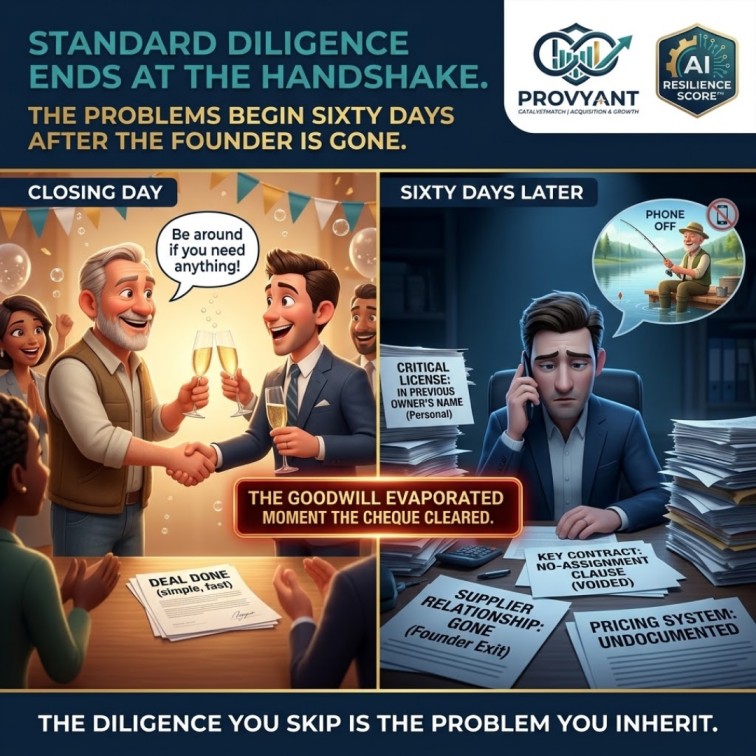
This is particularly relevant in the context of the ownership transition wave Provyant tracks closely. Businesses entering the acquisition market without documented continuity structures, and without a clear picture of their AI dependencies, face valuation discounts and buyer hesitation that well-prepared businesses avoid. Provyant’s analysis of why buyers look beyond revenue and what makes a business AI-resilient speaks directly to how continuity planning connects to commercial outcomes.
Building Continuity That Holds Under Pressure
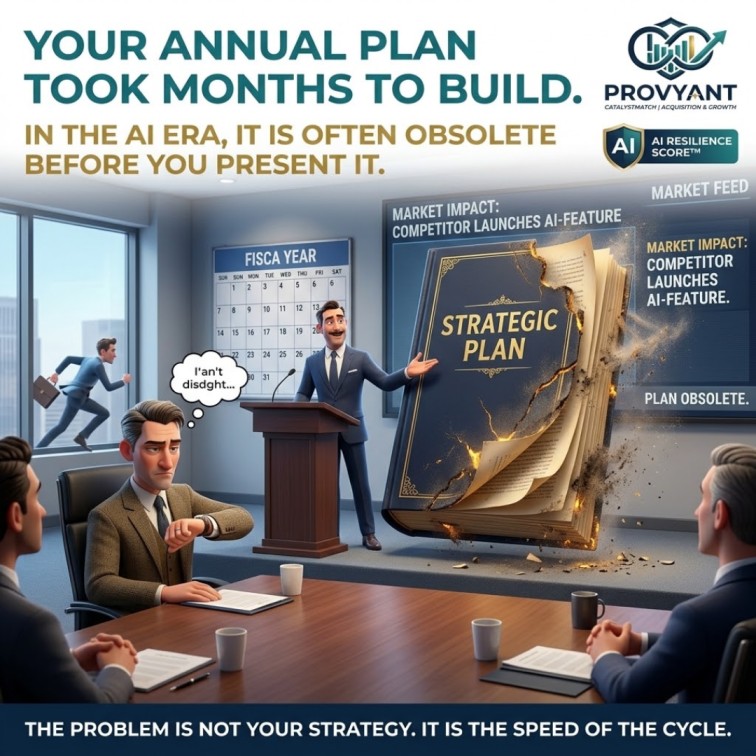
The organisations navigating AI disruption most effectively are not the ones with the longest continuity documents. They are the ones with real visibility into their operations, a clear understanding of where AI sits in their critical processes, and leadership that treats resilience as a strategic capability rather than a compliance obligation.
That starts with honest assessment. Which processes in your organisation are now AI-dependent? What happens when those processes fail? Who is accountable? Are your continuity frameworks tested against AI-specific failure scenarios, or built around disruption models that predate your current operational reality?
The Invisible Recession and the broader AI displacement convergence Provyant tracks are already reshaping the commercial landscape in ways that reward operational durability and punish fragility.
The AI Resilience Score at provyant.com provides the structured framework organisations need to assess their continuity posture honestly, because the businesses that survive disruption are not the ones who planned for yesterday’s risks.