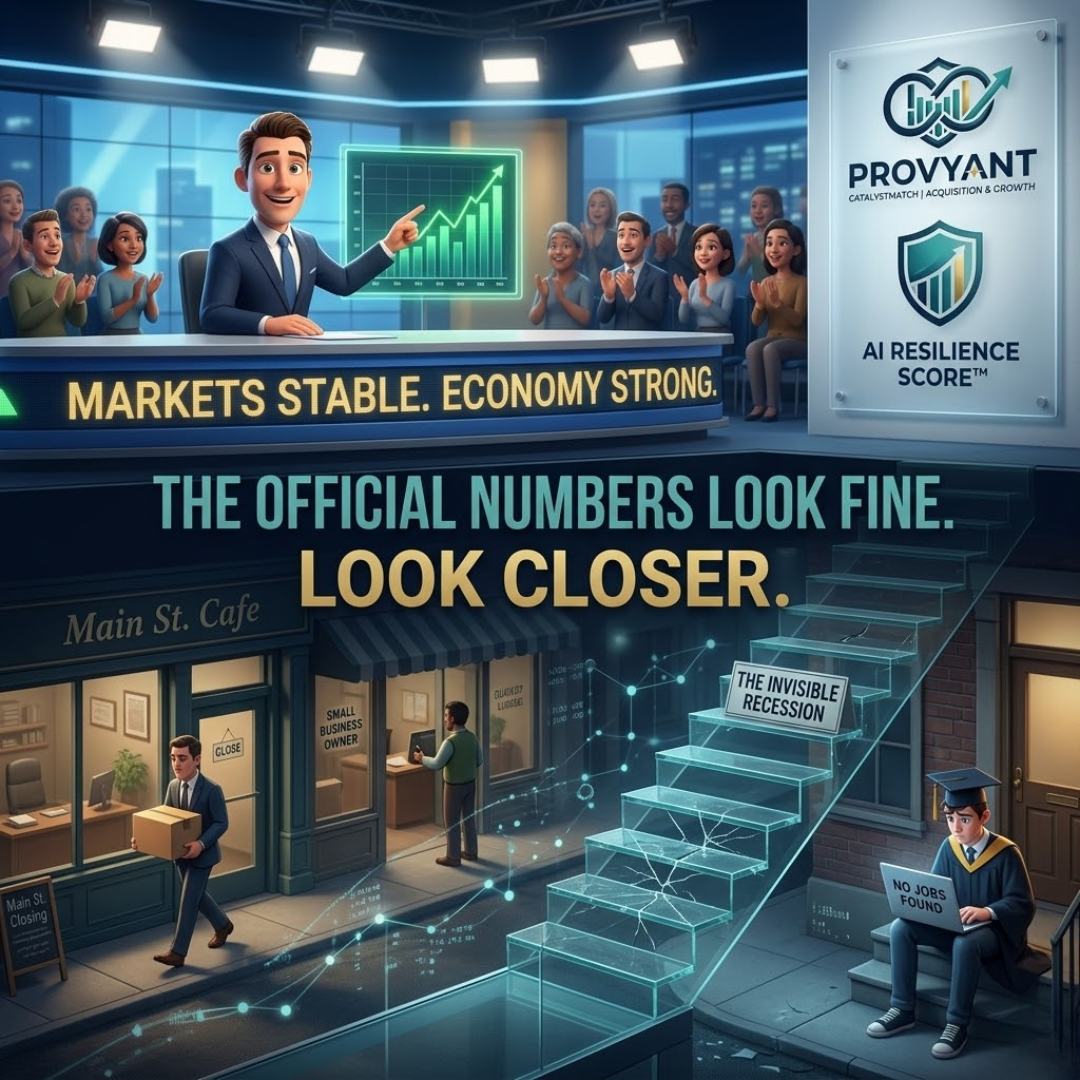
The official numbers look manageable. Unemployment sits near historic lows. GDP continues to grow. Corporate earnings reports are, in many sectors, better than expected. By the conventional metrics used to define a recession, nothing alarming appears to be happening.
But the conventional metrics are not measuring the right things.
Underneath the surface of a statistically stable economy, a structural disruption is already underway. It does not show up cleanly in labour data. It does not trigger a formal recession declaration. But it is reshaping employment pipelines, hollowing out professional career pathways, and beginning to erode the economic foundations of millions of households and communities. And the people experiencing it have few frameworks to describe what is happening to them.
What the Data Is Not Capturing
Standard economic reporting measures unemployment, GDP growth, and payroll additions. What it does not measure well is the quality and accessibility of work, the closing of entry pathways into professional careers, and the slow compression of opportunity across entire job categories.
J.P. Morgan projects that AI could displace approximately one million jobs per year over a ten-year transition, a pace significantly faster than previous technological transitions including the PC era and globalisation combined. Yet this displacement is happening in a way that aggregate statistics obscure.
Unemployment among recent graduates has climbed to nearly 6%, rising twice as fast as the rest of the workforce since 2022. Young workers in AI-exposed occupations have seen their share of employment slip measurably since late 2022, even as unemployment for other age groups remains stable. Firms are not cutting headcount in ways that register as mass layoffs. They are getting more output from the same workforce and slowing the pace at which they bring new people in.
The disruption is not showing up as a spike. It is showing up as a slow compression that the standard economic lens was not designed to detect.
The Structural Forces Nobody Is Connecting
The Invisible Recession is not driven by a single cause. It is the product of two massive economic forces converging at the same moment, in ways that mainstream commentary has not yet connected into a coherent picture.
The first is AI-driven workforce restructuring. Nearly 55,000 job cuts were directly attributed to AI in 2025 according to Challenger, Gray and Christmas, out of a total of 1.17 million layoffs, the highest level since the 2020 pandemic. Major organisations including Workday and Amazon have explicitly cited AI when announcing significant headcount reductions. The IMF has warned that 60% of jobs in advanced economies are already exposed to AI, and that 41% of employers intend to reduce their workforce by 2030.
The second force is the Silver Tsunami. Millions of Baby Boomer small business owners are retiring without succession plans, and the businesses they built are at risk of closing rather than transferring. These are not peripheral businesses. One in three Americans relies on income connected to a Boomer-owned small business. When these businesses close, the economic impact does not register as a recession event. It registers as nothing at all, a business that quietly stops existing, jobs that quietly disappear, a community that gradually hollows out.
Provyant tracks this convergence in detail. The analysis of the AI and Silver Tsunami collision outlines why these two forces arriving simultaneously represent an economic restructuring event of significant consequence, one that is already in motion and accelerating.
Why It Is Not Being Reported
The Invisible Recession is hard to report because it does not fit the narrative structures that economic journalism relies on.
There is no single triggering event. No market crash. No unemployment spike. No quarter where GDP visibly contracts. Instead there is a slow, distributed erosion of opportunity that accumulates across job categories, age groups, and communities simultaneously. Companies report record productivity yet payrolls barely rise. Investors cheer the efficiency. The people whose labour is being replaced have no category to identify themselves within.
The professional who cannot find a new role after a restructuring does not necessarily show up in unemployment data if they stop looking. The entry-level position that was quietly eliminated does not generate a press release. The small business that closes when its owner retires without a buyer does not trigger an economic alert. Each event is invisible in isolation. In aggregate, they constitute a structural shift of historic proportions.
What It Means for Businesses and Leaders
For organisations, the Invisible Recession creates both risk and opportunity depending on how clearly they can see it.
The risk is operational and commercial. Businesses that are heavily dependent on workforce models that AI is now disrupting face margin pressure, talent instability, and valuation risk that standard financial reporting is not yet reflecting. Leaders who are not actively mapping their AI exposure are accumulating risk they have not quantified.
The opportunity is in the convergence. AI-displaced professionals represent a pool of capable, experienced operators looking for new economic pathways at exactly the moment that viable small businesses need new owners. Businesses that are operationally durable and AI-resilient are positioned to attract that capital and capability. Those that are not are at risk of becoming part of the problem rather than the solution.
Understanding why buyers look beyond revenue to assess operational resilience is increasingly essential for anyone navigating this environment, whether as a seller, a buyer, or an advisor.
Measuring What the Headlines Miss
The Invisible Recession will eventually become visible. The structural forces driving it are too large and too persistent to remain below the surface indefinitely. The question for leaders, owners, and operators is whether they are positioned ahead of that recognition or caught flat-footed by it.
The AI Resilience Score at provyant.com is built to measure the dimensions of business durability that standard reporting misses. Because the recession nobody is reporting on is the one already deciding which businesses survive.