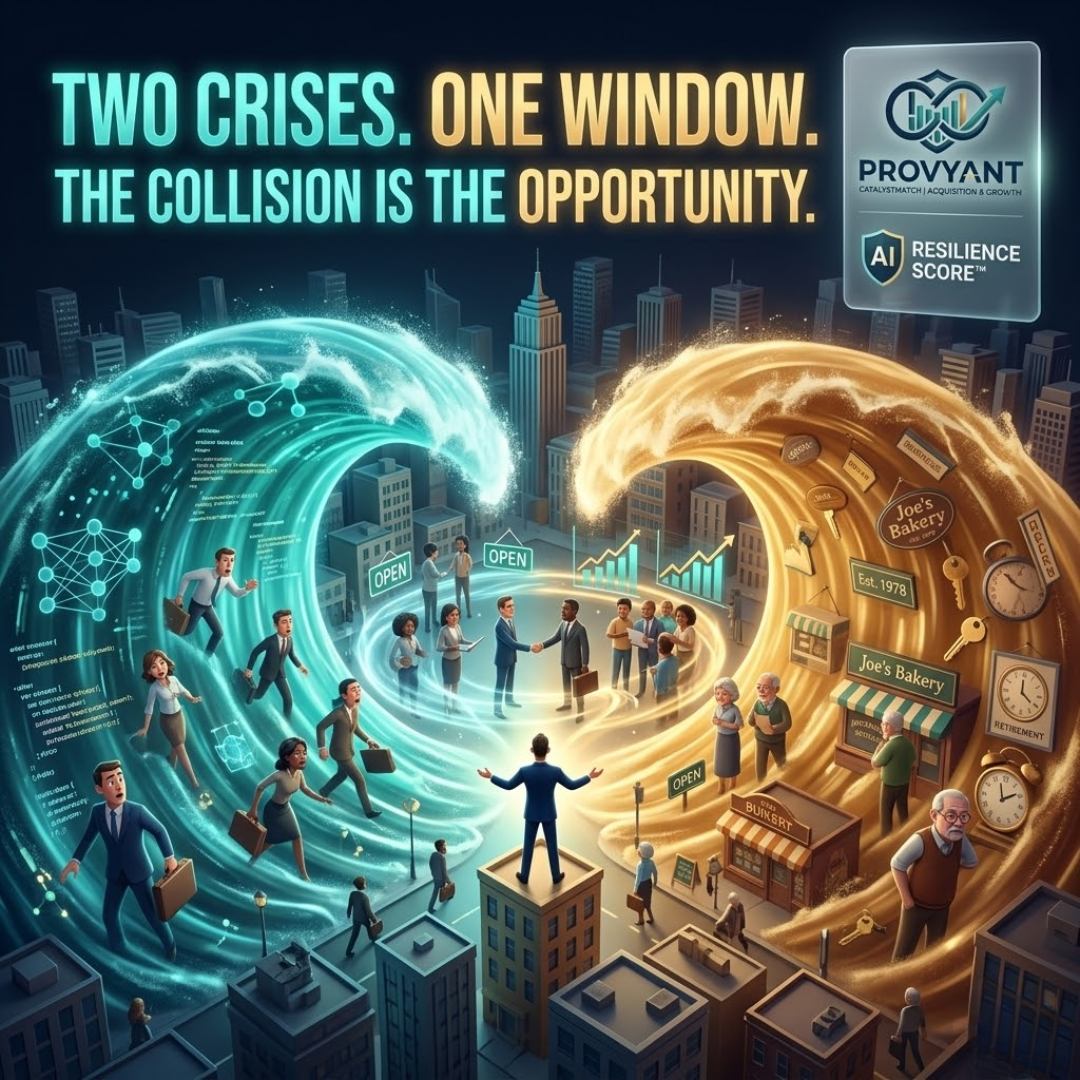
Two of the most consequential economic disruptions of this decade are unfolding simultaneously. Each one is significant on its own. Together, they are creating a convergence event that most economic commentary has not yet connected, and that most organisations have not yet prepared for.
The first is the AI-driven displacement of white-collar professionals at a scale and pace that is reshaping knowledge work across every major industry.
The second is the Silver Tsunami, the retirement of millions of Baby Boomer small business owners without succession plans, leaving trillions in economic value and tens of millions of jobs without a clear path forward.
These two forces are not coincidentally arriving at the same moment. They are colliding, and the consequences of that collision are already visible for those paying attention.
Crisis One: The AI Displacement Wave
The IMF managing director stated at Davos 2026 that AI is hitting the labour market like a tsunami, and that most countries and most businesses are not prepared for it. The data supports that assessment.
Nearly 40% of jobs globally are exposed to AI-driven change. J.P. Morgan projects that AI could displace approximately one million jobs per year over a ten-year transition, a pace significantly faster than previous technological shifts. Nearly 55,000 job cuts were directly attributed to AI in 2025 according to Challenger, Gray and Christmas, with major organisations including Amazon and Workday explicitly citing AI in their headcount reduction announcements.
The displacement is not evenly distributed. It is concentrated in the cognitive middle layer of organisations: analysts, coordinators, administrators, researchers, and junior professionals whose work AI can now replicate at a fraction of the cost. These are not entry-level workers fresh out of school. Many are experienced, educated, financially capable professionals in the middle of careers they expected to continue.
Crisis Two: The Silver Tsunami
At the same moment, approximately 2.3 million Baby Boomer-owned small businesses in the United States are approaching ownership transition due to retirement. More than half of all small business owners are now over the age of 55. 10,000 Boomers retire every single day.
The succession planning picture is alarming. Fewer than 20% of small business owners have formalised succession plans. Only 30% of family businesses make it to the second generation. A third of owners over 50 struggle to find a qualified buyer at all.
These businesses collectively employ more than 62 million Americans and account for roughly 43% of U.S. GDP. When they close without a successor, the impact does not generate headlines. It generates quiet economic erosion across communities, supply chains, and local labour markets that never fully recovers.
The Collision Point
What makes this moment historically significant is not just that both crises are happening. It is that they are creating conditions that mirror each other in a way that, if understood correctly, reveals a structural solution embedded within the problem itself.
On one side: a growing pool of experienced, financially capable professionals who have been displaced from knowledge work roles and are looking for a new economic pathway.
On the other side: millions of viable, cash-flowing small businesses that need qualified operators and owners to survive the transition their founders cannot manage alone.
The displaced professional who spent twenty years in operations, finance, or business development is, in many cases, precisely the kind of operator a Boomer-owned business needs to survive its ownership transition. The skills are aligned. The timing is aligned. The market conditions are aligned.
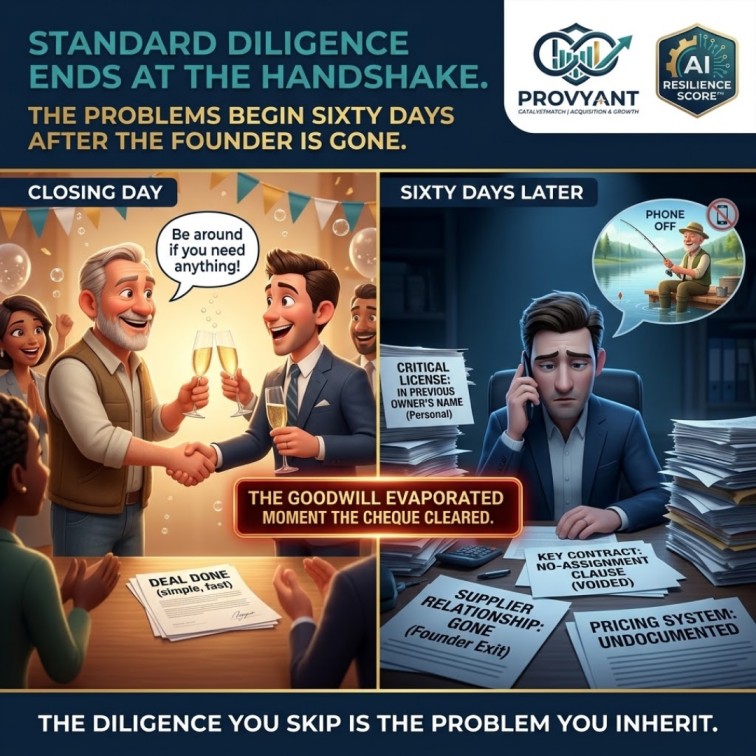
This is the convergence Provyant was built to track. The full analysis outlines why this collision represents one of the most significant and least discussed economic restructuring opportunities of this decade, and why the Invisible Recession unfolding within it is already shaping business valuations and workforce structures in ways that standard reporting is missing.
Why Most Commentary Is Missing the Connection
The Silver Tsunami is covered as a small business story. AI displacement is covered as a technology and labour story. The economic and commercial opportunity created by their intersection is almost entirely absent from mainstream coverage.
That coverage gap is itself an opportunity. The organisations, advisors, and individuals who understand the connection before it becomes conventional wisdom are the ones positioned to act on it most effectively.
For AI-displaced professionals, that means recognising small business acquisition not as a fallback but as a strategically sound pathway that their skills and experience are directly suited for. Boomer sellers frequently prioritise legacy over maximum cash at close, creating deal structures that significantly reduce initial capital requirements for the right buyer.
For business owners approaching retirement, it means understanding that operational durability and AI resilience are now central to whether a business attracts a qualified buyer or quietly closes. Buyers are increasingly evaluating AI exposure alongside financial performance, and the businesses positioned beyond revenue are the ones commanding stronger terms.
The Window Is Open, Not Permanent
Convergence events of this scale do not stay invisible indefinitely. As mainstream recognition catches up to the structural reality, the dynamics will shift. Competition for quality acquisition targets will increase. Deal terms will tighten. The window for early movers will narrow.
The organisations and individuals best positioned are the ones acting now, with a clear understanding of what the collision means and a structured framework for evaluating their options within it.
The AI Resilience Score at provyant.com provides the diagnostic framework buyers, sellers, and advisors need to assess where they stand at this collision point. Two crises. One window. The question is whether you are already through it.