Disruption is no longer something organisations prepare for in advance. It is something they are already inside of. And the leaders responsible for navigating it are discovering that the frameworks, governance structures, and decision-making models they built for a more stable environment are not equipped for what AI is demanding of them now.
The organisations that are managing this well share a common characteristic. They have treated AI preparedness not as a technology initiative but as a leadership discipline. The ones struggling have done the opposite.
The Gap Between Adoption and Governance
The adoption numbers are not the problem. 88% of organisations already have an AI implementation strategy in place. 36% of senior executives say AI is their number one strategic priority. Investment is accelerating. Tools are proliferating. The experimentation phase is largely over.
The governance gap is where the problem lives. Only 23% of executives consider their board highly fluent in AI. AI expertise among S&P 500 directors has grown from 1.5% to just 2.7% over four years, even as AI risk disclosures surged from 12% to 83% across those same companies. Organisations are disclosing AI risk at record levels while simultaneously lacking the board-level expertise to govern it.
Only one in five companies has a mature model for governing autonomous AI agents, even as agentic AI deployment accelerates rapidly across industries. The tools are scaling. The governance is not keeping pace.
What AI Preparedness at the Leadership Level Actually Requires
Effective AI preparedness is not about having an AI policy document. It is about building the organisational capacity to make accountable, informed, and defensible decisions about how AI is used, where it operates, and what happens when it fails.
Deloitte’s research is direct: enterprises where senior leadership actively shapes AI governance achieve significantly greater business value than those delegating the work to technical teams alone. True governance makes oversight everyone’s role, not a function assigned to a compliance committee that meets quarterly.
That means leadership teams must be able to answer the hard questions without routing them through IT first. Which AI systems are operating inside critical business processes? Where are automated decisions being made without adequate human oversight? What happens when an AI-dependent workflow fails? Who is accountable when AI outputs cause harm?
Harvard Law’s governance analysis frames it clearly: governance effectiveness in 2026 is defined less by episodic intervention and more by disciplined, integrated oversight. Boards that invest in leadership depth, skills alignment, and clear accountability retain greater control over timing, narrative, and strategic flexibility. Preparedness itself has become a competitive advantage.
The Regulatory Environment Has Changed the Stakes
For most of the past decade, AI governance was a matter of intent. Organisations articulated principles, formed review committees, and relied on internal guidelines. That approach stopped working in 2025.
Regulators have moved from guidance to enforcement. In the United States, states from California to Colorado and Texas have enacted or are enforcing AI-specific legislation. In Europe, the EU AI Act has moved into binding implementation. What was voluntary is becoming mandatory, and organisations without auditable oversight across their AI systems face fines, forced withdrawals, reputational damage, and legal fees.
Less than 10% of executives say their companies are fully prepared to comply with existing AI regulations. The gap between what is now legally expected and what most organisations have actually built is significant and growing.
Shadow AI and the Governance Drift Problem
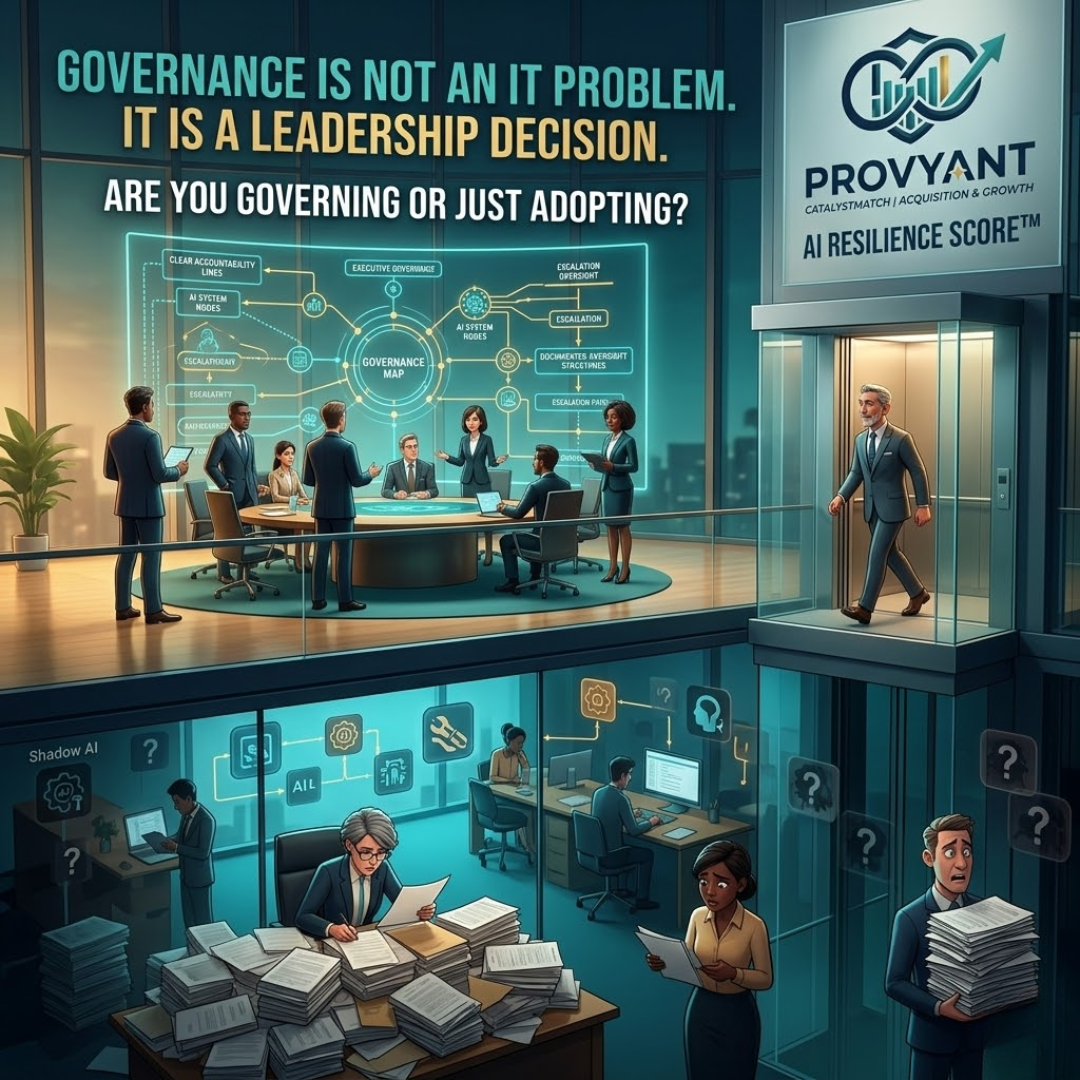
One of the most underappreciated risks in AI governance is shadow AI: the proliferation of AI tools being used across departments without leadership visibility, oversight, or policy coverage.
AI governance that sits only within IT or compliance loses the organisational context it needs to be effective. When governance is not embedded in strategy, innovation, people operations, and culture, it becomes a parallel structure that employees route around. Shadow AI grows precisely in the environments where governance does not feel relevant or accessible.
The consequence is that decisions are being shaped by AI tools that leadership cannot see, audit, or account for. That is not a technology problem. It is a leadership accountability problem.
Connecting Governance to Commercial Value
AI preparedness at the leadership level is not only a risk management exercise. It is directly connected to business value and commercial positioning.
Businesses that can demonstrate structured AI governance, documented operational processes, and clear leadership accountability are fundamentally more attractive to buyers, lenders, and partners. 75% of executives say AI will disrupt employment and workforce structures on a large scale within three years. The organisations that govern that disruption proactively are the ones that preserve operational continuity and acquisition value through it.
Provyant’s analysis of the Invisible Recession and the AI and Silver Tsunami convergence makes clear that the economic restructuring underway rewards operational durability and governance maturity in ways that are now showing up in valuations and deal structures. Understanding why buyers look beyond revenue increasingly means understanding how AI governance is being evaluated as a component of business quality.
Building the Leadership Capacity to Lead Through It
The organisations governing most effectively through disruption are not waiting for perfect conditions or complete regulatory clarity. They are building the capacity now: designating clear AI ownership at the executive level, connecting AI risk to enterprise risk frameworks, ensuring escalation paths exist for high-stakes AI decisions, and treating AI literacy as a leadership requirement rather than an optional development activity.
74% of executives expect AI to redefine leadership roles enterprise-wide by 2030. The leaders best positioned for that redefinition are the ones who started governing seriously before it became unavoidable.
The AI Resilience Score at provyant.com provides the structured framework leadership teams need to assess their governance maturity, operational preparedness, and AI exposure across the dimensions that matter most. Because the leaders who govern well through disruption do not just survive it. They come out ahead.