There is a period in every major economic transition where the people and organisations that move deliberately still have the advantage. The window is wide enough to act thoughtfully, the signals are clear enough to read accurately, and the consequences of inaction have not yet become irreversible.
That window is open right now.
The AI workforce transition is not a future event on a distant horizon. It is an active restructuring, already reshaping roles, compressing career pathways, and redefining what professional value looks like across industries. The organisations and individuals who treat this moment as preparation time are the ones who will shape what comes next. Those who are waiting for the disruption to become undeniable are already losing ground they will struggle to recover.
The Scale of What Is Being Demanded
The numbers are not ambiguous.
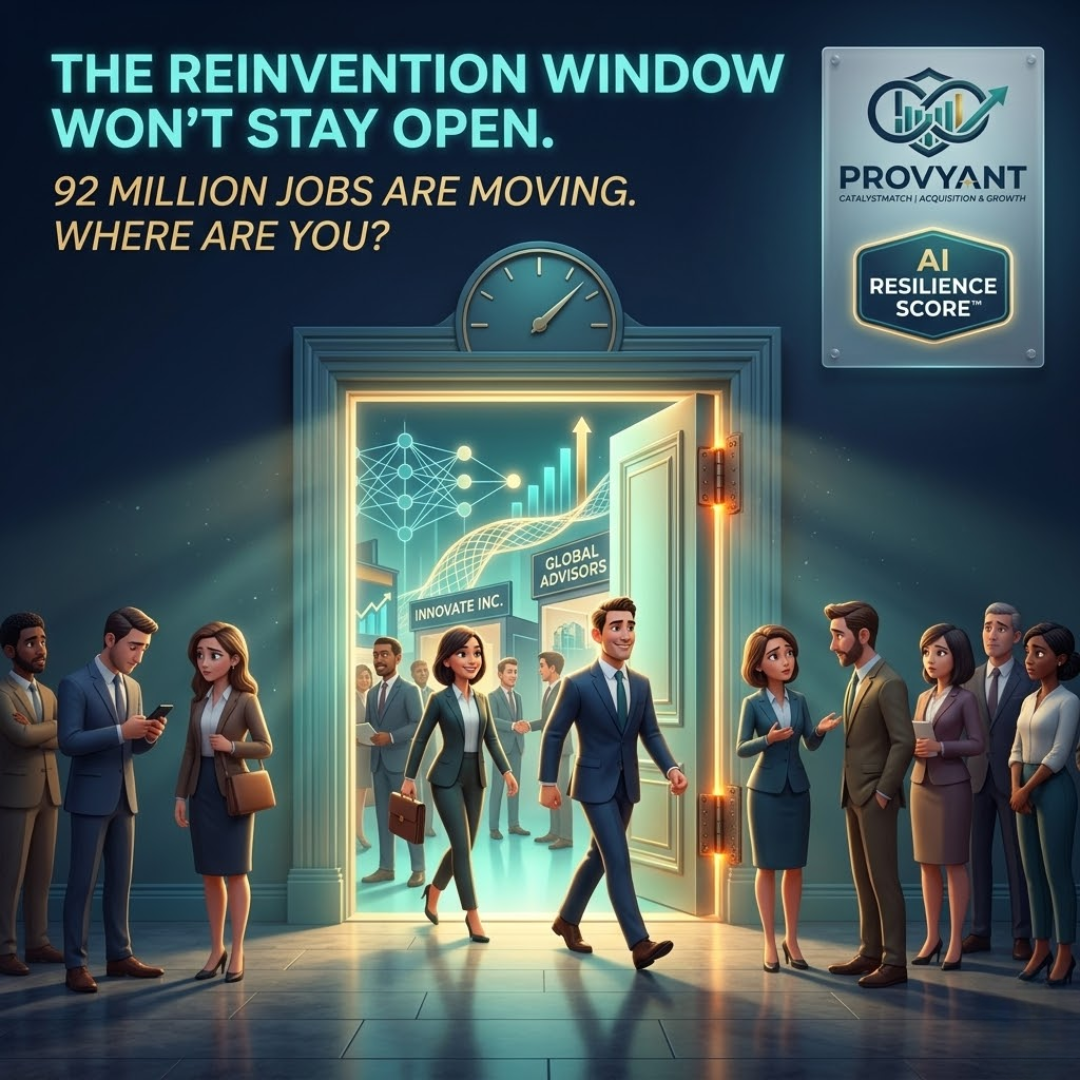
The WEF Future of Jobs Report 2025 projects that 92 million jobs will be displaced by 2030 while 170 million new roles are created. The net gain of 78 million positions sounds reassuring until you understand that the displacement and the creation are happening in fundamentally different skill categories, and that the people most affected by displacement are not automatically positioned for the roles being created.
59% of the global workforce will need significant training to remain competitive. An estimated 120 million workers are at medium-term redundancy risk because they are unlikely to receive the reskilling they need. 86% of businesses will be affected by AI and information processing by 2030.
The challenge for organisations is not whether workforce transformation will occur. It is whether it is designed intentionally or absorbed reactively, and who pays the cost of that difference.
Why the Window Is Narrowing
The reinvention window exists because transitions create a period of genuine optionality. Skills can be redirected. Roles can be redesigned. New economic pathways can be identified and pursued before competitive pressure makes them inaccessible.
Workers with AI skills already command wage premiums up to 56% higher than their peers without them, according to PwC’s 2025 Global AI Jobs Barometer. The gap between those who adapted early and those who are still waiting is already measurable in compensation, career trajectory, and professional positioning. That gap compounds over time.
For organisations, the divide is equally stark. On one side are organisations treating AI as a justification for workforce reduction. On the other are organisations treating it as a catalyst for reinvention, upskilling employees, reshaping roles, and building the capability to operate at a higher level. The difference will come down to whether leaders choose long-term capability building over short-term efficiency pressure.
The organisations that lay off their way through the transition will find themselves on the far side of it without the institutional knowledge, relational capital, or operational depth that durable businesses are built on.
What Reinvention Actually Requires
Reinvention is not reskilling in the traditional sense. It is not a training programme or a certification course. It is a structural reassessment of where human value sits inside an organisation that is increasingly capable of automating its own cognitive throughput.
In the AI age, adaptability determines productivity more than expertise alone. Career ladders are turning into career lattices. A finance professional becomes an AI operations manager. A marketing coordinator becomes a data analyst. A customer service lead becomes a product specialist. The shortest path between where someone is and where they need to be is no longer a vertical climb. It is a lateral identification of transferable capability.
Deloitte research found that organisations investing in workforce development were 1.8 times more likely to report better financial results. AT&T’s reskilling initiative reduced turnover by 25% among participants. The return on deliberate investment in workforce reinvention is measurable and significant.
The organisations getting this right are not simply training employees to use AI tools. They are rebuilding their operating models around a clearer understanding of which functions benefit from AI augmentation and which require the kind of judgment, relationship management, and contextual reasoning that AI cannot replicate.
The Professional in Transition
For the individual professional navigating this shift, the reinvention window is both an opportunity and a constraint with a time limit.
The AI-displaced professional who acts now, while their skills are still current, their network is still intact, and the acquisition market for Boomer-owned small businesses is still at peak supply, has access to options that will not be available at the same terms in three years. The convergence of AI displacement and the Silver Tsunami is creating a structural acquisition opportunity that plays directly to the strengths of operationally experienced professionals looking for a new economic pathway.
As Provyant has outlined in its analysis of the Invisible Recession, the restructuring underway is already closing pathways that were open two years ago. Waiting for conditions to stabilise before acting is a strategy that the transition does not accommodate.
What Organisations Must Do Now
The organisations that navigate the workforce reinvention window most effectively share a common characteristic. They are not managing AI as a technology project. They are governing it as a human capital and business continuity issue.
That means mapping which roles are most exposed to AI compression and designing transition pathways before pressure makes those conversations reactive. It means investing in AI literacy at every level of leadership, not just within technology functions. It means connecting workforce strategy to operational continuity planning in a way that treats human capital stability as a direct determinant of business value.
85% of employers plan to prioritise workforce upskilling by 2030. The organisations ahead of that curve are the ones building the internal capacity now, before the talent gaps become operational liabilities and what makes a business AI-resilient becomes the defining question in every acquisition and succession conversation.
Act While the Window Is Still Open
The reinvention window is a function of timing. It is wide right now because the transition is active and the optionality is real. It will narrow as competitive differentiation between those who moved and those who waited becomes entrenched.
The AI Resilience Score at provyant.com provides the structured diagnostic organisations and leaders need to understand exactly where they stand in this transition. The window is open. The question is whether you walk through it deliberately or get pushed through it by circumstances.