The conversation about AI disruption has largely been framed around large corporations, enterprise software, and the future of white-collar knowledge work. It has been populated with examples from Fortune 500 restructuring announcements, venture capital predictions, and Silicon Valley commentary.
That framing has left small business owners dangerously underserved.
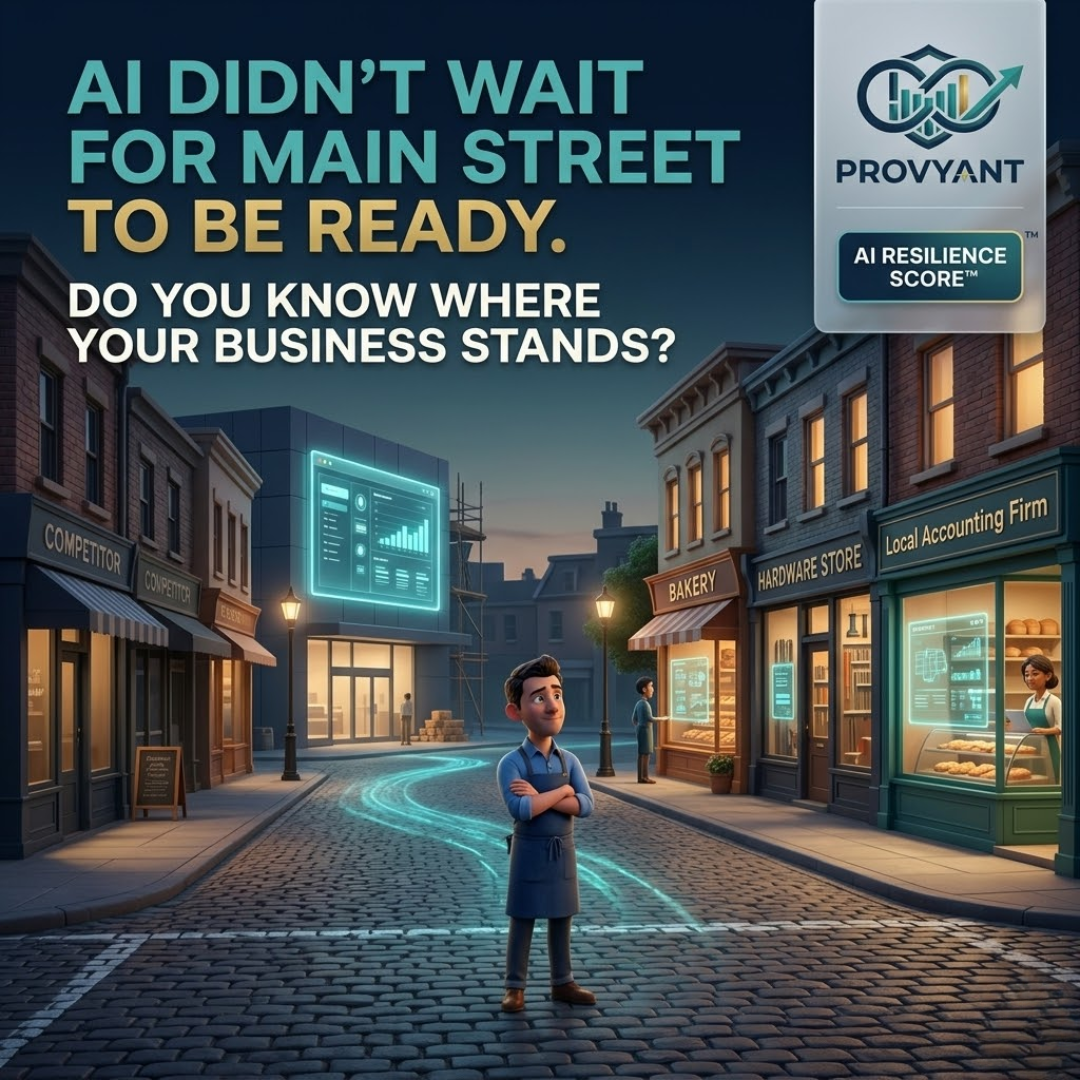
The AI disruption playing out across the economy is not a corporate phenomenon that filters down to Main Street eventually. It is already reshaping the competitive landscape, operational expectations, and valuation dynamics of small businesses right now. The owners who understand this are building resilience. The ones waiting for the headline risk to arrive are already behind.
The Risk Is Real and It Is Arriving on Multiple Fronts
AI has surged to the second-highest global business risk in the Allianz Risk Barometer, rising from tenth place in a single year. Critically, it has moved into the top three concerns for large, mid-sized, and smaller firms simultaneously. This is not an enterprise-only problem. It is an economy-wide shift that reaches into every sector and every size of business.
For small businesses, the risk materialises across several distinct dimensions that often get conflated or overlooked entirely.
The first is competitive displacement. As larger competitors and AI-native entrants deploy tools that automate customer service, marketing, pricing, inventory management, and operational workflows, small businesses without comparable capability face a structural disadvantage that compounds over time. The gap between AI-enabled and non-AI-enabled businesses will not be a differentiator forever. By 2029 it will be table stakes.
The second is operational exposure. AI-driven cyber threats are increasingly targeting smaller businesses, which typically lack the security infrastructure of larger organisations. AI-crafted phishing, synthetic identity fraud, and automated exploit tools have made smaller enterprises significantly more vulnerable than they were two years ago. Smaller and mid-sized businesses are being targeted at increasing rates precisely because their defences have not kept pace with the threat landscape.
The third is valuation risk. This is the dimension least discussed, and potentially the most consequential for owners approaching succession or exit.
What AI Disruption Does to Business Value
A business that has not addressed its AI exposure does not simply face an operational risk. It faces a commercial one.
Buyers, lenders, and advisors are increasingly evaluating AI resilience as a component of business quality alongside revenue, EBITDA, and customer concentration. A business that is heavily dependent on processes AI can automate, that lacks documented systems, or that has not demonstrated the operational durability to survive the transition its sector is undergoing, is a less attractive and less financeable asset than one that has.
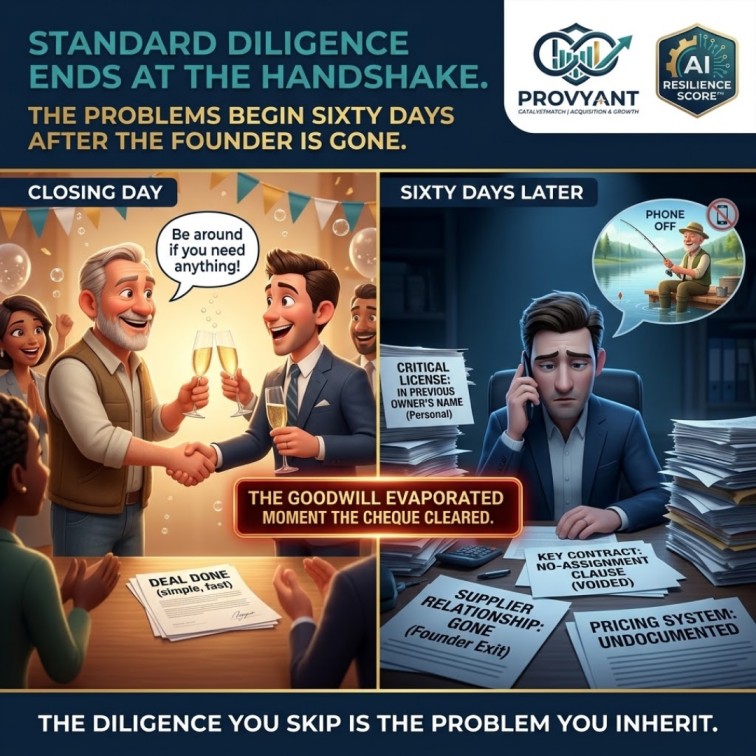
This connects directly to the larger succession crisis Provyant tracks. Millions of Baby Boomer-owned businesses are approaching ownership transition without succession plans. The ones coming to market with low AI resilience scores, high owner dependency, and undocumented operations face the steepest discounts and the narrowest buyer pool. As Provyant has outlined in its analysis of why buyers look beyond revenue, the valuation conversation has permanently shifted.
The Opportunity Within the Risk
The picture is not uniformly negative. For small businesses that act deliberately, AI represents a genuine operational amplifier that large organisations have been exploiting at scale while smaller ones have been observing from the sideline.
Most AI capabilities relevant to small business operations in 2026 are accessible at costs that were unimaginable five years ago. Customer service automation, cash flow forecasting, marketing content, lead qualification, and inventory management tools are now available to a ten-person operation that would previously have needed a dedicated team to deliver them.
The competitive advantage available to small businesses that integrate AI meaningfully is real. Workers with AI skills command wage premiums up to 56% above peers without them. The same dynamic applies at the business level: operations that leverage AI intelligently are producing more output with fewer resources and positioning themselves with a defensibility that owner-dependent, under-documented competitors cannot match.
The question is not whether to engage with AI. It is whether to do so proactively or reactively, and whether the business is structured to absorb that integration without creating new fragility in the process.
What Main Street Owners Actually Need to Do
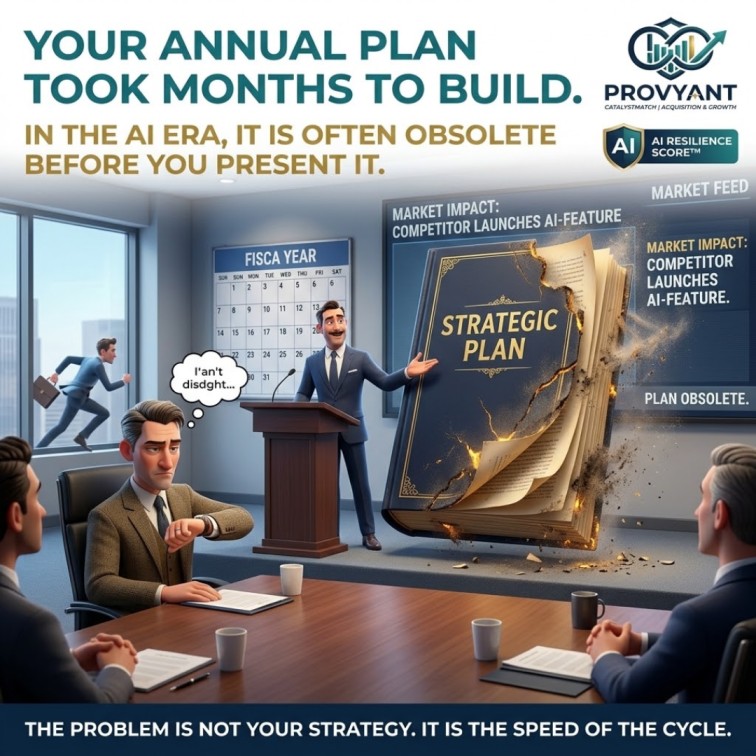
The risk for most small business owners is not that they are unaware of AI. It is that their response has been limited to adopting a few tools while leaving the underlying operational structure of their business unchanged.
Real AI resilience for a small business means something more specific. It means understanding which functions in the business are most exposed to AI-driven competitive pressure from better-resourced competitors. It means having documented processes and systems that can survive an ownership transition or a key person departure. It means reducing the owner dependency that makes a business fragile at exit and unattractive to buyers. It means knowing what the business would score on the dimensions that matter to the buyers and lenders who will eventually evaluate it.
As Provyant’s analysis of what makes a business AI-resilient outlines, resilience is not about having the most sophisticated tools. It is about whether the business can adapt, transfer, and hold its value through the transition that is already underway.
The Invisible Recession and the AI and Silver Tsunami convergence are creating consequences that reach all the way down to Main Street, whether the owners there are paying attention or not.
Know Your Number Before the Market Decides It for You
The small businesses that navigate AI disruption most effectively are not the biggest or the most technically sophisticated. They are the ones that understood their exposure honestly and addressed it before the market made the assessment for them.
The AI Resilience Score at provyant.com gives small business owners, buyers, and advisors the structured framework to understand where a business actually stands across AI exposure, operational durability, and market resilience. Because on Main Street, the risk that goes unmeasured is the one that eventually closes the door.