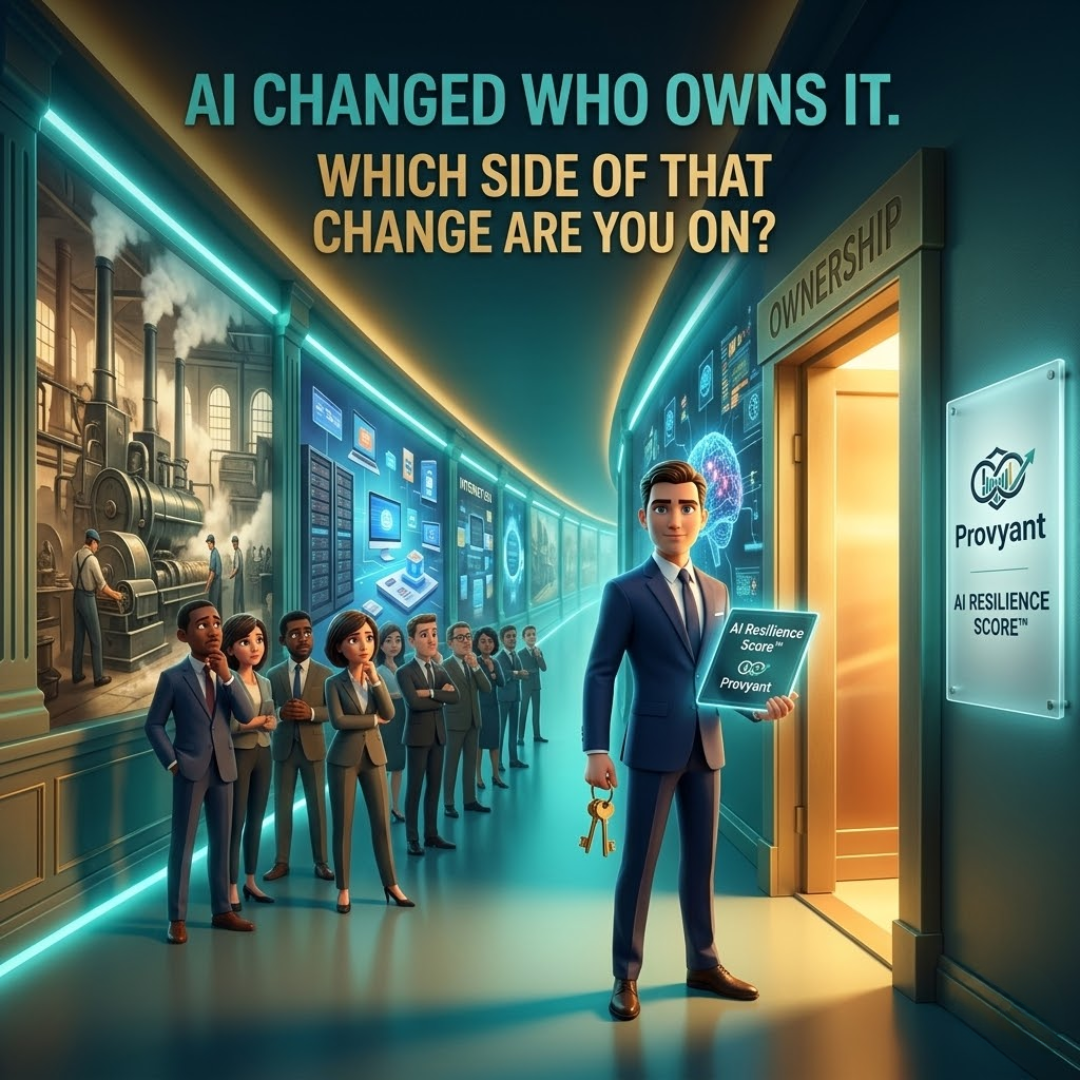
Every major technological transition in history has reorganised not just how work gets done, but who benefits from the doing of it. The industrial revolution concentrated ownership in the hands of those who controlled the machines. The internet concentrated it in the hands of those who controlled the platforms. Each time, the people who adapted early to the new ownership logic came out ahead. The ones who stayed tethered to the previous model were left behind.
We are inside one of those transitions right now. And the ownership question it is raising is one that most economic commentary has not yet addressed directly.
AI is not simply automating tasks. It is restructuring who controls productive output, who captures the value of cognitive labour, and who has the leverage to build durable economic assets in the era that is replacing the one we came from. The shift is not just in employment. It is in ownership. And understanding that distinction is the most important thing a professional, a business owner, or a leader can do right now.
The Old Contract Is Broken
For most of the modern era, the professional contract was straightforward. You traded expertise and time for compensation and career progression. The organisation owned the output. You owned the career. The arrangement was stable enough that generations of educated professionals built their economic identity around it.
AI-induced displacement is breaking that contract at scale. Entrepreneurs in the United States filed 1.56 million business applications in a single three-month period recently, the most of any comparable period since at least 2004. The surge is not incidental. It is a structural response to a professional employment landscape that is becoming less stable, less predictable, and less capable of absorbing the volume of experienced talent that AI-driven restructuring is releasing.
The professionals making that shift are not doing so because entrepreneurship suddenly became easier. They are doing so because the alternative, waiting inside an organisation for a disruption that is already underway, has become a worse bet than the uncertainty of building something they own.
What AI Has Actually Changed About Ownership
The deepest change AI is producing is not in job titles or headcounts. It is in the economics of productive output.
When a single professional with the right tools and frameworks can produce the output that previously required a team, the value is no longer distributed across that team. It concentrates in the person who controls the tools, the process, and the output. Workers with AI skills already command wage premiums up to 56% above peers without them. That premium is not a salary increase. It is a signal that ownership of productive capability is shifting.
The WEF projects that 170 million new roles will be created even as 92 million are displaced. But the distribution of those roles is not uniform, and the people best positioned to occupy the new economic landscape are not those waiting for organisations to redesign roles around them. They are the ones who have already moved toward ownership of their own economic contribution.
This is the ownership shift that most workforce commentary misses. It is not just about who has a job. It is about who owns the process, the system, and the asset that generates value in an AI-augmented economy.
The Acquisition Opportunity Nobody Is Framing Correctly
At exactly the moment that AI displacement is creating a pool of capable, experienced professionals seeking new economic ownership, a parallel transition is making that ownership unusually accessible.
Millions of Baby Boomer business owners are retiring without succession plans. These are not failing businesses. Many are profitable, operationally sound enterprises that simply lack a qualified next owner. Boomer sellers frequently prioritise legacy over maximum cash at close, creating deal structures including seller financing, earn-outs, and equity rollovers that significantly reduce initial capital requirements.
The professional displaced from a knowledge work role who spent two decades in operations, finance, or business development is, in many cases, exactly the operator one of these businesses needs. The skills are aligned. The timing is structural. The market conditions are historically favourable. Provyant’s analysis of the AI and Silver Tsunami convergence outlines in detail why this collision is creating one of the most significant and least discussed acquisition opportunities of this decade.
As Provyant has tracked in its analysis of the Invisible Recession, the economic restructuring underway is already closing some pathways while opening others. The ownership pathway is one of the ones opening. But it requires seeing it clearly and acting on it deliberately.
What Owning Well Looks Like in the AI Era
Ownership in the AI era is not simply about acquiring an asset. It is about acquiring the right asset, structured correctly, and building the operational resilience to hold and grow it through a transition that is still accelerating.
That means understanding which businesses are genuinely durable and which are fragile in ways that AI disruption will expose. It means knowing how much of a business’s value is embedded in the owner’s relationships and knowledge versus its documented systems and processes. It means understanding the AI exposure of the business model itself, whether the core value proposition is defensible or vulnerable as AI capabilities expand across its sector.
Why buyers increasingly look beyond revenue is precisely this. A business generating strong revenue on a fragile operational foundation is not a durable asset. A business with documented systems, reduced owner dependency, and a clear AI resilience profile is. The difference between those two outcomes is measurable, and it shows up in acquisition terms, financing confidence, and long-term performance.
What makes a business AI-resilient is the central question for anyone moving toward ownership in this environment, whether as a buyer, a seller preparing an exit, or an existing owner building toward a transition.
The Ownership Era Is Already Here
The professionals who thrive in the next decade will not be defined primarily by their credentials or their employer. They will be defined by what they own, what they built, and how well they understood the transition that was happening while everyone else was watching their inbox for the next restructuring announcement.
AI transformation is not a software implementation. It is a workforce and operating model overhaul. The organisations and individuals who understand that are already building the economic structures that will outlast the disruption. The ones treating it as a technology trend are building on foundations that are quietly being removed underneath them.
The AI Resilience Score at provyant.com is built for the people who have already decided that ownership is the answer and want to make sure they are buying, building, or positioning the right thing. AI changed who owns it. The question now is whether you are on the right side of that change.