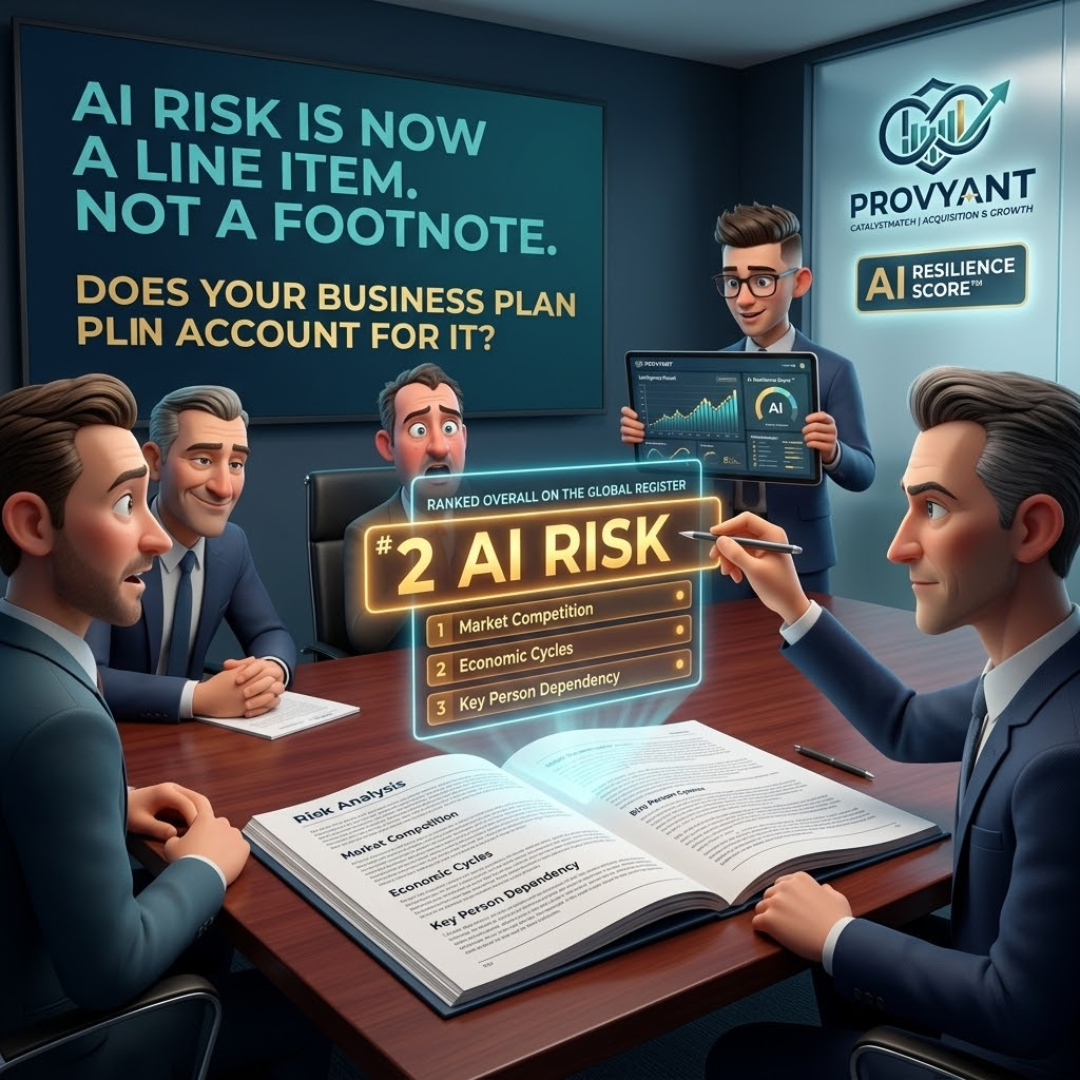
For most of the past decade, the risk section of a business plan covered predictable categories: market competition, economic cycles, key person dependency, and regulatory changes. These were the variables that lenders, investors, and boards expected to see addressed. Provyant tracks what that list looks like in 2026, and it now has a new and unavoidable addition.
AI risk has moved from the margins of enterprise risk management into the mainstream of business planning, and it has done so faster than most organisations anticipated. The business plan that does not address it in 2026 is not a conservative document. It is an incomplete one.
Why AI Risk Became Impossible to Ignore
The shift in how seriously organisations are treating AI risk is visible in the data.
AI jumped from tenth to second place in the Allianz Risk Barometer in a single year, the biggest single-year jump in the survey’s history. It now ranks as a top five business risk in every region globally and has moved into the top three concerns for large, mid-sized, and smaller firms simultaneously.
362 AI-related incidents were recorded in 2025, up 55% from 233 the prior year. Major business conduct risk incidents rose 55% between 2023 and 2025, with each incident costing an average of $14 million USD. Only 16% of executives identified AI-related conduct risks as a top material concern over the past three years. Yet 56% expect them to be a top material risk over the next three years.
The gap between where organisations are today and where they expect to be in three years is precisely the window that serious business planning needs to address now.
What Does AI Risk Actually Mean for a Business?
AI risk is not a single category. It is a cluster of distinct exposures that affect different parts of a business in different ways.
The Allianz Risk Barometer identifies three primary categories organisations need to plan for. Operational risks include business interruption, failed or misaligned systems, and errors cascading through automated workflows. Legal and compliance risks include breaches of emerging regulations, liability for harmful AI outcomes, and sanctions under evolving governance frameworks. Reputational risks include brand damage tied to misinformation, unethical AI use, data breaches, or biased decisions affecting customers or employees.
Beyond those three, workforce risk deserves its own category. Organisations that adopt AI without a workforce transition strategy create internal disruption, talent erosion, and in some cases legal exposure around how those changes are communicated and managed.
Valuation risk is the dimension that business owners and acquirers are beginning to understand most acutely. As Provyant has outlined in its analysis of why buyers look beyond revenue, a business that cannot demonstrate structured AI governance and clear accountability for AI-dependent functions is a less attractive and less financeable asset than one that can.
Why Governance Is the Differentiating Factor
The organisations separating themselves from the risk are not necessarily the ones with the most sophisticated AI tools. They are the ones with the governance structures to manage what they have already deployed.
Only 8% of organisations globally have a comprehensive AI governance framework. That figure drops to 2% among small firms. Meanwhile 88% of organisations are actively using AI across business functions. The distance between those two numbers represents the core governance deficit that businesses must close, and that every serious business plan must now account for.
74% of all AI-generated economic value flows to just 20% of organisations. 35% of organisations admit they could not shut down a rogue AI agent if one emerged. Deploying autonomous systems without shutdown capability is not a theoretical risk. It is an operational liability that no enterprise risk framework would accept in any other technology context.
What the Regulatory Environment Is Demanding
The compliance landscape has shifted from voluntary to mandatory faster than most organisations anticipated.
The EU AI Act now imposes penalties of up to 35 million euros or 7% of global turnover for prohibited AI practices. Colorado now requires risk assessments for high-impact AI decisions. New York’s Department of Financial Services has proposed guidance on AI use across financial services. The average cost of a data breach reached $4.88 million USD in 2024, and AI-crafted phishing emails now show click-through rates of 54% compared to 12% for traditional attacks.
Organisations without auditable AI governance are accumulating compliance exposure they have not yet quantified. And that exposure is now appearing in due diligence, insurance underwriting, and acquisition conversations in ways that directly affect commercial outcomes.
What Belongs in the AI Risk Section of a Business Plan
A credible AI risk section is not a paragraph acknowledging that AI exists. It is a structured assessment that addresses several specific questions.
Which AI systems are currently operating inside the business, and which core processes depend on them? What happens operationally when those systems fail or produce unreliable outputs? Who is accountable for AI-driven decisions and their consequences? What is the business’s exposure to AI automation within its core revenue-generating functions? How does the organisation monitor, audit, and govern its AI use on an ongoing basis?
These are the questions that lenders, acquirers, and boards are beginning to ask. The organisations that have already answered them arrive at those conversations with credibility and confidence. As Provyant’s analysis of the Invisible Recession and the AI and Silver Tsunami convergence makes clear, the economic restructuring underway is already rewarding businesses that have addressed these questions and penalising those that have not.
The Businesses That Plan for AI Risk Now Are the Ones Still Here Later
AI risk is not a future budget line. It is a present one. The organisations that treat it as such are building the kind of documented, governed, and commercially defensible operations that hold their value through disruption.
The AI Resilience Score at provyant.com provides the structured framework organisations need to assess their AI risk exposure honestly across operations, governance, workforce, and market positioning. Because the business plan that accounts for AI risk today is not the cautious one. It is the only credible one.