
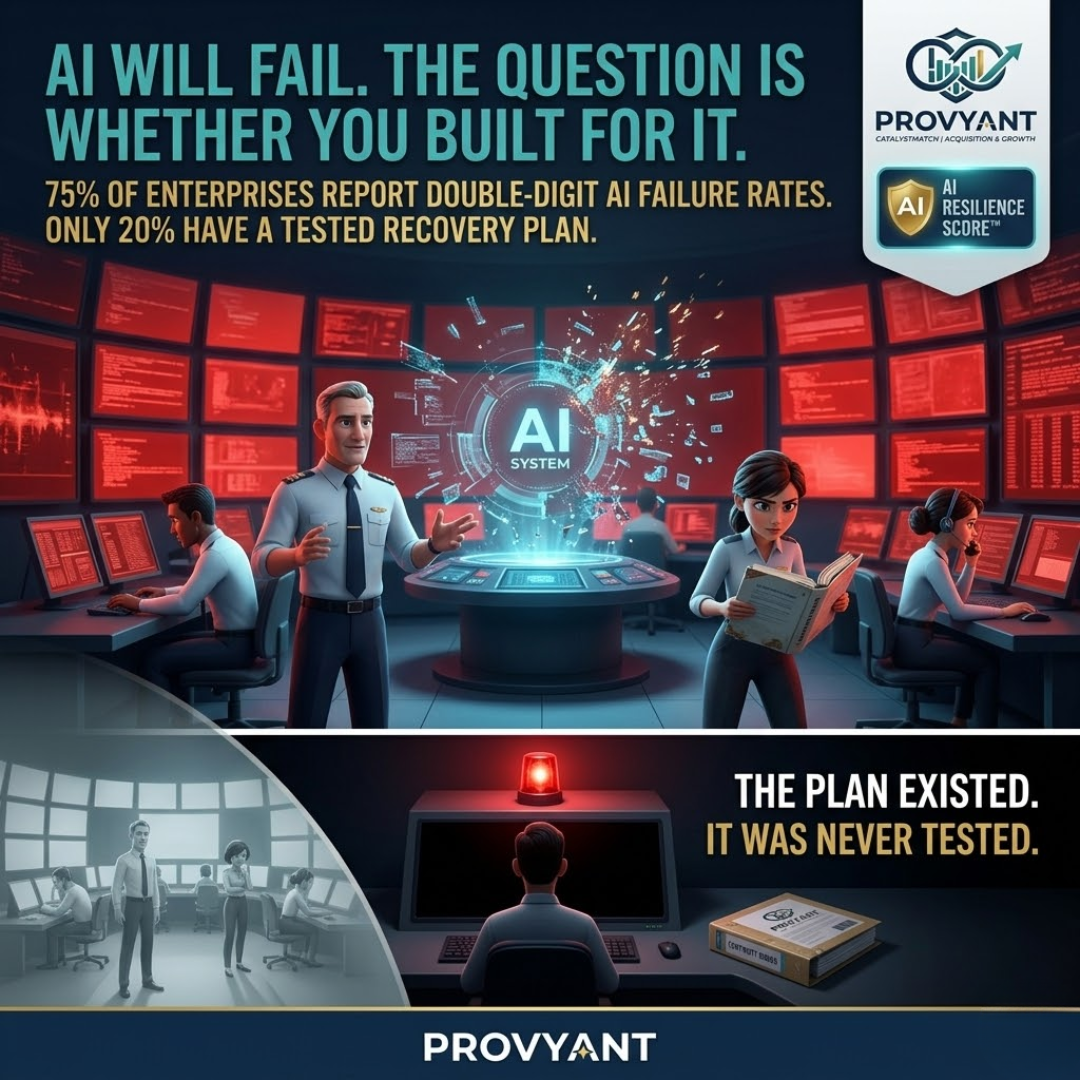
The question organisations should be asking is not whether their AI systems will fail. The question is whether they have built the operational structures to keep functioning when they do.
75% of enterprises now report double-digit AI failure rates. The AI project failure rate sits at 95% according to MIT’s State of AI in Business 2025, with most initiatives never successfully scaling into production. And smaller businesses lose an average of $427 per minute of operational downtime, a figure that rises to $15,000 per minute for larger enterprises.
AI failure is not an edge case. It is a standard operational risk that most continuity frameworks were not built to handle.
Why AI Failure Is Different From Traditional System Outages
Traditional business continuity planning was built around a relatively clear failure model. A system goes offline. An alert fires. A recovery process activates. The problem is visible, the source is identifiable, and the recovery path is documented.
AI failure does not always work that way.
When an AI-dependent system degrades, it does not always produce an obvious error. It can produce subtly incorrect outputs that propagate through downstream processes before anyone identifies the source. A pricing model that drifts. A document summarisation tool that begins omitting critical detail. A customer service system that starts generating responses that are technically coherent but factually wrong. The system stays online. The damage accumulates quietly.
AI models rely on fast, uninterrupted access to reliable data, and weaknesses in durability, availability, and recovery design often lead to costly interruptions. Even brief failures can stall training, delay model delivery, and drain budgets. But it is the silent failures, the ones that do not trigger an alert, that carry the greatest continuity risk.
94% of organisations say AI is the dominant disruptor of cyber risk in 2026. 87% flag AI-system vulnerabilities as a fast-rising threat. The continuity frameworks that predate AI adoption were not designed for a threat landscape that moves at this speed or degrades in this way.
What Happens to Operations When AI-Dependent Processes Break
The operational consequence of AI failure depends heavily on how deeply embedded the AI system is in core business processes, and how much of the organisation’s continuity planning accounts for its absence.
For organisations that have integrated AI into customer-facing functions, the failure surface is immediate and visible. Service quality degrades. Response times extend. Customers notice before leadership does. For organisations where AI is embedded in internal workflows, the failure is often slower to surface but more systemically damaging. Decisions get made on unreliable outputs. Reports carry errors. Financial models produce projections based on corrupted or outdated data.
42% of companies abandoned most AI initiatives in 2024, a sharp rise from 17% the previous year. Many of those abandonments were not strategic decisions. They were reactive responses to implementation failures that the organisation was not equipped to manage or recover from. The cost of those failures included not just the sunk investment but the operational disruption that accompanied the unplanned reversal.
Unexpected network outages affect 91% of businesses at least once per quarter. When those outages intersect with AI dependencies, the recovery complexity multiplies. Organisations must recover not just data but model accuracy, inference integrity, and in regulated environments, demonstrable algorithmic fairness.
What Continuity Planning Must Now Include
The organisations managing AI failure most effectively are those that have updated their continuity frameworks to reflect a fundamentally different operational environment.
The EU AI Act now requires high-risk AI systems to demonstrate resilience against attempts to alter their use, outputs, or performance. Organisations must prove they can recover not just data but model accuracy, inference latency, and algorithmic fairness post-recovery. This is a governance standard that most legacy continuity frameworks do not address.
Effective AI continuity planning now requires mapping every AI-dependent process in the organisation and assigning it a criticality rating. It requires building manual override or fallback procedures for every high-criticality AI function. It requires testing those fallbacks under realistic failure conditions, not just documenting them. And it requires establishing clear accountability for who detects, escalates, and resolves AI-specific failures before they compound into broader operational crises.
Only 20% of organisations have a tested AI incident response plan. The gap between AI adoption rates and AI recovery preparedness is one of the most significant and least discussed operational risks in modern business management.
The Connection to Business Value and Transferability
AI continuity is not only an operational concern. It is a commercial one.
A business that cannot demonstrate how it responds to AI system failure is a business that buyers, lenders, and partners cannot adequately assess. The inability to show documented fallback procedures, tested recovery processes, and clear accountability for AI-dependent functions introduces uncertainty into acquisition and financing conversations that well-prepared businesses avoid.
As Provyant has outlined in its analysis of what makes a business AI-resilient and why buyers look beyond revenue, operational durability under stress is now a core component of how businesses are evaluated in the acquisition market. The Silver Tsunami of Boomer business exits is bringing thousands of AI-dependent businesses to market. The ones that have documented continuity plans will command stronger terms. The ones that have not will face harder questions and narrower buyer pools.
Building Recovery Capability Before It Is Required
The organisations that survive AI failure with minimal disruption are not the ones with the most sophisticated tools. They are the ones that built recovery capability into their operating structure before a failure made it necessary.
Dedicated incident response teams save an average of $2.2 million per breach. Regular continuity exercises trim detection times by approximately 28 days. The investment in continuity preparedness is not a cost. It is risk mitigation that pays for itself when something goes wrong, as it will.
The Invisible Recession Provyant tracks is already exposing the fragility of businesses that adopted AI without building governance and recovery structures around it. The organisations that built continuity into their AI strategy from the beginning are the ones holding their value as that fragility becomes visible.
The AI Resilience Score at provyant.com is built to assess exactly this dimension of business durability, because the organisations that survive AI failure are the ones that planned for it before it arrived.