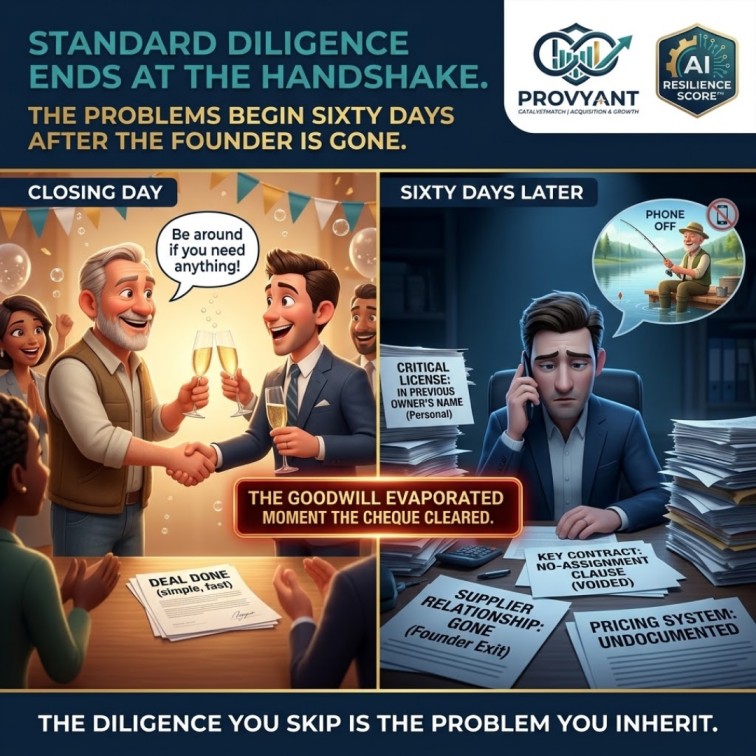
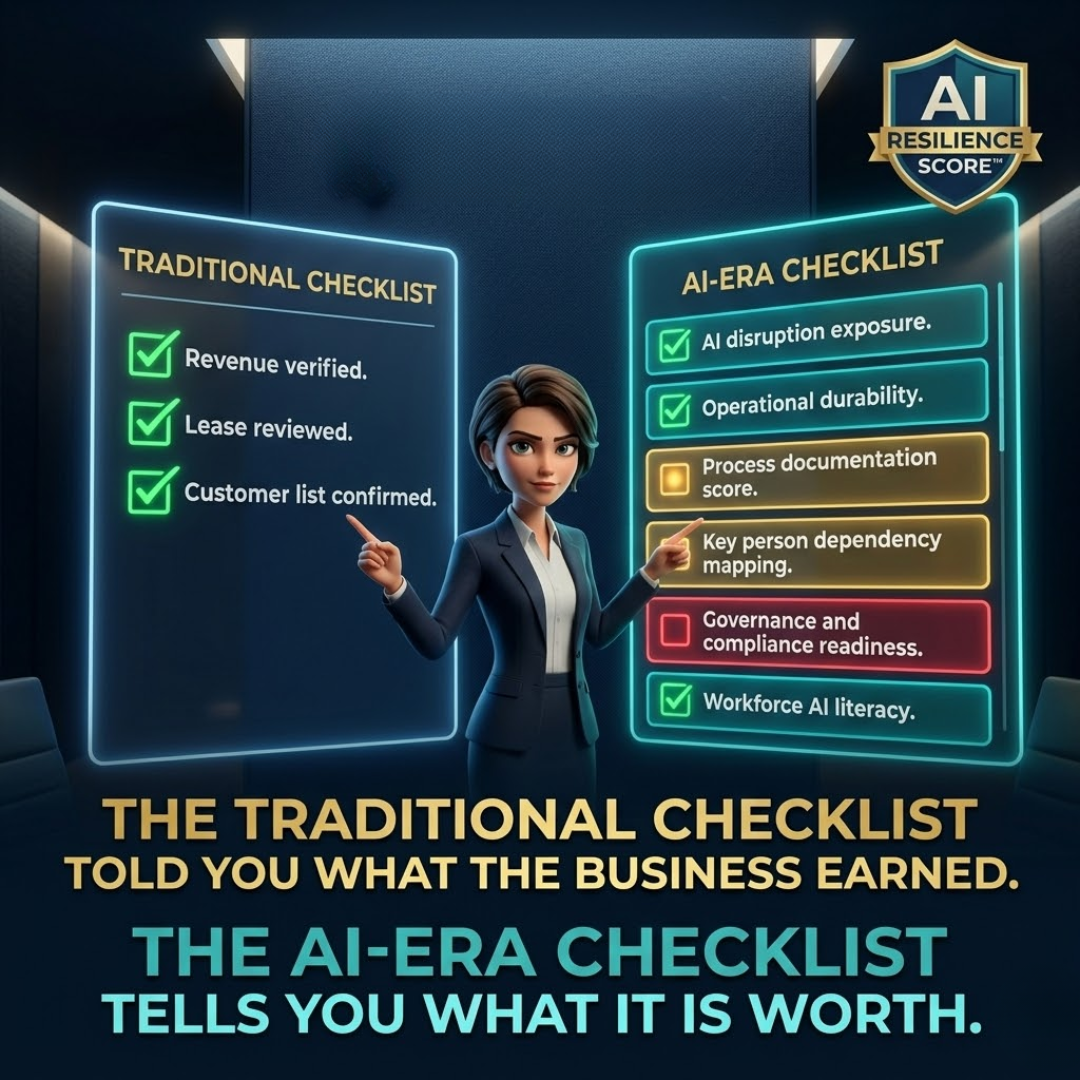
The due diligence process that served business buyers well for the past two decades was built for a different market. Financial statements. Customer concentration. Key person risk. Lease agreements. These remain important. But they do not tell a buyer what they need to know about the dimension of risk that AI disruption has added to every acquisition decision made in 2026.
One in five strategic dealmakers walked away from an acquisition in 2026 specifically because of AI’s anticipated impact on the target business. 74% of late-stage deals now include a dedicated AI or technical review, compared to 31% in 2022. The buyers still relying on traditional checklists are not just moving slower than the market. They are assessing the wrong things. As Provyant’s analysis of why buyers look beyond revenue makes clear, the acquisition conversation has permanently changed.
Why Standard Due Diligence Is No Longer Enough
Standard due diligence was designed to verify what a business claims about itself financially and operationally. It was not designed to assess whether the business model itself is durable in a market being reshaped by AI.
A business with three years of clean financials and strong EBITDA can still be a poor acquisition if its core revenue is generated by services that AI is commoditising. A business with owner-concentrated relationships and undocumented processes can still look healthy on paper while carrying operational fragility that will surface immediately after close. And a business with AI tools embedded in critical workflows but no governance around them carries liability that does not appear anywhere in the standard financial review.
Average due diligence now takes 203 days, up 64% from a decade ago, according to Bayes Business School. The lengthening timeline reflects the increased complexity of what buyers need to assess. Buyers who build AI-specific evaluation into their diligence process from the outset move more efficiently and with greater confidence than those who try to bolt it on after the fact.
The AI-Era Acquisition Checklist
The following checklist reflects what sophisticated acquirers are now evaluating across every deal, regardless of the industry or business type.
AI Disruption Exposure
The first and most fundamental question is whether AI is likely to weaken the business’s core value proposition within the next ownership cycle.
Is the primary revenue stream generated by services or products that AI can replicate at lower cost without significant quality degradation? Are the business’s competitors already deploying AI in ways that create structural cost or speed advantages? Has the business taken deliberate steps to position itself on the right side of AI disruption, either as an adopter or as a business whose value is not susceptible to AI replication? What is the realistic competitive position of this business in three to five years if AI capabilities continue to expand at their current pace?
These questions do not have simple answers. But the buyer who cannot frame them clearly going into a deal is the one most likely to discover the answers expensively after close.
Operational Durability
Operational due diligence has become the primary driver of value creation in 2026, requiring a granular understanding of how a business creates value on a daily basis. The questions that matter here are direct.
Can the business operate at full capacity if the current owner steps back within 90 days of close? Are processes documented in a way that allows a new operator to understand, manage, and improve them without a lengthy knowledge transfer? Is customer concentration manageable, with no single customer representing more than 20 to 30% of total revenue? Are supplier and vendor relationships documented and transferable, or are they personal relationships that exist in the seller’s contact list?
Provyant’s analysis of from founder-dependent to buyer-ready outlines precisely why operational durability is the dimension that most consistently separates successful acquisitions from costly ones.
Workforce and Key Person Risk
Buyers must map governance structure and identify key person risks as a core component of any diligence process. In the context of AI disruption, this dimension has expanded.
Which employees carry knowledge or relationships that are not documented and could not be transferred if they left after close? Is there a talent retention structure in place that survives the acquisition event itself? How dependent is the business on specific individuals to manage or oversee the AI tools embedded in its operations? What is the workforce’s AI literacy level, and does the team have the capability to adopt and manage AI tools without significant external support?
AI Governance and Compliance
For AI-focused transactions, Skadden’s 2026 M&A guidance recommends reviewing training data provenance, model performance benchmarks, data licensing agreements, and compute infrastructure details. For small and mid-market acquisitions, the relevant questions are more practical but equally important.
What AI tools are currently in use, and under what licensing terms? Is there documented oversight of AI-generated outputs in customer-facing or compliance-relevant functions? What data is being fed into third-party AI systems, and are there contractual protections around that data? Has the business assessed its exposure to emerging AI regulations in the jurisdictions where it operates?
Regulatory, privacy, and technical risks can reduce valuation multiples by 15 to 30%. A business that cannot answer these governance questions clearly is one where that discount is already baked into the buyer’s assessment, whether the seller knows it or not.
Financial Quality in an AI Context
The financial review still matters, and the AI era adds a specific layer to it.
The Quality of Earnings process examines three to five years of financials, isolating one-time revenue events and normalising owner add-backs to arrive at a true recurring earnings picture. In an AI disruption context, this review needs to additionally consider whether recent revenue growth reflects durable competitive positioning or a window of opportunity that AI is about to close. Revenue that is growing because a business happens to be ahead of AI adoption in its sector is different from revenue that is growing because the business has built something genuinely defensible.
What the Checklist Reveals About a Business
The value of an AI-era acquisition checklist is not just risk identification. It is clarity about what a business is actually worth and what it will require from a new owner.
A business that scores well across AI exposure, operational durability, workforce resilience, and governance is a business that transfers cleanly, performs predictably, and holds its value through the disruption that is continuing to reshape its market. A business that scores poorly is not necessarily a bad business, but it is one where the new owner’s first year will be spent building the structures that should have been in place before close.
Understanding where a target sits across these dimensions before signing a letter of intent is the difference between an acquisition that delivers on its thesis and one that produces a year of expensive correction. As Provyant’s analysis of what makes a business AI-resilient outlines, the characteristics that make a business worth buying are the same ones that make it durable over the next ownership cycle.
The Buyer Who Moves With Clarity
The acquisitions that perform best are not the ones where the buyer moved fastest. They are the ones where the buyer knew exactly what they were buying, understood the risk profile at depth, and entered the negotiation with a clear picture of value that held up under scrutiny.
The AI Resilience Score at provyant.com is designed to give buyers, advisors, and operators exactly that clarity, across the dimensions that traditional due diligence does not capture and that AI disruption has made newly decisive. Because in the acquisition market of 2026, the buyer who moves with the clearest picture of what a business is actually worth is the one who gets the best deal.