For most of the past decade, the AI conversation in the boardroom was about opportunity. How could the organisation use AI to grow, to compete, to become more efficient? It was a strategy question, and it was usually delegated to the technology function to answer.
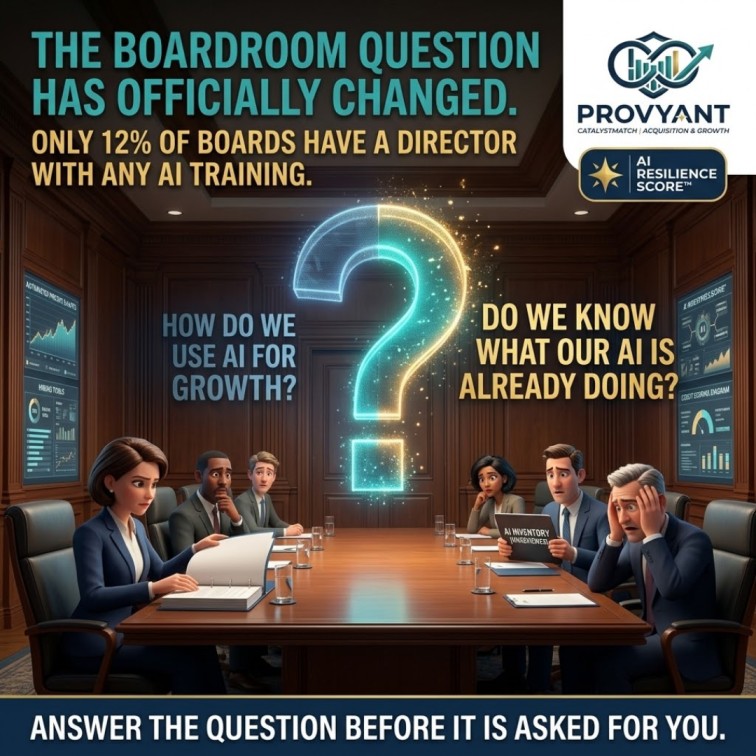
That conversation has fundamentally changed. The question boards now face is not what AI can do for the organisation. It is whether the board has adequate oversight of what the organisation’s AI is already doing. As Provyant has outlined in its analysis of why AI readiness is a board-level conversation, AI has moved from a technology agenda to a governance mandate, and the boards that have not made that shift are carrying accountability they have not yet structured themselves to manage.
The Question Has Officially Shifted
The reframing of the board’s AI responsibility is not subtle. It is a wholesale change in what directors are expected to oversee.
The central question for the board is no longer what AI can do for the organisation, but whether the board has sufficient oversight of what its AI is actually doing. As artificial intelligence transitions from a speculative technology to core infrastructure, the focus of boardroom conversation has irrevocably shifted from opportunity to risk management and fiduciary duty. The era of experimentation is giving way to an era of accountability.
This is echoed across governance research. The central task for directors in 2026 is not deciding whether AI matters. It is ensuring that AI is governed with the same discipline applied to finance, cybersecurity, and corporate risk. The conversation has matured from the technology itself toward accountability, oversight, and outcomes.
Why This Is a Fiduciary Issue, Not a Technology One
The reason this shift matters so much is that AI oversight now sits squarely within the board’s core fiduciary responsibilities, not adjacent to them.
The fiduciary rationale is straightforward. In many jurisdictions, directors are expected to exercise duties of care and loyalty, which include oversight of enterprise risk management and compliance programs. As AI becomes embedded in high-impact business processes, from credit assessments and pricing models to hiring tools and customer interactions, AI-related risks including data privacy failures, algorithmic bias, model opacity, and third-party dependency increasingly meet the threshold of material enterprise risk that boards are obligated to oversee.
The consequence of this is that directors are now personally exposed. Board members understand that they will be held accountable for AI failures, and that the organisation cannot rely on intuition, incomplete inventories, or siloed data science teams. Directors have seen examples of AI-driven failures that created regulatory intervention, reputational damage, and operational shocks. The oversight is no longer optional, and neither is the accountability.
The Oversight Gap the Data Reveals
The uncomfortable reality is that most boards have not yet built the structures to meet this responsibility, even as they acknowledge it.
The gap is stark. Nearly half of boards now disclose AI as part of board-level risk oversight, almost triple the share in 2024, and 40% have assigned it to a specific committee. But only 12% report that any board member has actually received AI training. Boards are formally taking responsibility for AI oversight while lacking the literacy to exercise it credibly.
The expertise gap is corroborated across multiple studies. 66% of directors already use AI for board work, but only 22% have governance processes in place for the board’s own AI usage, and 40% of directors named technological developments including AI as the single most challenging issue to oversee. A separate survey found that 51% of public-company respondents reported no board-specific AI policy, guidance, or governance practices at all. The recognition has arrived faster than the capability to act on it.
The Question Every Board Must Actually Answer
So what is the governance question every board should be answering right now? It is not a single question but a structured inquiry, and the encouraging news is that it does not require directors to become technologists.
Effective board oversight of AI does not require directors to become technologists. It requires boards to ask the right questions consistently, systematically, and with enough structure to support informed oversight of management’s approach. Structured inquiry allows boards to assess AI risk effectively without deep technical expertise.
In practice, boards are expected to make sure management has built the right systems, then exercise informed oversight. That includes approving the AI policy and risk appetite, confirming which committee owns AI oversight, reviewing the AI inventory and material AI risks at least annually, reviewing incidents and management’s response, and ensuring the board can access enough AI expertise to challenge management credibly. The core question underneath all of these is simple to state and difficult to answer honestly: does this board know where AI is operating in the organisation, what happens when it fails, and who is accountable for the outcome?
The Governance Dimension Boards Are Underweighting
There is a further dimension to this question that governance research increasingly emphasises, and that most boards have not yet fully internalised: AI governance maturity now directly affects business value.
Investors have evolved from curiosity to scrutiny. Analyses from major institutions emphasise that AI governance maturity now affects valuation. Organisations that demonstrate reliable, transparent AI behaviour outperform peers, while those operating opaque or unmonitored models invite uncertainty and market penalties. AI governance is not an impediment to growth. It is increasingly a precondition for it.
This connects directly to the broader question of business durability that Provyant tracks. As outlined in the analysis of what makes a business AI-resilient, governance maturity is now a measurable component of how businesses are valued, financed, and acquired. A board that has answered the governance question well is protecting not only against risk but in favour of value. The businesses coming to market in the Silver Tsunami with demonstrable AI governance are the ones commanding stronger buyer confidence.
Answer the Question Before It Is Asked for You
The governance question every board should be answering right now is not going away, and the boards that defer it are accumulating exposure that grows with every AI system the organisation deploys. Regulators, investors, employees, and customers increasingly expect evidence that AI risks are being managed thoughtfully and transparently, and that expectation is hardening into legal requirement across jurisdictions.
The boards that answer the question well are the ones that treat AI oversight with the same discipline they apply to financial and cybersecurity governance: structured inquiry, clear accountability, regular review, and enough literacy to challenge management credibly. The AI Resilience Score at provyant.com gives boards and leadership teams the structured framework to assess where their governance actually stands across oversight, accountability, and AI exposure. Because the board that answers the governance question deliberately is the one still in control when regulators, investors, or a failure asks it for them.