
The Silver Tsunami has created a paradox for anyone looking to buy a business. There has never been more supply. Millions of established, profitable businesses are coming to market as their Baby Boomer owners retire. And yet finding one that is genuinely worth buying, one that will transfer cleanly and hold its value, is harder than the sheer volume of listings suggests.
The abundance is real, but so is the risk. The skill that separates successful acquirers from those who overpay for a business that collapses after close is not the ability to find a business. It is the ability to identify the right one. As Provyant has outlined in its analysis of why buyers look beyond revenue, the businesses worth acquiring are the ones where durability and transferability align with the financial performance, and knowing how to spot that combination is the entire game.
Start With Your Criteria, Not the Listings
The most common mistake first-time buyers make is starting their search by browsing listings. The businesses that look interesting are rarely the businesses that fit the buyer, and a search without clear criteria wastes months on opportunities that were never right.
The disciplined approach is to define the acquisition criteria first. That means understanding location, owner involvement requirements, and preferred management style before evaluating any specific business. Clear criteria allow a buyer to filter opportunities quickly and focus the search on businesses that actually match their skills, capital, and goals.
This matters even more given the market dynamics. Buyers should search with intent, not just curiosity, targeting businesses that fit their skills, geography, and financial criteria rather than whatever looks interesting on a given day. The buyer with defined criteria moves faster, evaluates more accurately, and presents as a more serious candidate to sellers who care deeply about who takes over their life’s work.
Match the Business to Your Capital and Experience
One of the sharpest frameworks for finding the right business is recognising that the Silver Tsunami is not a single market. It is really two markets with completely different risk profiles, and matching the business to your position is what prevents a costly first deal.
The right question is not whether a business is a good opportunity in the abstract. It is whether it is the right risk for your capital position. A buyer with scarce capital in the six-figure range is best suited to binary-risk deals, where the price of admission matches the budget. A buyer with more capital but thin operating experience in an industry is better suited to execution-risk deals, but only if they structure continuity into the deal through seller financing, a long transition period, or an operating partner who stays on.
Getting this distinction wrong is precisely how capital-only buyers lose their first deal. The business that is right for one buyer’s position is wrong for another’s, and the discipline to match the opportunity to your own capital and experience is what separates a durable acquisition from an expensive lesson.
Learn to Read the Green Lights and Red Flags
Once criteria are set, the core skill becomes evaluation: distinguishing the businesses that will survive a change of ownership from the ones that will not.
The businesses worth pursuing show green lights: stable and documented customer relationships, clean and verifiable financials, systems that do not depend entirely on the owner, and a market position that is defensible. The businesses to avoid show red flags that should make a buyer think twice, and spotting those early keeps the search focused on the most viable deals from the start.
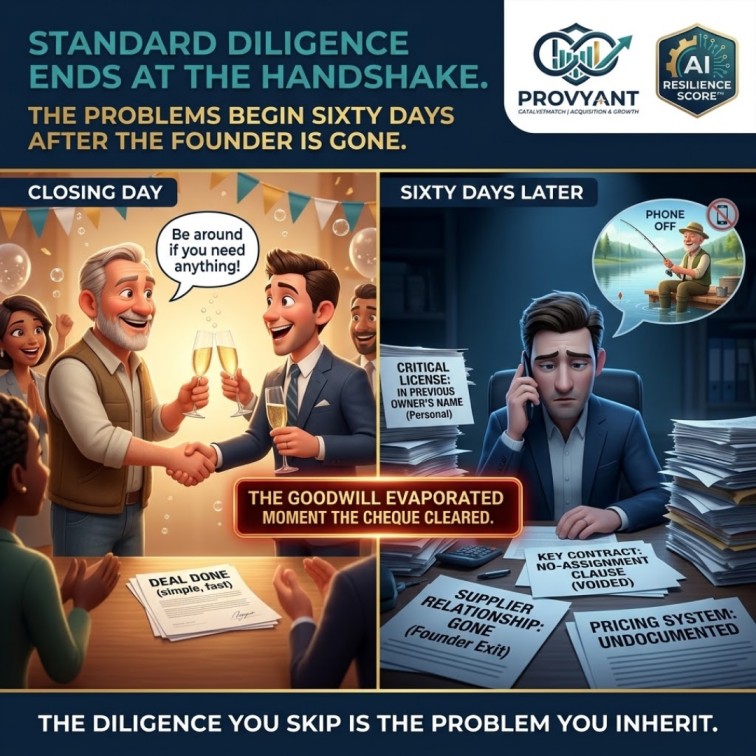
The single most important thing to evaluate is owner dependency. A business where the pricing logic, key relationships, and daily operational decisions all live in the retiring owner’s head is a business whose value may evaporate the moment that owner leaves. As Provyant has outlined in its analysis of what makes a business AI-resilient, the durability that makes a business worth buying comes from documented systems and reduced owner dependency, not from the founder’s personal involvement.
Understand the Seller You Are Sitting Across From
Finding the right business is not only about analysing financials. It is also about reading the seller, because the Silver Tsunami has created a specific kind of seller whose expectations often do not match market reality.
The Silver Tsunami has produced a class of motivated sellers who are, in many cases, not financially sophisticated about what makes a business sellable. Sellers who have never had a formal valuation, never cleaned up their financials, and never reduced owner dependency frequently have a price in mind that no buyer’s diligence will support. Those conversations can turn adversarial quickly.
This is where preparation becomes an advantage rather than just a defence. A prepared buyer who can walk into the conversation with a clear framework, explaining how they value a business, what they look for, and what they need to close, wins deals that less disciplined buyers cannot. Understanding the seller’s motivations, particularly the common priority of legacy preservation over maximum cash, also opens the door to the creative deal structures that make these acquisitions accessible.
Get Your Financing Ready Before You Search
A practical point that separates serious buyers from browsers: financing readiness is not a step you handle after finding a business. It is preparation that should be complete before the search begins.
Buyers should get pre-qualified financing before they start looking, because a pre-approval letter shortens the credibility check with sellers from weeks to days. SBA 7(a) loans remain the standard path to acquisition financing, and knowing the budget before searching saves months of evaluating businesses that were never affordable. As Provyant has outlined in its analysis of seller financing, the combination of SBA lending and seller notes is what makes many of these acquisitions accessible, and the buyer who arrives with financing ready presents as a stronger candidate than one offering a higher price with no plan.
Add AI Resilience to Your Evaluation
There is one evaluation dimension that most acquisition frameworks still overlook, and that is becoming decisive in the current market: the AI exposure of the business being acquired.
A business can pass every traditional test, clean financials, documented operations, reduced owner dependency, and still be a poor acquisition if its core value proposition is being commoditised by AI. The buyer evaluating a business in the Silver Tsunami needs to ask whether the business model is defensible as AI capabilities expand across its sector, whether its operations can integrate AI under new ownership, and whether it sits in one of the categories genuinely resistant to AI disruption.
This is the dimension Provyant tracks most closely. The businesses that combine strong financials with genuine AI resilience are the ones that will hold their value through the next ownership cycle, while the ones that look sound today but carry unexamined AI exposure are the ones that erode. Adding this lens to the evaluation is what distinguishes a durable acquisition from one that was durable only until the sector caught up.
Find the Right One Before Everyone Else Does
The Silver Tsunami is a genuine, once-in-a-generation opportunity, but abundance is not the same as quality. The buyers who succeed are the ones who define their criteria, match the business to their capital and experience, read the green lights and red flags accurately, prepare their financing in advance, and add AI resilience to their evaluation framework.
That discipline is what turns an overwhelming market of listings into a focused search for the businesses actually worth owning. The AI Resilience Score at provyant.com gives buyers the structured framework to evaluate a target across operational durability, AI exposure, and long-term value, the dimensions that determine whether a business is worth buying at all. Because in a market this crowded, the advantage does not belong to the buyer who finds a business. It belongs to the one who finds the right one first.