
Budget season has a way of exposing what a business actually believes. Line items are where strategy stops being a slogan and becomes a number, and for 2027 the number most owners are getting wrong sits under a heading many still treat as optional. With AI spending forecast to reach $2.5 trillion in 2026, the businesses capturing value are the ones that stopped treating artificial intelligence as a discretionary purchase and started planning around it like any other operating condition.
Why is AI no longer a software line item?
AI stopped being a software purchase the moment it started shaping labour, risk, and valuation at the same time. Filing it next to the accounting platform caps the conversation at a vendor decision and hides the structural change underneath. A budget that isolates AI to one department misses where the real cost and the real opportunity actually live.
The instinct to treat it as technology is understandable, but it is expensive. When McKinsey mapped the exposure, it found the roles most affected cut across nearly every function, not just the obviously technical ones. That means AI planning belongs in the labour conversation, the operations conversation, and the continuity conversation, not only in the technology line.
The scale is what makes this urgent rather than theoretical. Entire sectors are being re-engineered around the technology, and a business that budgets as though AI were optional is quietly deciding to fall behind competitors who already treat it as foundational. The decision rarely feels dramatic. It just shows up a year later as lost ground.
What should a 2027 AI budget actually fund?
A strong 2027 budget funds answers to three questions before it funds any tool: where the business is already dependent on AI it does not control, what work the market will soon expect done faster, and what it would cost to run without its most knowledgeable people. Tools come after the diagnosis, never before it.
The first question exposes hidden dependence. Many owners discover a core workflow quietly runs through a third-party model with no backup. That is a continuity exposure sitting in plain sight, and it belongs in the risk column before a single new licence is purchased.
The second question is about competitive pace. The Future of Jobs Report projects significant change in task composition by 2030, which means the distance between a lean competitor and a slow one grows every quarter. Budgeting for the work that is about to be commoditized protects margin before it erodes rather than after.
The third question connects AI readiness to succession. A business that cannot run without a few key people is fragile regardless of its technology spend, and workflow automation that captures institutional knowledge is often a higher-return line than any new platform on the market.
How much should the risk column hold?
The AI risk column should hold a real, funded reserve, not a placeholder. Owners already budget for insurance they hope never to use, and AI dependence deserves the same discipline. A practical starting point is enough to cover a fallback for every workflow that would stop the business if a single AI tool failed.
This is where planned capital beats panicked capital every time. The pattern without a reserve is predictable. A competitor moves, a tool breaks, or a model changes behaviour, and money then gets spent fast and badly under pressure. A funded reserve converts a crisis into a line item, which is the entire point of planning.
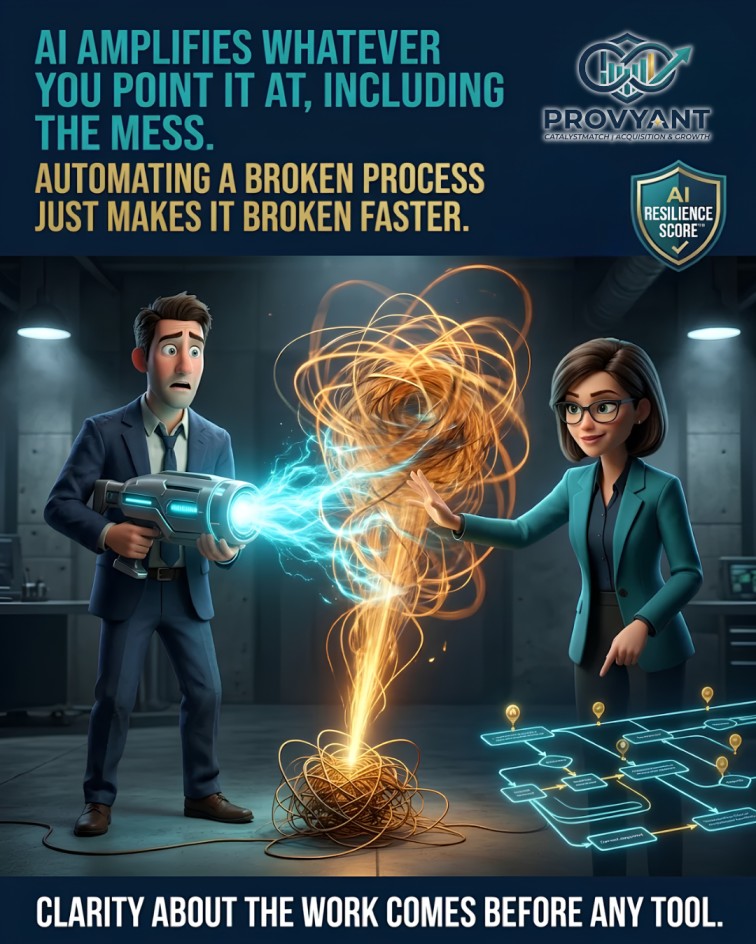
Mapping that exposure is the work that makes the number defensible. Measuring your AI Resilience Score before committing budget turns a guess into a diagnosis, showing exactly where dependence has formed and where continuity planning is missing. The reserve then matches real risk rather than a round figure chosen for comfort.
How do resilient owners structure the spend?
Resilient owners structure the spend around continuity rather than novelty. The most durable 2027 budgets are not the ones with the largest AI allocation. They are the ones where every dollar maps to adaptability, controlled operations, and a business that holds its value through disruption.
In practice, that means ranking spending by the fragility it removes. Automation that eliminates a single point of failure is worth more than a tool that impresses in a demo and gathers dust by March. Owning the critical path matters too, which is why custom software a business actually controls often outperforms a rented tool it cannot govern.
It also means budgeting for people, not just platforms. Research into the hidden penalty of AI at work shows adoption stalls when the workforce is expected to absorb change silently. A line for training and honest communication protects the return on every other AI dollar, because tools that are bought but never trusted are simply cost without capability.
Frequently Asked Questions
How much of my budget should go to AI in 2027?
There is no universal percentage, because the right figure depends on your exposure, not an industry average. Start by diagnosing where your operations are AI-dependent and where they are fragile, then allocate against that. Most resilient owners split the spend across investment, a risk reserve, and continuity planning rather than a single tool budget.
Is AI a capital expense or an operating expense?
In most small and mid-sized businesses, AI now behaves like an operating condition rather than a one-time purchase. Subscriptions, retraining, and continuity planning recur every year. Budget for it the way you budget for labour or insurance, as an ongoing cost of doing business, not a single capital line you fund once and forget.
What happens if I delay AI budgeting another year?
Delay rarely saves money. It usually converts a planned, deliberate spend into a reactive one triggered by a competitor move or a tool failure. The business also loses a year of workforce adaptation and process documentation, which are the slow investments that cannot be bought quickly when pressure finally arrives.
How do I budget for AI risk I cannot predict?
You budget for the category, not the specific event, the same way you insure against fire without predicting one. Fund a reserve sized to cover a fallback for any AI-dependent workflow that would halt the business. A resilience assessment helps you locate those workflows so the reserve matches real exposure.
Plan It With Provyant
This is exactly the work Provyant was built for. A defensible 2027 budget starts with an honest diagnosis of where your operations are exposed and where they are already strong, and that is what the AI Resilience Score delivers before you commit a dollar. From there, Provyant helps you turn the diagnosis into a plan, mapping the risks, the dependencies, and the continuity gaps that generic AI advice never catches. Next year’s winners are already budgeting on purpose. The only question left is whether yours is one of them.