
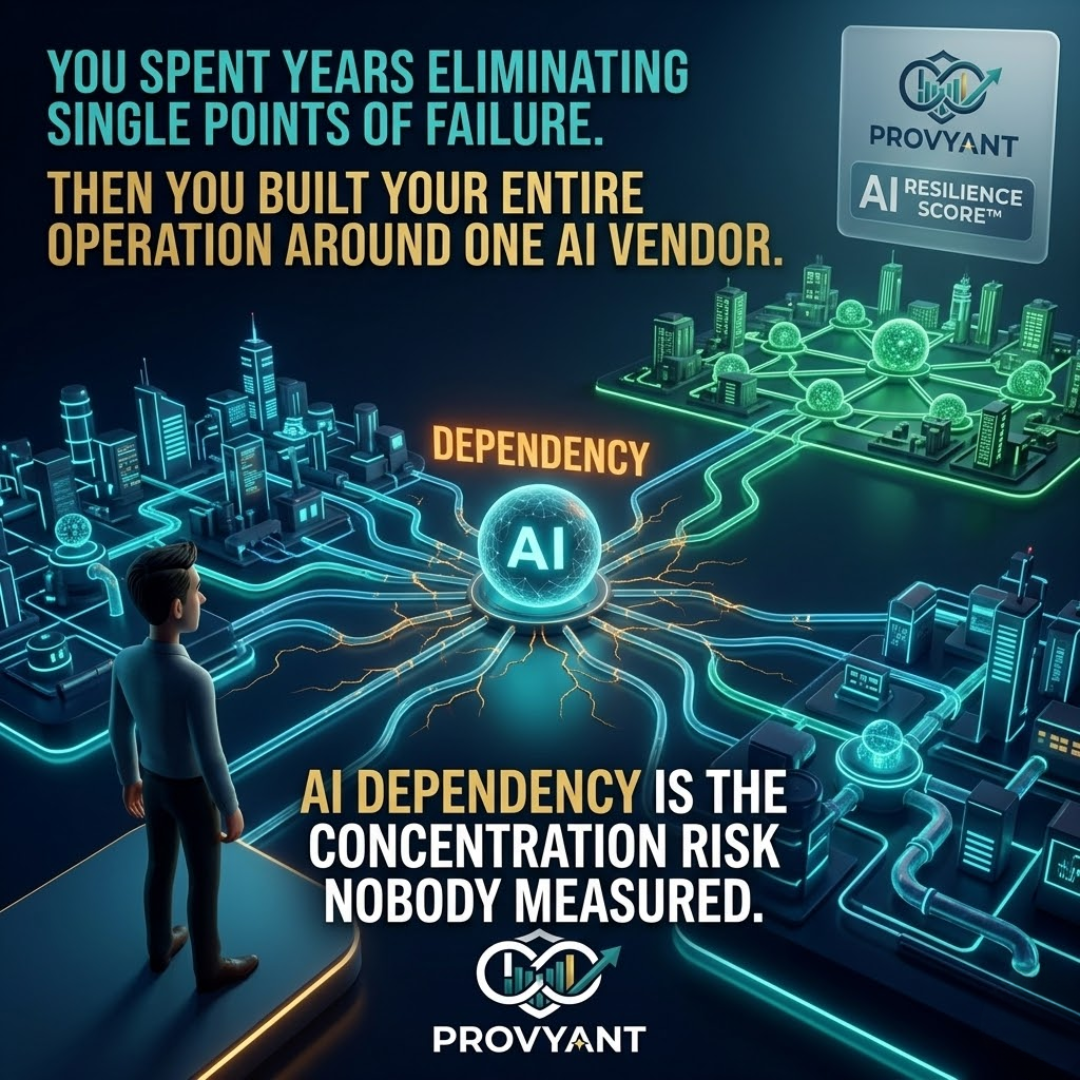
For decades, operational risk management taught organisations to identify and eliminate single points of failure. No critical process should depend on one system, one vendor, one employee, or one data source. Redundancy was the standard. Concentration risk was the enemy.
That discipline has quietly been abandoned in the rush to adopt AI.
Across industries and organisation sizes, businesses have embedded AI tools into core functions at a pace that has significantly outrun the governance frameworks designed to manage dependency risk. The result is a new and largely unacknowledged category of operational fragility: AI vendor dependency that most organisations would never have accepted in any other technology context.
How AI Became a Hidden Dependency
The dependency did not happen through a deliberate strategic decision in most organisations. It happened incrementally.
A team adopts a generative AI tool to accelerate document production. Another department integrates an AI assistant into its customer service workflow. Finance begins running forecasting models through an AI-enabled platform. Each decision is individually reasonable. The cumulative effect is an operational infrastructure that is now deeply reliant on AI systems whose reliability, availability, and pricing the organisation does not control.
Foundation models are no longer just infrastructure. They are wired into decisions, workflows, and customer experiences. When pricing, behaviour, or availability changes, the shock ripples across the whole product surface at once. Traditional vendor lock-in was manageable. AI model dependency presents a fundamentally different challenge, and yet most organisations treat it as if it were business as usual.
AI disruption days rose from 6 in Q1 2025 to 51 in Q1 2026, according to Ookla’s analysis of 3.72 million user reports across major AI platforms. Even short disruptions, including login failures, stalled prompts, and broken connectors, now interrupt active business processes rather than isolated tasks. The organisations that built their operations around uninterrupted AI availability are discovering that availability is not guaranteed.
The Silent Failure Problem
The most dangerous form of AI dependency is not the one that announces itself through an outage. It is the one that degrades quietly while operations continue.
When businesses automate tasks around a single AI model, they are no longer just using a tool. They are delegating judgment. And a system that is consistently trusted even when it is subtly wrong creates a category of operational risk that most continuity frameworks were not designed to detect.
The real risk is not hallucination, the occasional and visible incorrect output that organisations have learned to check. The real risk is a system that drifts in subtle ways: slightly skewed financial projections, gradually degraded summarisation quality, incrementally biased customer-facing outputs. Each individual error is small enough to go unnoticed. The aggregate effect can be significant by the time anyone traces it back to the source.
The biggest AI failures of 2025 were not technical. They were organisational: weak controls, unclear ownership, and misplaced trust in systems that were never designed to operate without oversight. The lesson those failures produced is the same one that operational risk management has always taught. Concentration of dependency without redundancy, fallback, or oversight is not efficiency. It is fragility.
The Vendor Lock-In Dimension
Beyond the reliability risk, AI dependency creates a commercial vulnerability that most procurement and risk functions have not adequately addressed.
When a single AI vendor controls a critical business process, that vendor also controls the terms under which that process continues to operate. Pricing changes. API modifications. Service discontinuations. Capability shifts as the underlying model is updated or replaced. Each of these events, individually manageable in a diversified technology environment, becomes a business continuity event when the dependency is deep enough.
88% of organisations now report using AI in at least one business function. The question most of them have not answered is what happens to that function when the AI vendor changes something they did not expect. Aon’s risk analysis is direct: AI accelerates the speed and scale of operational failure and amplifies dependencies on third-party systems. Early governance, clear accountability, and resilient controls are now non-negotiable for business leaders.
What Reducing AI Dependency Risk Actually Requires
Managing AI dependency is not a technology problem. It is a governance and architecture problem.
It begins with visibility. Most organisations cannot comprehensively map where AI is currently operating inside their business, which processes depend on it, and which vendors underpin those dependencies. Without that map, dependency risk cannot be measured, let alone managed.
It requires redundancy thinking. Reliable systems are not built on perfection. They are built on validation, redundancy, and verification. Every high-criticality AI-dependent process needs a documented manual fallback or an alternative system pathway that can activate without disruption when the primary fails.
It requires treating third-party AI vendors as part of the risk ecosystem, not as utilities. That means asking where models run, what data is retained, how incidents are handled, who is accountable, and what the contractual protections are if the vendor changes terms, gets acquired, or exits the market.
And it requires connecting AI dependency risk to enterprise continuity frameworks in the same way that infrastructure, staffing, and supply chain dependencies are managed. What Provyant’s analysis of operational continuity in the AI era consistently surfaces is that the organisations most exposed are the ones that treated AI adoption as a capability decision and never connected it to their risk management structures.
The Business Value Consequence
AI dependency risk is not only an operational concern. It is a direct commercial liability.
In 2025, global enterprises invested $684 billion in AI initiatives. Over 80% of that investment failed to deliver intended business value. 42% of companies abandoned at least one AI initiative, with average sunk costs per abandoned initiative reaching $7.2 million. The organisations absorbing those losses were not poorly managed. Many were sophisticated enterprises that simply underestimated how deeply dependency risk was embedded in their AI adoption strategy.
For businesses approaching a sale, a succession event, or a capital raise, the stakes are compounded further. A business that cannot demonstrate how it manages AI dependency, including what happens when a key system fails, is a business that buyers and lenders cannot adequately underwrite. As Provyant has outlined in its analysis of why buyers look beyond revenue and what makes a business AI-resilient, operational durability under AI stress is now a measurable component of business quality.
The Organisations That Get This Right
The organisations managing AI dependency most effectively are not the ones that have adopted the most tools. They are the ones that built governance structures before dependency became concentration risk.
They map their AI dependencies systematically. They test fallback procedures under realistic failure conditions. They treat AI vendors with the same contractual rigour they apply to any critical infrastructure supplier. And they connect AI resilience to their broader business continuity and succession planning frameworks in ways that hold up under scrutiny from buyers, lenders, and regulators.
The AI Resilience Score at provyant.com is built to assess exactly this dimension of operational durability, because the single point of failure nobody planned for is always the one that costs the most to fix.