The most dangerous talent loss in an AI disruption environment does not make headlines. There is no single announcement, no mass departure event, no restructuring press release. It happens gradually, in exit interviews that never quite capture the real reason, in project handoffs that feel slightly less thorough than they should, in conversations where experienced professionals talk about their options with a clarity they would not have shown two years ago. It is the kind of structural erosion that Provyant tracks in its analysis of the Invisible Recession reshaping organisations from the inside out.
The quiet exodus of senior talent from organisations managing AI disruption poorly is already underway. And the organisations that are not measuring it are the ones most at risk from it.
What Is Driving Senior Talent Out the Door
The factors pushing experienced professionals toward the exit in the AI era are specific, consistent, and largely distinct from the headline narratives about automation and job loss.
91% of respondents in DHR Global’s 2026 Workforce Trends Report say that the loss of high-performing colleagues impacts the organisation. Burnout, declining engagement, and the pace of AI-driven change are identified as the primary drivers of that talent risk. The connection between how AI is being implemented and how experienced people are responding to those implementations is direct and measurable.
Leadership teams evaluating AI adoption spend enormous energy calculating what AI will save and produce. Very few spend equivalent energy calculating what a botched rollout costs in lost talent. The employees most capable of adapting to an AI-augmented future are also the ones most capable of walking out the door. They have options. An AI rollout is an audition, whether the organisation knows it or not.
The signals appear long before exit interviews. When experienced professionals stop volunteering for projects, begin leaving at exactly the scheduled hour, and disengage from the informal conversations that signal genuine investment in an organisation’s future, they have mentally started looking elsewhere. Most organisations are not watching for those signals with the same rigour they apply to financial metrics.
The Burnout Dimension Nobody Is Measuring
AI burnout is a specific and growing phenomenon that is distinct from general workplace burnout, and it is hitting some of the most valuable people in organisations first.
The pace of AI-driven change is not experienced uniformly across organisations. Senior professionals who have built careers on expertise, judgment, and accumulated knowledge are being asked to simultaneously adopt new tools, redesign their workflows, absorb the output of AI systems they did not choose, manage the anxiety of teams uncertain about their own futures, and maintain performance standards that have not been adjusted for the transition overhead all of this creates.
43% of workers fear automation may replace their job within the next two years. Regular AI usage jumped 13% to 45% of workers, while confidence in using technology fell sharply by 18%. The combination of increased adoption and decreased confidence is producing a specific kind of pressure: professionals are using AI tools they do not fully trust, for tasks that matter to their careers, in organisations that have not clearly communicated how the transition affects them.
For senior professionals, that pressure compounds with the added weight of being expected to lead teams through a transition that leadership has not fully mapped. The people being asked to carry the most weight in the AI transition are experiencing some of the highest burnout risk. And they are the least likely to wait around for the organisation to figure out how to support them.
The Invisible Departure Pattern
Senior talent departure in the context of AI disruption rarely looks like a clean break. It looks like a slow withdrawal of the discretionary effort and institutional investment that made those individuals valuable in the first place.
Forrester’s AI layoff trap research identifies a growing population of coasters: disengaged workers who do not believe their employer deserves their full effort. These are not junior employees experimenting with boundaries. They are experienced professionals who have made a rational calculation that the organisation is not investing in their future at the level that justifies their full investment in return.
What makes this pattern particularly damaging is its invisibility. The professional who is mentally checked out continues to show up, complete assigned tasks, and avoid creating obvious friction. The degradation in output quality, the reduction in proactive contribution, and the absence of the informal knowledge-sharing that made them genuinely valuable are all gradual enough to be misattributed to other causes until the departure itself makes the pattern retrospectively obvious.
In the AI industry specifically, major organisations have experienced significant talent departures at the senior level, with experienced professionals citing unsustainable pace, unclear governance, and a misalignment between stated values and operational decisions as the primary drivers. The organisations losing senior talent in this way are not necessarily the ones with the worst AI strategies. Some of them have the most aggressive ones. The pace of change itself, without adequate communication, support, and organisational clarity, is producing the exit pressure.
Who Is Left Behind
The consequence of the quiet exodus is not just the departure of the professionals who leave. It is the shape of the organisation they leave behind.
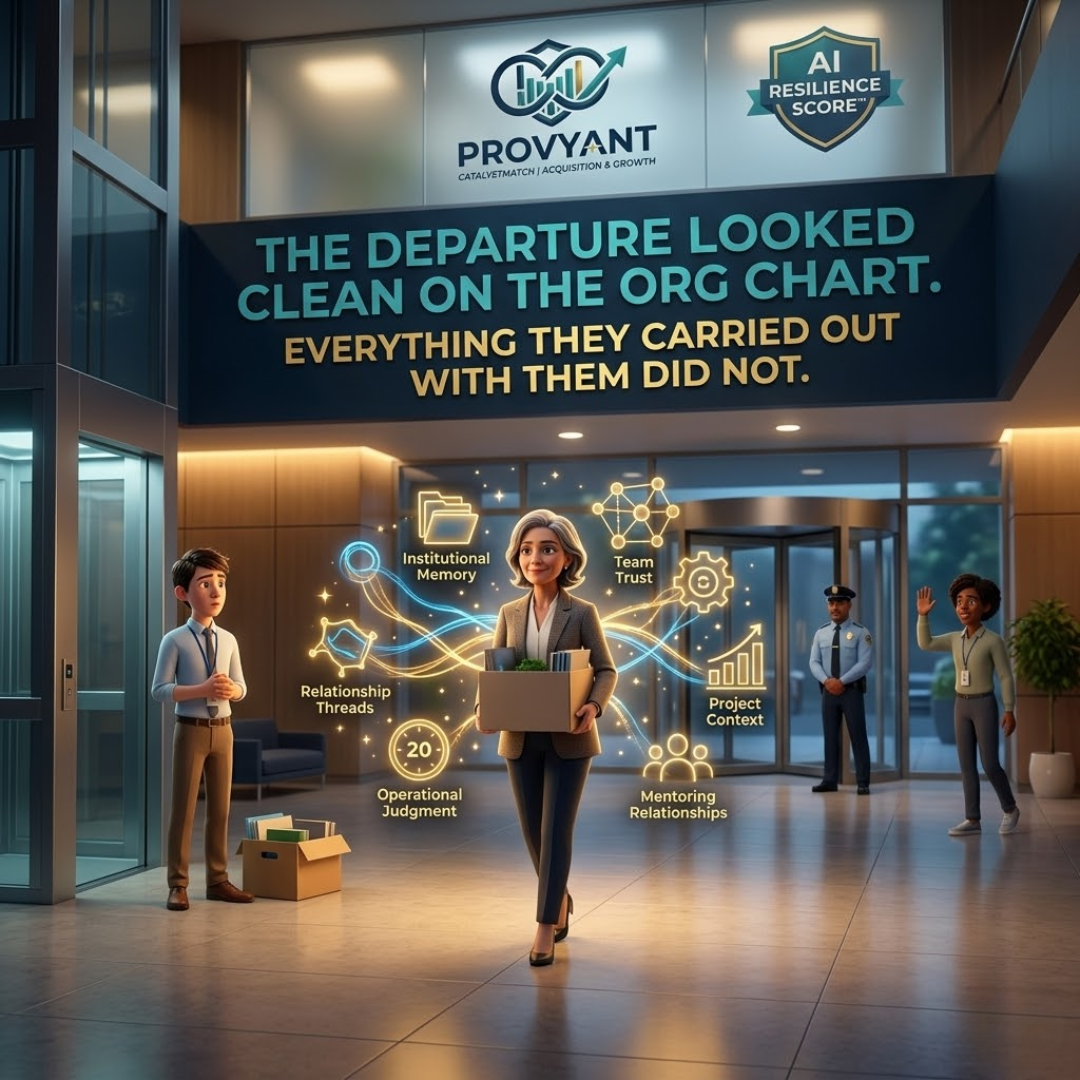
Senior talent does not exit cleanly. It takes institutional knowledge, client relationships, team trust, and operational judgment that took years to build and cannot be reconstructed on a short timeline. What remains after a sustained quiet exodus is an organisation that looks structurally intact but is operationally thinner than its headcount suggests.
The professionals remaining after senior talent departs tend to fall into predictable categories. Some are early in their careers and genuinely committed, but lack the experience base to carry responsibilities at the level departing seniors held. Others are mid-career professionals who stayed for reasons of financial stability rather than conviction, and whose engagement levels reflect that calculation. And some are the genuinely adaptable performers who saw the transition clearly and positioned themselves as indispensable within it.
The last group is the one that matters most for operational continuity, and also the one most at risk of being recruited away once the talent market recognises where the durable performers are concentrated.
What Organisations Must Do Before the Exodus Becomes Irreversible
The organisations retaining senior talent most effectively through AI disruption are not doing it through compensation alone. 19.5% of employers who gave retention-driven pay raises found it did not work. What works is organisational clarity, investment in professional development that accounts for an AI-augmented future, and honest communication about what the transition means for each person’s role and career path.
Senior professionals need to see that leadership understands the weight of what is being asked of them. They need clear answers to the questions that generate the most anxiety: What does my role look like in 18 months? How is the organisation thinking about AI governance and accountability? What is the plan for the teams I manage? How is my expertise being valued in a structure that is simultaneously deploying tools designed to replicate it?
Organisations that cannot answer those questions clearly are the ones accelerating the departure timeline of the people best positioned to survive the transition without leaving.
As Provyant has outlined in its analysis of what makes a business AI-resilient and why buyers look beyond revenue, workforce stability and human capital depth are central to how businesses hold their value through disruption. The AI displacement convergence Provyant tracks is already manifesting in talent markets in ways that standard business reporting does not capture. The organisations feeling it earliest are the ones where AI implementation outran people strategy.
Keeping the People Who Make the Difference
The quiet exodus is quiet precisely because no single departure triggers an alarm. But the cumulative effect of losing experienced professionals to burnout, disengagement, and mismanaged AI transitions is one of the most significant and least measured risks in modern business management.
The AI Resilience Score at provyant.com assesses workforce preparedness and human capital resilience as core dimensions of business durability. Because the organisations that survive and thrive through AI disruption are the ones that kept the people who knew how to navigate it.