If your business has a continuity plan, there is a good chance it was written for a world that no longer exists. It probably defines how to restore servers after a hardware failure, how to recover data after an outage, and how long the business can tolerate downtime before the losses become critical. Those objectives still matter. But they describe a category of disruption that is no longer the primary threat.
The disruptions reshaping business risk in 2026 do not look like a server going offline. They look like AI systems degrading quietly, third-party dependencies failing without warning, and automated workflows breaking in ways that traditional recovery frameworks were never designed to address. As Provyant has outlined in its analysis of operational continuity in the AI era, the gap between how most continuity plans are built and how disruption actually arrives is now a material operational risk.
What Traditional Continuity Planning Was Built For
To understand why most plans are outdated, it helps to understand what they were designed to do in the first place.
Traditional disaster recovery was built around a single objective: restore IT systems after a catastrophic event. Recovery Time Objectives and Recovery Point Objectives defined acceptable downtime and data loss. The model assumed a clear failure event, a visible trigger, and a documented path back to normal operation. A fire, a flood, a hardware failure, a power outage. Something happens, an alert fires, the recovery process activates.
That model was appropriate for the disruptions it was designed around. The problem is that business continuity has evolved far beyond restoring servers, and now must encompass cyber resilience, cloud governance, third-party risk management, regulatory accountability, and operational agility. Disaster recovery remains one component of resilience, but a plan that treats it as the whole strategy is a plan built for the wrong decade.
Why AI Changed the Nature of Disruption
The most significant reason continuity plans are outdated is that AI has fundamentally changed what a disruption looks like.
An AI continuity plan must ensure the continuity of decision-making chains, approvals, and actions rather than just maintaining server uptime. When a business embeds AI into its core workflows, the failure surface changes. It is no longer just about whether the system is online. It is about whether the decisions the system is making are reliable.
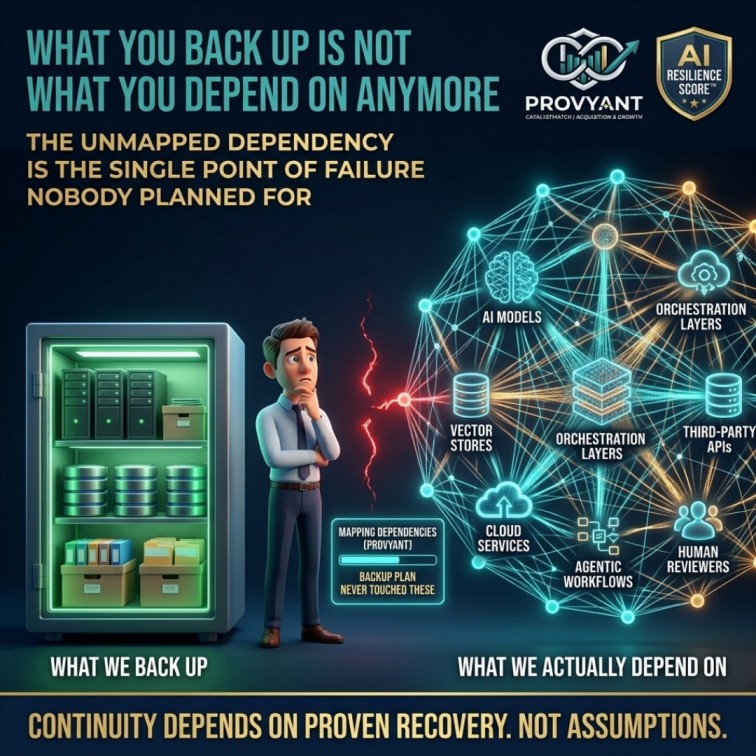
An AI system can stay fully operational and still fail in ways that matter. A pricing model can drift. A document workflow can begin omitting critical detail. An agentic process can take actions based on incomplete or incorrectly permissioned data. None of these trigger a downtime alert. All of them cause real operational damage. Modern agentic workflows depend on models, orchestration layers, vector stores, APIs, permissions, and human reviewers, so keeping work moving takes far more than a backup server. A continuity plan that only addresses infrastructure has no answer for the kind of failure AI actually produces.
The stakes of this are not theoretical. One healthcare organisation discovered its diagnostic AI model’s accuracy dropped 3% after a recovery event due to configuration drift, a potentially life-threatening degradation that traditional testing would never have detected.
The Dependencies Most Plans Never Mapped
Beyond AI itself, the modern operating environment carries dependencies that traditional continuity planning rarely addressed at all.
The core problem is a scope mismatch. In 2026, the inventory of what we back up lags meaningfully behind the inventory of what we depend on. Backups protect what they back up, but the AI tools, cloud services, and third-party providers that now underpin critical operations frequently sit outside that inventory entirely. The unmapped dependency is the single point of failure nobody planned for.
The cyber dimension has intensified this. Ransomware operators increasingly manipulate or corrupt data prior to encryption, which means the recovery mechanism itself is now a target. A plan that assumes backups will be available and uncompromised when needed is a plan built on an assumption that AI-driven attackers are actively working to break.
The Testing Gap That Turns Plans Into Paperwork
Even where continuity plans have been updated, most carry a critical weakness: they have never been tested against the failures they are supposed to address.
The numbers are stark. 23% of organisations have never tested their disaster recovery plans, and 65% of those that do still fail to pass. A continuity plan that has not been tested is only a draft, and agentic workflows need regular drills because failure paths are more varied than standard application outages. The difficult cases are often partial and messy rather than total and clean.
The consequence of that gap is severe. Most organisations acknowledge the importance of continuity planning, but far fewer actually invest in building, testing, and maintaining effective plans. Continuity depends on proven recovery, not on assumptions that have never been stress-tested. And once a disruption hits, the window for survival is measured in days, not months.
What a Modern Continuity Plan Actually Requires
Bringing a continuity plan up to date does not mean discarding disaster recovery. It means expanding the plan to reflect how disruption actually arrives now.
A modern plan maps every AI-dependent process and assigns it a criticality rating. It builds documented fallback procedures for high-criticality functions and tests them under realistic conditions. Beyond standard failover testing, organisations must verify model accuracy, inference latency, and algorithmic fairness after recovery, because the subtle degradation AI produces is exactly what conventional testing misses. And critically, testing must demonstrate not only technical capability but decision-making effectiveness under pressure. Crisis leadership structures need to be tested, not simply documented.
This connects directly to business value. As Provyant has outlined in its analysis of what makes a business AI-resilient, a business that can demonstrate a tested, current continuity framework is more transferable and more attractive to buyers, lenders, and partners than one whose plan predates its own operating reality. The businesses coming to market in the Silver Tsunami with outdated continuity plans are the ones facing harder due diligence questions and narrower buyer confidence.
Update the Plan Before the Disruption Updates It for You
A continuity plan is only valuable if it reflects the disruptions the business actually faces. Most plans do not. They were written for a threat landscape that has been overtaken by AI dependency, third-party concentration, and failure modes that do not announce themselves with an outage alert.
The businesses that navigate disruption most effectively are the ones that treated their continuity plan as a living document, updated it to reflect their real operating reality, and tested it before a failure forced the issue. The AI Resilience Score at provyant.com gives business owners and advisors the structured framework to assess where their continuity posture actually stands across AI exposure, operational durability, and dependency risk. Because the continuity plan that survives the next disruption is the one that was updated before it arrived, not after.