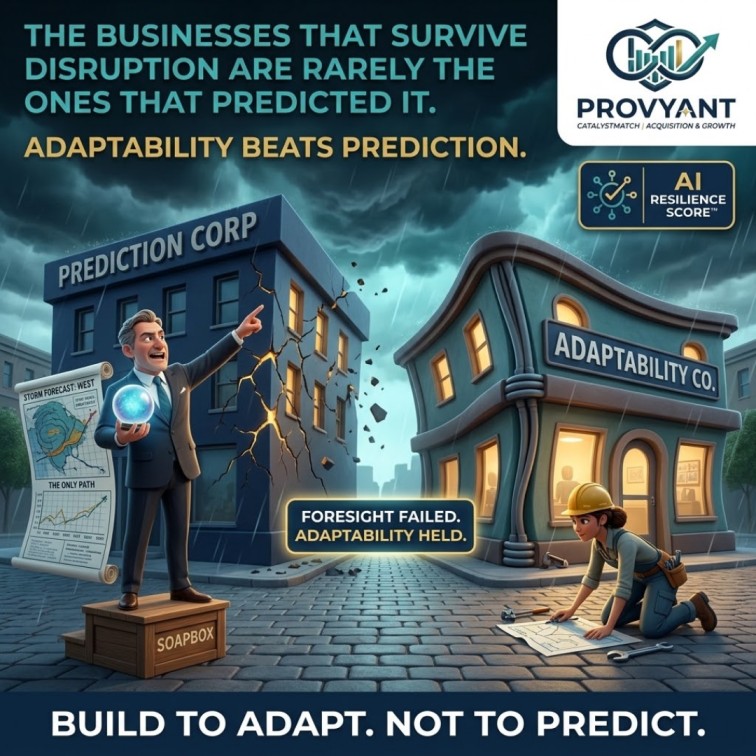
There is a comforting myth in business strategy that survival belongs to the visionaries, the leaders who saw the disruption coming, called it early, and positioned themselves ahead of it. It is a satisfying story. It is also, for the most part, wrong.
The businesses that actually survive major disruption are rarely the ones that predicted it accurately. They are the ones that built the capacity to absorb a shock they did not anticipate and keep operating while their competitors froze. As Provyant has outlined in its analysis of organisational adaptability under AI pressure, the durable advantage is not foresight. It is the structural ability to adapt when the thing you did not forecast arrives anyway.
The Prediction Trap
The instinct to predict disruption is understandable. If you can see the shock coming, you can prepare for it specifically. But this instinct contains a trap that has undone many well-run businesses.
The trap is that prediction, by its nature, involves betting on a specific outcome. And the most successful companies in a volatile environment are precisely the ones that do not bet big on one outcome. Conventional business models built around efficiency, predictability, and linear growth worked well in a more stable era. In a world of exponential technological change, that rigidity becomes a liability rather than a strength.
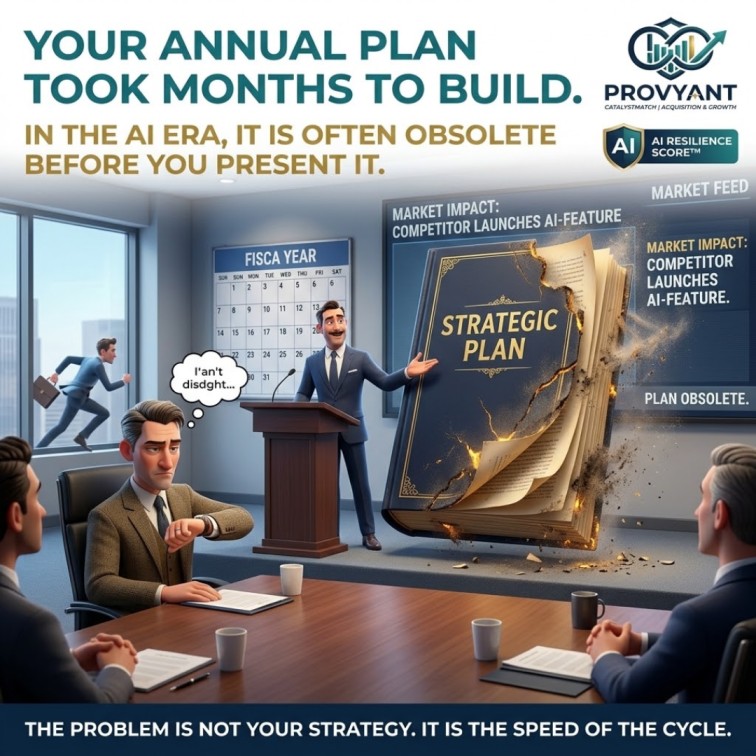
The businesses that stake their strategy on a particular forecast, whether about AI adoption timelines, market shifts, or competitive moves, are exposed the moment reality diverges from the prediction. And reality almost always diverges. The generative AI shock, climate-related supply disruptions, and consumer behaviour shifting in weeks rather than years are the kinds of changes that do not announce themselves on a predictable schedule.
What Actually Determines Survival
If prediction is not the differentiator, what is? The research points consistently to a different capability entirely.
Resilient organisations do not rely on prediction accuracy. Instead, they design systems that sense change, adapt quickly, and continue operating under stress. This mindset treats risk as dynamic rather than static, and it moves the organisation away from the impossible task of forecasting every shock toward the achievable one of building the capacity to withstand shocks in general.
This is the crucial reframe. Resilience is not defined by the absence of disruption, but by how effectively organisations respond when disruptions occur. The goal is not to avoid being hit. It is to remain functional after the hit lands. And that capacity is built through structure, not through prophecy.
The businesses that survived recent waves of disruption were rarely the ones with the most accurate forecasts. They were the ones with variable cost structures, documented operations, diversified dependencies, and the financial discipline to absorb a blow without collapsing. Those are not predictive capabilities. They are structural ones.
The Visibility That Matters More Than Foresight
If there is one capability that predicts survival better than foresight, it is visibility into the organisation’s own dependencies and vulnerabilities.
Many organisations discovered during recent disruptions that their critical services relied on technology, data, and third parties in ways they had documented but never operationally understood. Disruptions often originated in areas that looked fine on paper but concealed single points of failure nobody had stress-tested. Visibility continues to be one of the most powerful predictors of resilience maturity, and it is entirely distinct from the ability to predict external events.
The business that knows exactly where its own vulnerabilities sit does not need to predict which shock will arrive. It knows where it will break regardless of the cause, which means it can reinforce those points in advance. This is why Provyant’s analysis of operational continuity emphasises mapping dependencies over forecasting events. The map is actionable. The forecast rarely is.
The Adaptive Behaviours That Separate Survivors
The organisations that survive disruption also behave differently from those that merely react to it, and the difference is measurable.
Companies that drive disruption in their industries actively reshape their portfolios in anticipation of change. According to the 2026 AlixPartners Disruption Index, nearly four out of five companies that drive disruption expect to make material acquisitions in the year ahead, compared to just 45% of companies that react to disruption. The survivors are not sitting still waiting for clarity. They are continuously reevaluating their positions and moving while others wait.
This is what the World Economic Forum describes as continuous adaptation, which takes root when leaders integrate change and continuity into how the organisation operates rather than treating adaptation as a one-time response to a specific crisis. The survivors have made adaptability a permanent operating capability, not an emergency measure they deploy when a predicted shock finally arrives.
Why This Matters for Business Value and Ownership
The distinction between prediction and adaptability is not only a strategic curiosity. It has direct consequences for business value, particularly in the context of the ownership transitions reshaping the small business market.
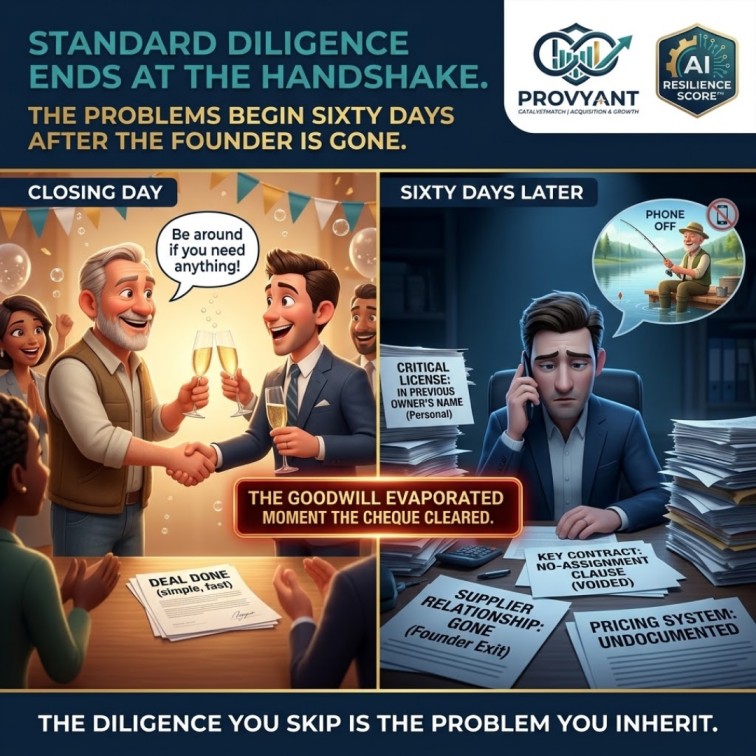
A business built for adaptability, with documented operations, diversified dependencies, and the structural capacity to absorb disruption, is a fundamentally more valuable and transferable asset than one whose stability depends on conditions remaining exactly as they are. Buyers and lenders increasingly recognise this. As Provyant has outlined in its analysis of why buyers look beyond revenue, the durability that comes from adaptability is now a measurable component of how businesses are evaluated.
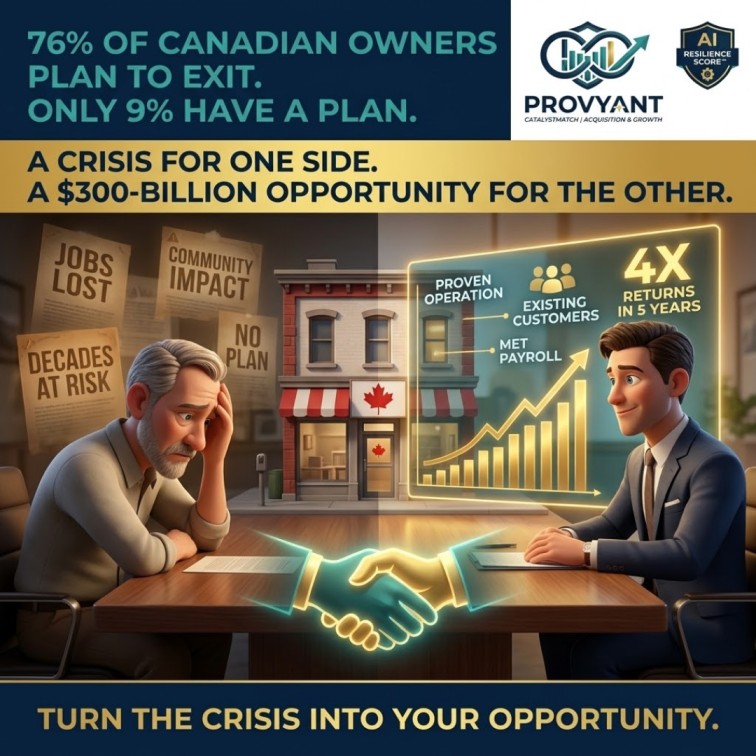
This is especially relevant for the businesses coming to market in the Silver Tsunami. A profitable business that is fragile, dependent on the owner, and structured around conditions never changing is a riskier acquisition than one built to adapt. The businesses that will hold their value through the AI transition are the adaptable ones, regardless of whether their owners predicted the transition at all.
Build to Adapt, Not to Predict
The lesson from every major disruption is consistent. The survivors are rarely the prophets. They are the organisations that stopped trying to predict the future precisely and started building the capacity to withstand whatever version of it arrived.
That is a more achievable goal than perfect foresight, and a more durable one. It requires honest visibility into the organisation’s own vulnerabilities, structural adaptability built into operations, and the discipline to keep adapting continuously rather than waiting for a crisis to force the issue. The AI Resilience Score at provyant.com gives business owners and buyers the structured framework to assess exactly that capacity, across operational durability, AI exposure, and adaptability. Because the businesses that survive what is coming will not be the ones that saw it coming. They will be the ones that were built to absorb it.