
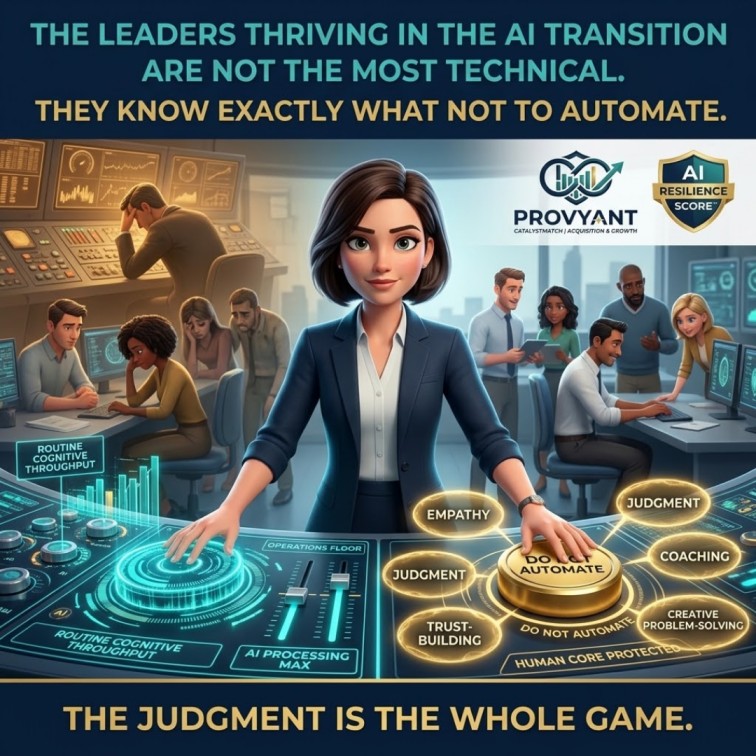
There is a temptation to assume that the leaders thriving in the AI transition are the technical ones, the executives who understand the models most deeply, who can talk fluently about architectures and capabilities. It is an intuitive assumption. It is also wrong.
The leaders coming out ahead in this transition share a trait that has very little to do with technical fluency and everything to do with judgment. They understand where AI creates genuine value, where human capability remains irreplaceable, and how to organise the two together. As Provyant has outlined in its analysis of governing through disruption, the leaders defining this era are not the ones deploying the most technology. They are the ones treating AI as a management challenge rather than a technology one.
It Is a Leadership Gap, Not a Technology Gap
The most important finding across the leadership research of 2025 and 2026 is that the difference between organisations thriving with AI and those struggling is not a difference in tools. It is a difference in leadership.
The data is direct. BCG found that companies where leadership actively understands and adopts AI deliver results 5.3 times higher. The pattern is consistent: AI return on investment depends not on technology budgets but on executive posture. Only 8% of managers have the AI competencies their organisations need, and that shortfall is described explicitly as a leadership gap rather than a technology gap.
This reframes the entire question. The organisations falling behind are not the ones with inferior technology. In most cases they have access to the same tools as everyone else. What separates them is whether their leadership has the judgment to direct that technology toward genuine value. As the McKinsey State of AI survey shows, 88% of organisations now use AI, but almost two-thirds have yet to implement it at scale, and only 39% demonstrate a quantifiable EBIT impact. The problem is no longer technological maturity. The disconnect is in leadership, organisational preparedness, and people capabilities.
The One Thing They Have in Common
So what is the trait the thriving leaders share? It is the ability to hold two things in balance: using AI aggressively for what it does well, while protecting and investing in the human capabilities that AI cannot replicate.
The executives advancing most in 2026 share something: they know what to do with the time AI frees up, how to direct the systems their teams use, and where to keep their own judgment intact. That last point is the crux. It is not enough to adopt AI. The leaders who thrive know precisely where to deploy it and where to hold the line on human judgment.
This is echoed across the research. The organisations that thrive will be those where leaders blend technological abilities with human skills like emotional intelligence, creative problem-solving, and relationship building. The most effective AI leaders are the ones who can leverage technical proficiency with ethical judgment, lead cultural transformation rather than just digital change, and treat AI as a strategic partner rather than a replacement for human decision-making.
The common thread is judgment about where humans matter most. The thriving leaders are not the ones who automated the most. They are the ones who knew what not to automate.
Why the Human Focus Is the Competitive Edge
It might seem counterintuitive that in an AI transition, the leaders who win are the ones focused on human capability. But the logic is sound, and the evidence supports it.
When AI takes over the routine cognitive throughput, the value that remains, and the value that becomes scarce, is the human capability that AI cannot replicate. Leaders who prioritise human infrastructure thrive in innovation, retention, and resilience. When the soft elements of leadership get automated away, burnout risks rise and the organisation loses the very capabilities that differentiate it. The leaders who double down on empathy, conflict resolution, and authentic development are the ones building organisations that hold together under the pressure of transition.
This connects directly to the retention challenge that AI disruption creates. As Provyant has outlined in its analysis of why your best employees are planning their exit, the organisations that manage AI disruption poorly lose their most capable people. The leaders who thrive are the ones whose human-centred approach keeps the talent that makes the organisation valuable in the first place.
The Management Revolution, Not the Technology Race
The most useful way to understand the trait the thriving leaders share is the reframe offered by the strategy researchers themselves.
In 2026, the most successful organisations will stop treating AI as a technology race and start treating it as a management revolution. The winners will not be those deploying the most models, but those reinventing how decisions, teams, and accountability are organised around AI. This is a leadership discipline, not a technical one, and it is precisely the discipline the thriving leaders have developed.
The scale of this shift is significant. According to IBM Institute for Business Value research, 74% of executives expect AI to redefine leadership roles enterprise-wide by 2030. The leaders who are getting ahead of that redefinition are the ones who understood early that the transition would be won or lost at the level of management judgment, not technology adoption.
What This Means for Business Durability
The trait that distinguishes thriving leaders is not only a personal advantage. It is a direct determinant of business value and durability.
A business led by someone who understands where AI creates value and where human capability must be protected is a more resilient and more valuable business than one led by someone chasing tool adoption without that judgment. This matters enormously in the context of the ownership transitions reshaping the market. As Provyant has outlined in its analysis of what makes a business AI-resilient, leadership quality and the judgment behind AI adoption are increasingly components of how businesses are evaluated. A business with strong technology and weak leadership judgment is not a durable asset. One with the balance right is.
The Trait Worth Building
The leaders thriving in the AI transition are not the most technical, the earliest adopters, or the biggest spenders. They are the ones with the judgment to use AI aggressively where it delivers value and to protect the human capabilities that remain irreplaceable. That trait, more than any technical skill, is what separates the leaders getting ahead from the ones falling behind.
It is also a trait that can be built deliberately, through honest assessment of where an organisation’s AI adoption is creating value and where it is eroding the human capabilities that matter most. The AI Resilience Score at provyant.com gives leaders the structured framework to assess exactly that balance across their organisation. Because the leaders who thrive in this transition are not the ones who mastered the technology. They are the ones who mastered the judgment about where it belongs.