
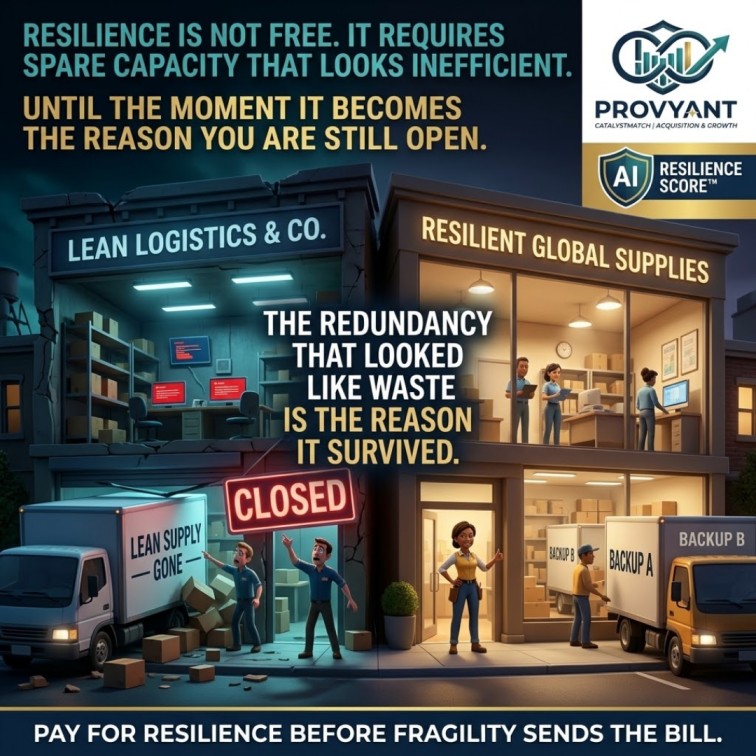
Resilience has a marketing problem. Everyone agrees it matters. Boards endorse it, strategy documents reference it, and leaders describe their organisations as resilient with genuine conviction. But when it comes time to fund it, resilience runs into an uncomfortable truth. It has a real cost, and that cost often looks like inefficiency on a spreadsheet.
This is the tension that determines whether an organisation is actually resilient or just describes itself that way. As Provyant has outlined in its analysis of organisational adaptability under AI pressure, genuine resilience is built through structure and investment, not through slogans. Understanding what that investment actually costs, and what fragility costs in return, is the calculation every leader now has to make.
Why Resilience Looks Like Inefficiency
The first thing to understand about the cost of resilience is why organisations resist paying it. The resistance is not irrational. It comes from a genuine tension at the heart of how businesses are run.
The barriers are consistent across the research. Organisations hesitate to invest heavily in resilience because of high upfront costs for technology, training, and restructuring, competing priorities that push resilience down the list, and the fundamental tension between efficiency and redundancy. Resilience often requires spare capacity, which can seem inefficient. And because success usually means avoiding a visible failure, measuring the return on investment is genuinely difficult.
This is the core problem. An efficient organisation runs lean, with minimal redundancy and every resource optimised for output. A resilient organisation deliberately maintains slack, backup capacity, and duplicate pathways that an efficiency-focused analysis would flag as waste. The spare server that is never used, the second supplier who costs more, the cross-trained employee who could cover a departure. Each of these looks like a cost until the moment it becomes the reason the business survives.
What the Investment Actually Covers
When an organisation commits to building genuine resilience, the cost falls into several distinct categories, each addressing a different dimension of vulnerability.
The first is technology and infrastructure. Building resilience increasingly means investing in the systems that provide visibility, redundancy, and recovery capability. This spending is significant and rising. More than half of organisations reported increased capital and operational expenditure in 2025, with AI-related investments driving much of the increase as leaders build the technical foundations for a more adaptable operation.
The second is talent and training. Resilience depends on people who can adapt, make judgment calls under pressure, and cover gaps when disruption hits. A culture of continuous learning fosters the adaptability and resilience that are crucial for long-term success, and the organisations that invest in workforce development build a depth of capability that fragile competitors lack.
The third is supply chain and operational redundancy. Effective cost control frees up resources for resilience, but the resilience itself requires diversifying suppliers, exploring onshoring or nearshoring, and using scenario planning and stress testing to identify vulnerabilities before they become failures. This is the redundancy that looks inefficient until a single-source supplier fails.
The fourth, and the one most often underfunded, is ongoing commitment. Long-term organisational resilience requires a dedicated, ongoing budget rather than a one-time initiative. While low-cost options exist, they are often not sustainable, and transactional solutions never achieve long-term return on investment. Resilience built as a one-off project fades. Resilience built as a permanent line item endures.
The Cost of Not Building It
Here is where the calculation shifts. The cost of resilience is real, but it must be weighed against the cost of fragility, and that cost is far larger and far more sudden.
The starkest figure is survival itself. As Provyant has outlined in its analysis of operational continuity, a significant share of businesses that suffer a major disruption without adequate continuity arrangements never reopen. The cost of resilience is paid gradually and predictably. The cost of fragility is paid all at once, often fatally.
Beyond survival, fragility carries a compounding financial cost. Investing in resilience pays off by ensuring business continuity during disruptions and minimising revenue loss, building competitive advantage through faster adaptation, and enhancing reputation and customer trust through reliable service. Each of these is a benefit the fragile organisation forgoes, and the cumulative cost of forgoing them typically dwarfs the cost of the resilience that would have prevented it.
Resilience Is Now Priced Into Business Value
There is a further dimension to this calculation that has emerged sharply in 2026: resilience is no longer just an operational consideration. It is a valuation factor that buyers, lenders, and investors are actively pricing.
The shift in investor behaviour is direct. When assessing a business’s operational resilience, one of the biggest factors now in play is digital maturity, and smart investors are carrying out detailed evaluations to gauge exposure and risk readiness. Decision-making that was once dominated by balance sheet, margins, and revenue now incorporates operational resilience as a core signal.
This matters enormously for the businesses navigating ownership transitions. As Provyant has outlined in its analysis of why buyers look beyond revenue, the resilience of a business is increasingly central to how it is valued and financed. A business that invested in resilience is not just more likely to survive. It is more valuable, more financeable, and more attractive to the buyers who are now scrutinising these dimensions directly. The cost of resilience, in this light, is not a cost at all. It is an investment in the business’s own worth.
Frame Resilience as Investment, Not Expense
The reason resilience gets underfunded is that it is framed as an expense, a cost to be minimised. The organisations that build genuine resilience make a different frame. They treat it as a strategic financial investment that yields significant returns through avoided losses, faster recovery, and enhanced value.
The most useful reframe is to quantify what resilience protects against. By quantifying avoided costs, accelerated recovery, and reduced exposure to fines, organisations transform resilience from a just-in-case safety net into a demonstrable source of return. The resilience budget is not spending against nothing. It is spending against a specific, quantifiable set of risks that fragility would otherwise realise in full.
Pay for Resilience Before Fragility Sends the Bill
Organisational resilience costs real money. It requires redundancy that looks inefficient, ongoing investment that competes with more visible priorities, and a tolerance for spending against risks that may never fully materialise. That cost is genuine, and pretending otherwise does no one any favours.
But the cost of fragility is larger, more sudden, and frequently fatal. The organisations that thrive through disruption are the ones that paid for resilience deliberately, framed it as investment rather than expense, and understood that the bill for fragility always comes due at the worst possible moment. The AI Resilience Score at provyant.com gives business owners and leaders the structured framework to assess where their resilience actually stands and where the gaps are most costly. Because the only thing more expensive than building resilience is discovering, too late, that you never did.