
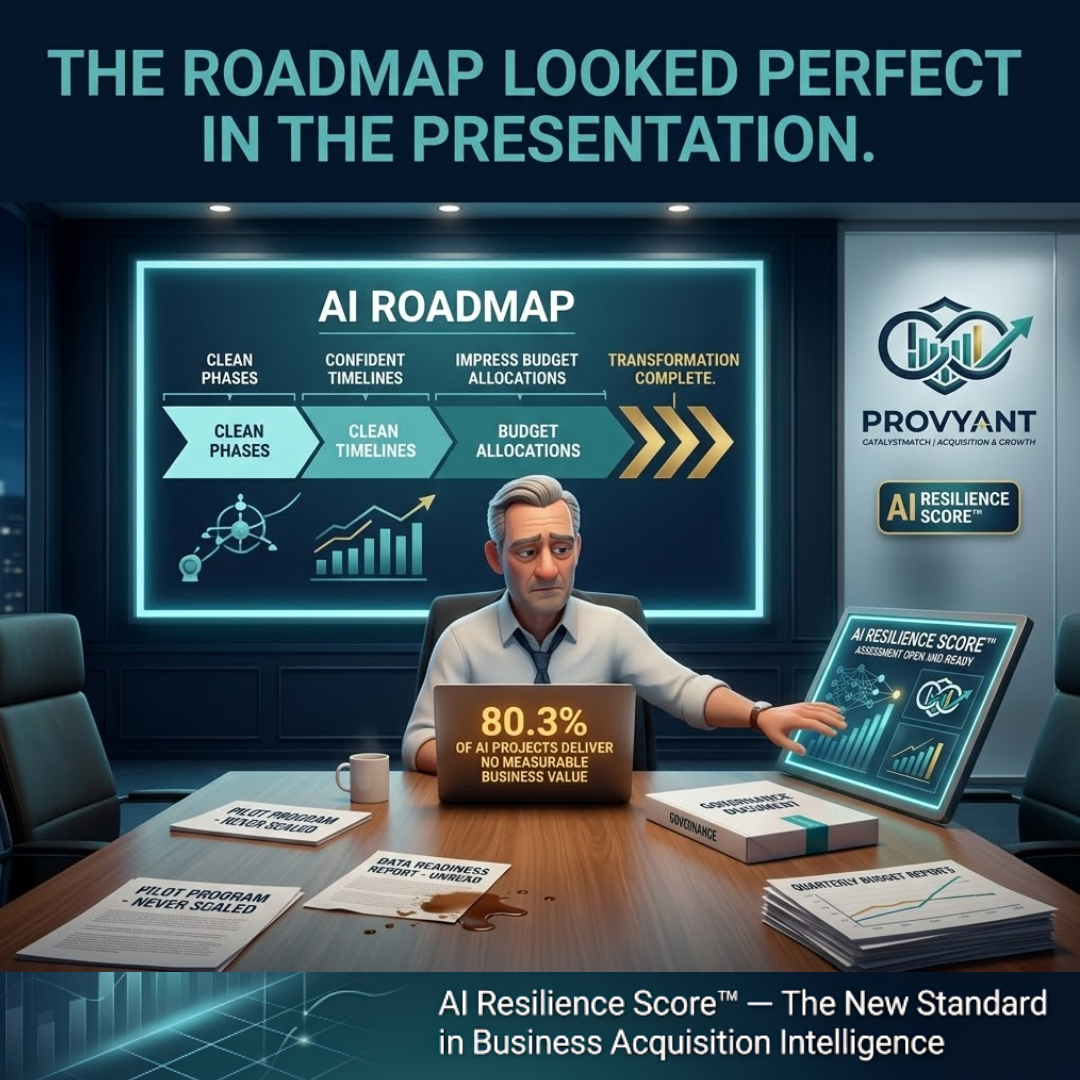
There is a version of AI strategy that exists on paper in most organisations right now. It appears in board presentations, strategic planning documents, and annual reports. It references transformation, efficiency gains, and competitive advantage. It includes a timeline, a budget, and a set of priorities that look coherent in a slide deck.
And then reality arrives. The gap between vendor demos and actual implementation was the defining story of 2025, according to McKinsey’s analysis. 88% of organisations use AI in at least one function. Most remain stuck in pilot purgatory, burning budget without generating returns. As Provyant has outlined in its analysis of the executive blind spot that most leaders carry into this environment, the confidence with which AI strategies are written rarely reflects the operational complexity of executing them.
The Numbers Behind the Gap
The failure rate of AI initiatives is not a minor implementation challenge. It is the dominant pattern.
RAND reports that 80.3% of AI projects deliver no measurable business value. MIT Sloan research found that 95% of generative AI pilots never reach production. S&P Global found that 42% of companies scrapped most AI initiatives in 2025 alone. Gartner notes that 60% of projects without AI-ready data are abandoned before reaching deployment.
Only 34% of enterprises say their AI programmes produce measurable financial impact, and less than 20% have mature governance frameworks in place. The organisations writing AI strategies and the organisations successfully executing them are almost entirely different populations.
The gap is not a technology problem. The most consistent finding across every major research study on AI initiative failure is that the technology itself is rarely what fails. Organisational learning gaps, not technology limitations, cause 95% of generative AI pilots to fail. Teams that do not understand the tools. Processes that were never redesigned. Stakeholders who were consulted too late. Governance that was added after deployment rather than built into it from the beginning.
Why Roadmaps Fail at the Execution Layer
The AI strategy gap has a specific anatomy. Understanding it is the first step to closing it.
The data readiness assumption is where most roadmaps fall apart earliest. 84% of organisations encounter data silos during AI integration, meaning the data the AI system needs is scattered across systems that do not communicate with each other. Roadmaps built on the assumption that data is available, clean, and accessible discover during implementation that the foundation was not there. Gartner’s finding that 60% of projects without AI-ready data are abandoned is not a coincidence. It is the most predictable failure mode in AI implementation, and most roadmaps do not assess it rigorously before committing to a timeline.
The governance afterthought compounds data readiness failures with accountability gaps. Fewer than 20% of organisations have comprehensive AI governance frameworks in place even as AI deployment accelerates. Governance built after implementation rather than before it produces the exact environment where AI-related incidents accumulate invisibly, where accountability is unclear, and where the compliance exposure that regulators are now actively pursuing has time to compound before anyone identifies the source.
The skills gap at scale prevents roadmaps from reaching the execution layer even when data and governance are adequate. In PwC’s 2026 survey, 38% of respondents identified skill gaps as a top three barrier to scaling AI agents, ranking above funding and tooling. 63% of enterprises report skill deficits in AI governance, data literacy, and leadership alignment. Only 28% are investing in formal training programmes to close those gaps. Roadmaps that do not account for the human capability required to execute them are plans that stall the moment implementation begins.
The pilot purgatory problem is the most visible symptom of all three underlying failures. An organisation discovers it has a data readiness gap. Rather than addressing it structurally, leadership approves a contained pilot in a low-risk environment. The pilot produces results that justify optimism but cannot scale because the conditions that made it work are not present across the broader organisation. The pilot is extended. Budget is consumed. The roadmap is revised. The strategic intent and the operational reality drift further apart.
What Separates the 5% That Succeed
The organisations that scale AI successfully are not the ones with the most sophisticated tools or the largest AI budgets. They are the ones that closed the gap between strategy and execution by addressing the underlying organisational conditions before committing to a deployment timeline.
The minority that succeeds starts with redesign, not automation. They map AI to existing employee journeys. They enforce governance from day one. They measure outcomes against real productivity metrics and treat AI initiatives as strategic bets rather than technology experiments.
Closing the gap between executive expectation and real-world execution is not about the technology itself. It is about aligning people, processes, and governance so that AI can actually deliver on its promise without creating new bottlenecks or risks. The organisations that understand that distinction are the ones producing measurable value from their AI investments. The ones that do not are the ones contributing to the 80% that deliver nothing.
Critically, successful AI programmes limit scope to high-impact use cases rather than attempting enterprise-wide transformation simultaneously. The roadmaps that fail most consistently are the ones that try to change everything at once without establishing the organisational readiness that makes any single initiative viable.
The Strategy Gap Is Also a Valuation Gap
For business owners and operators, the AI strategy gap carries a direct commercial consequence that most planning frameworks do not account for.
An organisation that has invested in AI without producing measurable returns has absorbed the cost of adoption without generating the competitive advantage it was supposed to produce. That is a straightforward operational problem. But it also carries a valuation dimension that becomes visible when the business approaches a sale, a capital raise, or a succession event.
Buyers and lenders are increasingly assessing whether an organisation’s AI investment has produced genuine operational improvement or simply generated cost and complexity without corresponding value. As Provyant has outlined in its analysis of why buyers look beyond revenue and what makes a business AI-resilient, the quality of AI integration is now a component of how businesses are assessed commercially, not just operationally.
The Invisible Recession Provyant tracks is already surfacing in organisations that spent 2024 and 2025 executing AI strategies that looked compelling on paper and delivered very little in practice. The strategy gap is not just an operational inefficiency. In a market that is rewarding genuine AI resilience and penalising fragility, it is a competitive liability.
Building a Roadmap That Holds Up Under Pressure
The organisations building AI strategies that survive contact with reality share a consistent approach. They assess data readiness before committing to deployment timelines. They build governance into the strategy rather than adding it after incidents make it unavoidable. They invest in workforce capability as a prerequisite for technology deployment rather than an afterthought. And they limit initial scope to use cases where success is achievable and measurable before expanding.
McKinsey’s finding that only 34% of AI programmes produce measurable financial impact is not an indictment of AI as a technology. It is an indictment of the planning and execution discipline applied to most AI initiatives. The 34% that succeed are applying exactly the discipline the other 66% are skipping.
The AI Resilience Score at provyant.com provides the structured diagnostic framework organisations need to assess their actual readiness before committing to an AI strategy that will not survive the moment it meets operational reality. Because the most expensive AI roadmap is the one that looked perfect in a presentation and delivered nothing in practice.