
Buying a business from a retiring owner is not the same transaction as buying from a founder in their prime. The financials look different. The operations are structured differently. The risks are concentrated in different places. And the single most valuable asset in the business, the owner’s accumulated knowledge and relationships, is about to walk out the door permanently.
Most buyers approach these acquisitions with a standard diligence checklist built for a different kind of deal. That is a mistake. As Provyant has outlined in its analysis of the acquisition checklist every AI-era buyer needs, the diligence required when the seller is 67 is calibrated to a specific set of risks that a generic financial review will miss entirely. Getting it right is the difference between a durable acquisition and a business that quietly collapses sixty days after the founder retires.
The Context That Makes This Diligence Different
The scale of retirement-driven business sales is reshaping the acquisition market, and the diligence challenges that come with it are becoming a mainstream concern for buyers.
52.3% of US employer businesses are in the hands of owners aged 55 or older, roughly 3 million of the nearly 6 million private-sector employer firms, according to Gallup analysis of US Census Bureau data. 27% of those firms either have no long-term plan or intend to close permanently. These are not distressed businesses. Many are profitable, stable operations. But they carry a specific risk profile that comes directly from the fact that the owner is retiring, and that risk profile is what diligence has to be built around.
The reason this matters is straightforward. When an owner has run a business for 30 or 40 years, the business and the owner have become deeply intertwined in ways that a standard financial audit does not surface.
The Financial Diligence That Standard Reviews Miss
The financial diligence for a retirement-driven sale requires looking past the surface numbers to the reality underneath them.
Buying a business from a retiring owner is more complex than a regular financial audit, because the books have often been optimised to minimise tax liabilities rather than display clear enterprise value. A business that has spent decades legitimately minimising its tax burden will show financials that understate its true earning power. The buyer’s job is to uncover the actual profitability, which means calculating Seller’s Discretionary Earnings by adding back the personal expenses, one-time costs, and owner-specific benefits that have been run through the business.
Small business owners often run personal expenses through their corporations. Identifying and validating these add-backs is central to understanding what the business actually earns. A standard review that takes the reported profit at face value will systematically undervalue a well-run retirement-driven business, or fail to identify where the reported numbers have been inflated by add-backs that will not survive scrutiny.
Due diligence timelines have been expanding, averaging 5.5 months in the $5M to $10M segment as of mid-2025, precisely because this reconciliation work is detailed and consequential. The buyer who rushes it is the buyer who pays for the oversight later.
The Key Person Test That Defines the Deal
The single most important diligence workstream when the seller is 67 is the assessment of how dependent the business is on the owner personally. This is the risk that a standard financial review does not capture at all.
The hit by a bus test asks a direct question: if the owner disappeared tomorrow, what would break? In many retirement-driven sales, critical operations live entirely in the founder’s head. The pricing logic, the key customer relationships, the supplier arrangements, the operational judgment that keeps the business running, all of it may be undocumented and irreplaceable.
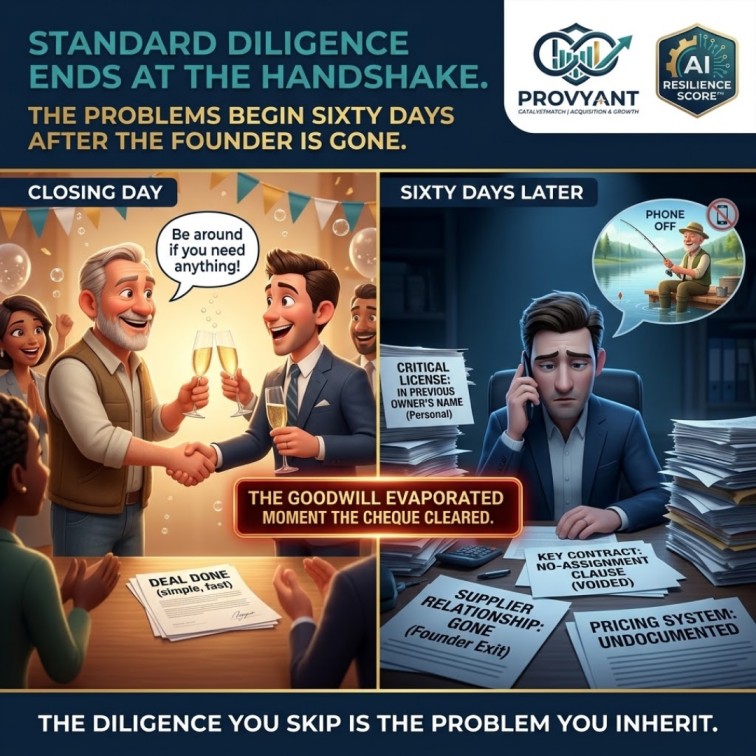
This is why the transition structure matters as much as the purchase price. Transition agreements typically run three to twelve months post-closing, with the seller committing 20 to 40 hours per week initially and tapering as the buyer assumes control. The critical warning is direct: do not let the seller walk away at closing with a handshake and a promise to be available if needed. Informal arrangements are not enforceable, and goodwill evaporates quickly once the check clears. The structured transition is how a buyer protects against the key person risk that diligence identifies.
As Provyant has outlined in its analysis of why buyers look beyond revenue, owner dependency is the single factor that most often separates a business that transfers successfully from one that struggles. When the seller is 67 and retiring, that dependency is not a theoretical risk. It is the central diligence question.
The Legal and Structural Diligence Retirement Sales Require
Beyond the financial and operational review, retirement-driven sales carry specific legal and structural risks that require targeted diligence.
Due diligence calibrated to retirement-driven sales requires confirming that employee classifications have been handled properly, reviewing whether material contracts contain no-assignment clauses that could void them upon a change of ownership, checking for UCC liens, identifying commingled personal and business finances, and verifying that the business holds all necessary licenses and permits in its own name rather than the owner’s personal name.
These are the issues that create the post-closing problems that surface sixty days after the deal closes, when the retiring seller is unreachable. A license held in the owner’s personal name, a key contract that cannot be assigned, a personal guarantee that does not transfer: each of these can undermine an otherwise sound acquisition, and each is specific to the reality of a long-tenured owner who built the business informally over decades.
The AI Resilience Dimension
There is one dimension of diligence for retirement-driven sales that most buyers, and nearly all conventional diligence frameworks, still overlook entirely: the AI exposure of the business being acquired.
A business built and run by a 67-year-old owner over several decades may be operationally sound and yet carry significant unexamined AI risk. Is the core service something AI is beginning to commoditise? Are the operational processes documented well enough to integrate AI under new ownership, or do they live entirely in the retiring owner’s head? Is the business positioned to hold its value through the next ownership cycle as AI reshapes its sector?
As Provyant has outlined in its analysis of what makes a business AI-resilient, these questions are now central to whether an acquisition represents durable value or a business whose value is about to erode. The Silver Tsunami is bringing enormous volumes of businesses to market, and the buyers who add AI resilience to their diligence framework are the ones who will distinguish the genuinely durable acquisitions from the ones that look sound today and fragile tomorrow.
The Diligence That Protects the Deal
Buying a business from a retiring owner is one of the most significant opportunities in the current market, and one of the easiest to get wrong. The businesses are real, the valuations are often attractive, and the financing is increasingly accessible. But the diligence required is specific, and the buyer who applies a generic checklist is the buyer who inherits the problems that surface after the founder is gone.
The buyers who succeed are the ones who calibrate their diligence to the reality of a retirement-driven sale: the optimised books, the owner-dependent operations, the informal legal structures, and the AI exposure that will define the business’s value over the next ownership cycle. The AI Resilience Score at provyant.com gives buyers and advisors the structured framework to assess these dimensions before the deal closes, not after. Because when the seller is 67, the diligence you skip is the problem you inherit.