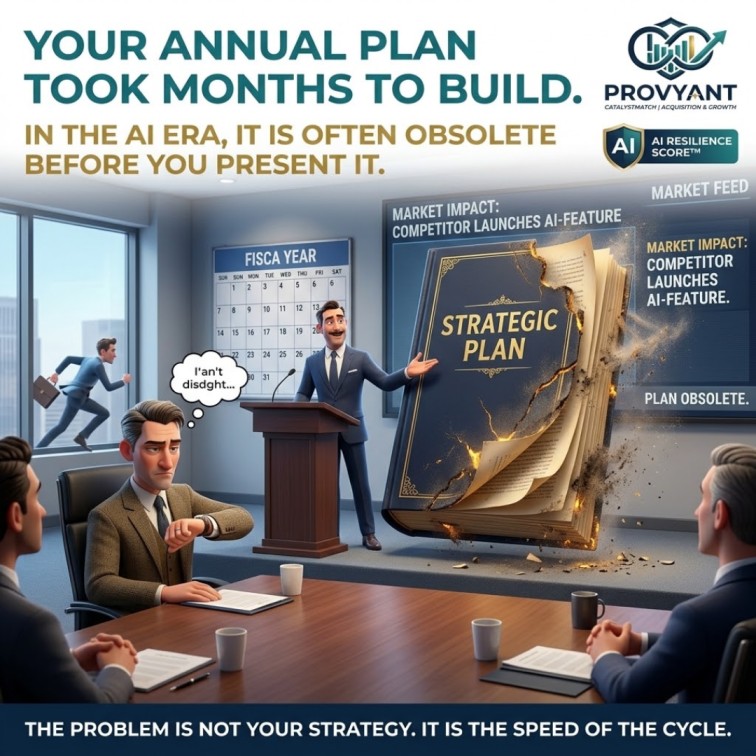
Most organisations believe they are further along with AI than they actually are. They have deployed tools, launched pilots, and rolled out assistants across departments. Usage dashboards look healthy. Leadership sees activity and declares progress. And then the results do not materialise, because activity was never the same thing as readiness. As Provyant has outlined in its analysis of the executive blind spot, the confidence with which leaders describe their AI position is frequently inversely correlated with their actual preparedness.
The distinction between AI adoption and AI readiness is not academic. It is the difference between the businesses generating measurable returns from AI and the ones quietly absorbing the cost of tools that never scaled.
What Adoption Actually Measures
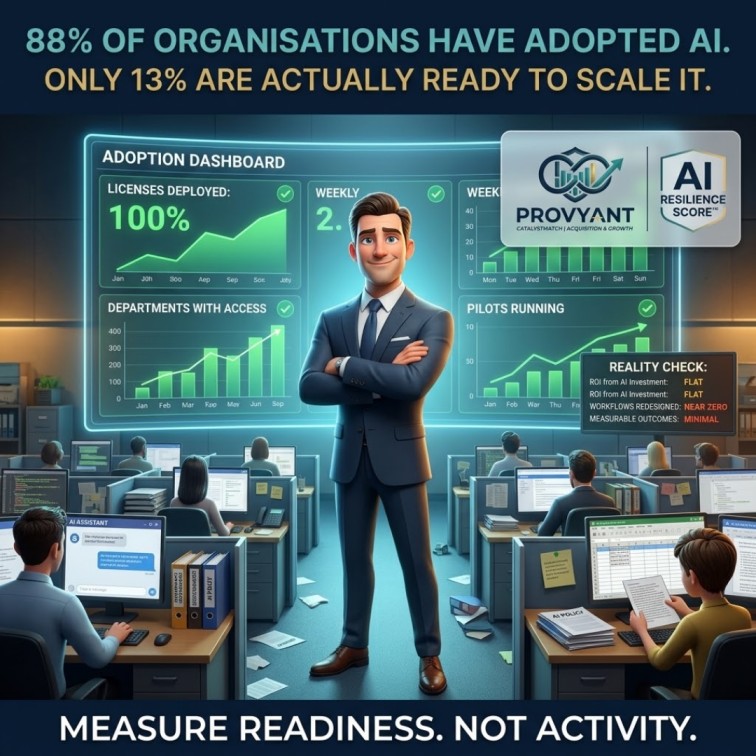
AI adoption is the procurement, integration, and operational use of AI tools. It is a measure of activity. How many licences are deployed, how many departments have access, how many pilots are running, how many employees are using an AI assistant on a given week.
By this measure, adoption is nearly universal. 88% of organisations now use AI in at least one business function, up from 78% the previous year, according to McKinsey’s 2025 State of AI report. 92% of companies plan to increase AI investment. Adoption is not the differentiator anymore, because almost everyone has adopted.
The problem is that adoption tells you very little about whether a business can actually extract value from the tools it has deployed. An organisation can score high on adoption with many tools in use while scoring low on maturity with no governance and no measurement, and near-zero on value realisation with no outcomes tracked. Most enterprise AI benchmarks measure adoption. Very few measure whether that adoption produced anything.
What Readiness Actually Measures
AI readiness is the organisational capability to consistently derive measurable business value from AI, without sacrificing security, governance, or agility. It is forward-looking. It describes whether a business has the prerequisites to use AI successfully at scale, not just whether it has purchased the tools.
Readiness spans several dimensions that adoption metrics do not capture. It includes governance structures, workforce skills, data quality, cultural buy-in, and change management capacity. When a leader approves a new AI platform without assessing whether teams have the skills, governance, or workflow readiness to use it, the result is expensive pilots that never scale.
The gap between adoption and readiness is stark in the data. Only 13% of organisations are fully prepared to deploy and scale AI successfully, according to Cisco’s 2025 AI Readiness Index, even as adoption approaches universal. Only 34% of organisations report truly reimagining their businesses around AI, according to Deloitte’s 2026 State of AI in the Enterprise report, even though worker access to AI increased 50% during 2025.
Why the Gap Is Where the Money Disappears
The consequence of confusing adoption with readiness is measurable and expensive.
95% of enterprise AI initiatives deliver zero measurable ROI, according to MIT’s State of AI in Business 2025, creating what researchers call the GenAI Divide: a widening gap between experimentation and scalable value. The reason is not model quality. Only 21% of companies have redesigned workflows to integrate AI effectively. The tools work. The organisations deploying them are not structured to extract value from them.
This is the pattern that plays out across industries. A company purchases enterprise licences. Employees receive AI assistants. Departments launch pilots. Executives see usage dashboards and declare progress. But the workflows, approvals, and business rules that AI systems need to perform reliably still live only in employees’ heads. The tool was deployed. The readiness was never built. And the investment quietly disappears into the gap between the two.
The Three Things Readiness Requires That Adoption Does Not
The organisations that close the gap between adoption and readiness address three things that tool deployment alone never touches.
Data readiness. 85% of leaders identified organisational data quality as their biggest anticipated AI challenge, according to KPMG. AI systems, and autonomous agents in particular, cannot perform reliably on data that is fragmented, outdated, or incorrectly permissioned. Readiness requires assessing data quality, ownership, and access before scaling deployment, not after incidents make the gaps obvious.
Governance and accountability. Readiness requires clear ownership of AI-driven decisions and their consequences. 72% of leaders say AI literacy is important, but only 35% report having a mature, organisation-wide AI literacy program. Governance that exists on paper but is not embedded in how the organisation operates is not readiness. It is documentation.
Workflow redesign. Readiness in 2026 is about context, not just models. If workflows and business rules live only in employees’ heads, AI systems will not have the structure needed to perform. Readiness requires redesigning how work gets done around AI capabilities, which is precisely the work that most organisations skip in favour of simply deploying the tool.
The Commercial Dimension of Readiness
The gap between adoption and readiness is not only an operational concern. It carries a direct valuation consequence that most planning frameworks do not account for.
A business that has invested heavily in AI adoption without building genuine readiness has absorbed the cost of the tools without generating the operational advantage they were meant to produce. When that business approaches a sale, a capital raise, or a succession event, the gap becomes visible. Buyers and lenders are increasingly assessing whether AI investment produced measurable improvement or simply added cost and complexity.
As Provyant has outlined in its analysis of why buyers look beyond revenue and what makes a business AI-resilient, the quality of AI integration is now a component of how businesses are assessed commercially. The Invisible Recession Provyant tracks is already surfacing in organisations that spent 2024 and 2025 adopting AI enthusiastically and building readiness not at all.
Measuring Readiness Instead of Assuming It
The businesses navigating AI most effectively are not the ones with the most tools. They are the ones that assessed their actual readiness honestly, identified the gaps in data, governance, and workflow, and built the organisational capability to extract value before scaling deployment.
That work begins with an honest baseline. Not a usage dashboard, but a structured assessment of whether the organisation has the prerequisites to make AI produce measurable business value. The AI Resilience Score at provyant.com provides exactly that framework, measuring readiness across operational durability, AI exposure, and organisational preparedness rather than counting the tools in use. Because the businesses that win with AI are not the ones that adopted it first. They are the ones that were actually ready for it.