The skills that define professional value are shifting faster than at any point in modern working history. The capabilities that got a professional hired in 2020 are not the same ones that will make them valuable in 2030. And the organisations that understand which skills are rising, rather than simply reacting to which roles are disappearing, are the ones building workforces that will hold their value through the AI transition.
This is not speculation. It is one of the most extensively researched shifts in the global economy, and as Provyant has outlined in its analysis of the workforce reinvention window, the transition is already underway. The professionals and organisations that identify the durable skills early are the ones positioned to come out ahead. The question is which skills those actually are.
The Scale of the Skills Shift
The data on how much the skills landscape is changing is unambiguous and comes from the most comprehensive global research available.
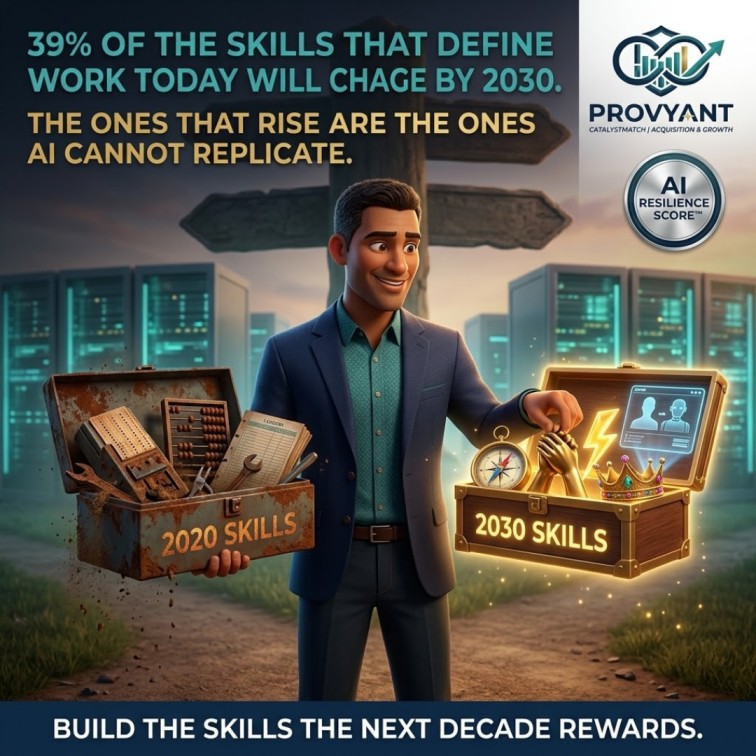
Employers expect 39% of workers’ core skills to change by 2030, according to the World Economic Forum’s Future of Jobs Report 2025, based on surveys of over 1,000 companies. That figure is down from 44% in 2023, a modest stabilisation that reflects growing investment in continuous learning. The same research projects 170 million new roles emerging by 2030 while 92 million existing positions are displaced.
The pressure this creates for organisations is significant. 63% of employers identify the skills gap as the single biggest barrier to business transformation. A further 85% of employers plan to prioritise upskilling as their primary workforce strategy through 2030. The recognition that the skills base needs to change is now nearly universal. The clarity about which skills to build is where most organisations still struggle.
The Technical Skills That Are Rising Fastest
The fastest-growing skills are, unsurprisingly, the ones directly tied to the technology reshaping work. But the nuance in the data matters more than the headline.
The three fastest-growing skill categories are AI and big data, networks and cybersecurity, and technological literacy, according to the WEF’s Future of Jobs 2025 report. Demand for AI and big data skills is expected to rise for 90% of employers by 2030.
But the important distinction is between AI engineering and AI literacy. The skill that matters most for the broad workforce is not the ability to build AI systems. It is the ability to work effectively alongside them: to understand what AI can and cannot do reliably, to verify its outputs, to apply human judgment to its recommendations, and to integrate it into workflows without creating new fragility. This is a capability that applies across virtually every professional role, not just technical ones.
The Human Skills That AI Makes More Valuable, Not Less
Here is the finding that most workforce commentary underweights. As AI takes over more technical and analytical throughput, the skills that rise in value are the distinctly human ones that AI cannot replicate.
The WEF is explicit that even as technical skills grow fastest, human skills such as analytical thinking, resilience, leadership, and collaboration will remain critical core skills. The most valuable professionals will be hybrids who combine both skillsets seamlessly rather than specialising in one at the expense of the other.
The reason is structural. Automation only complements human capability when the workforce possesses the cognitive and socio-emotional skills to adapt. Companies that invest in AI platforms but fail to develop these human capacities face implementation delays, reduced competitive positioning, and innovation stagnation. The technology works. The transformation fails when the human skills required to drive it are missing.
As Provyant has outlined in its analysis of what makes a business AI-resilient, the capabilities that resist automation are precisely the ones concentrating in value. Judgment under ambiguity, genuine trust-building, contextual reasoning, and the ability to lead through uncertainty are not being made obsolete by AI. They are being made scarce, and scarce is valuable.
The Leadership Skill That Is Rising Fastest of All
One category of skill deserves particular attention because its demand is growing faster than almost any other, and because it sits at the intersection of technical and human capability.
Business leaders across the WEF’s Reskilling Revolution strongly emphasise human-centric skills including leadership, curiosity, and resilience, even as most training investment targets digital capabilities. The reason is that as AI flattens organisations and automates coordination, the leadership skills that remain are the ones AI cannot perform: motivating teams, navigating interpersonal complexity, building trust under pressure, and exercising judgment where the right answer is not in any dataset.
The demand is not evenly distributed across the workforce. The reskilling gap between displacement and creation is the most urgent operational challenge facing organisations, because the workers losing roles are not automatically the ones filling the new ones. The organisations that build leadership capability to manage that transition are the ones that navigate it without losing their operational depth.
What This Means for Businesses and Their Value
The skills shift is not only a workforce development concern. It is directly connected to business durability and value.
A business whose workforce has the adaptability, AI literacy, and human capabilities that the 2030 economy rewards is a more resilient and more valuable business than one whose team is anchored in skills AI is making obsolete. This matters enormously in the context of the ownership transitions reshaping the small business market. A business being prepared for sale or succession is more attractive to buyers when its team has the capability to operate and grow under new ownership through continued disruption.
As Provyant has outlined in its analysis of why buyers look beyond revenue, workforce capability and human capital depth are increasingly central to how businesses are evaluated. The Invisible Recession Provyant tracks is already redistributing value toward the organisations and professionals who built the right skills early, and away from those still anchored in capabilities the transition is leaving behind.
Building the Skills the Next Decade Rewards
The professionals and organisations that thrive through 2030 will not be the ones who resisted the skills shift or waited for it to become undeniable. They will be the ones who identified the durable capabilities early, invested deliberately in building them, and positioned themselves on the right side of a transition that is already redistributing value.
That work begins with an honest assessment of where the gaps are, both at the individual and organisational level. The AI Resilience Score at provyant.com helps organisations assess their workforce preparedness as a core dimension of business durability. Because the skills that will matter more in 2030 are the ones worth building today, before the gap between the prepared and the unprepared becomes impossible to close.