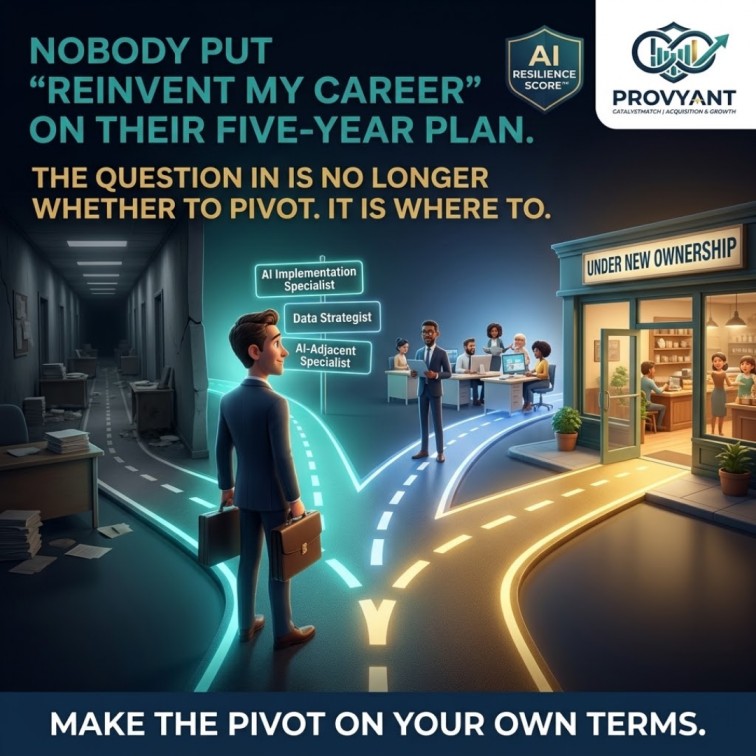
There is a career move happening across the professional economy right now that almost nobody wrote into their original plan. It is not a promotion, not a lateral move, and not a job change within the same field. It is a full pivot, a deliberate shift from one professional identity to another, driven by a labour market that is being reshaped faster than most careers were built to withstand.
The professionals making this move are not doing it out of restlessness. They are doing it because the ground has shifted underneath the roles they trained for. As Provyant has outlined in its analysis of the workforce reinvention window, AI is closing some pathways while opening others, and the professionals who recognise that early are the ones making the pivot on their own terms rather than being forced into it later.
The Pivot Is Now the Norm, Not the Exception
The scale of career change happening right now is not a minor labour market trend. It is a structural shift in how professional lives are being lived.
The average professional now changes entire careers three to four times in their working life, not just jobs. What was once considered a disruptive and risky move is now a common and increasingly accepted feature of a modern career. The difference in 2026 is that the path is clearer and the timeline is shorter than it has ever been.
The driver behind much of this is AI itself. According to the University of Phoenix Career Institute’s 2026 Career Optimism Index, 50% of people say AI makes them more confident about pivoting to a new role. What makes this notable is that employees are not waiting for their employers to lead. Half of workers are learning AI independently, positioning themselves for a transition without any formal support from the organisations that employ them.
Why the Pivot Feels Different This Time
Career change has always existed. What makes the current wave distinct is that it is being driven less by personal choice and more by structural necessity.
The most important reframe is this: career risk today is often not job loss. It is job stagnation. The shape of roles is evolving, and professionals who adapt early position themselves ahead of the curve rather than reacting to it. The danger is no longer only being laid off. It is staying in a role whose value is quietly eroding while the market moves toward capabilities the role does not build.
This is compounded by a shift in how the labour market treats loyalty. The job market does not reward loyalty the way it once did. Automation and AI are reshaping entire industries within the span of a few years, which means the professional who stays put out of loyalty to a stable-looking role may be making a riskier bet than the one who pivots deliberately.
The barriers to pivoting have also fallen. In 2025, 85% of employers adopted skills-based hiring, and over half removed degree requirements for certain roles. Major companies including Google, IBM, Walmart, and Bank of America dropped four-year degree requirements across large portions of their workforce. The pivot is more accessible than at any point in recent history.
Where the Pivots Are Actually Heading
Understanding the pivot requires understanding where professionals are actually going. The destinations fall into a few distinct categories.
The first is toward AI-adjacent roles. Roles like AI Engineer, Machine Learning Engineer, AI Consultant, and Data Center Technician barely existed at scale five years ago and are now among the fastest-growing roles globally. The advantage of pivoting into a genuinely new field is that nobody has a decade of experience in it, which levels the playing field for capable career changers.
The second is toward portfolio and fractional work. The rise of portfolio careers, with fractional CFOs, CMOs, and consultants working across multiple companies, reflects a shift away from single-employer commitment toward flexible, multi-client models where experienced specialists are in high demand.
The third destination, and the one that receives the least attention, is toward ownership.
The Pivot Toward Ownership
For a significant and growing cohort of experienced professionals, the pivot is not into another job at all. It is into owning a business.
This is where the current career transition wave intersects with a second structural force. Experienced tradespeople running their own businesses can earn six figures in many markets, and for many professionals this is not a fallback path but a strategic pivot toward stability and ownership. The professional who spent two decades in operations, finance, or management often has exactly the capabilities that a small business needs in a new owner.
This pathway is being made unusually accessible by the retirement wave reshaping the small business market. As Provyant has outlined in its analysis of the pathway from displaced professional to business owner, the convergence of AI displacement and the Silver Tsunami is creating an environment where capable professionals can acquire established, profitable businesses at terms that did not exist at this scale before. The pivot toward ownership is not a consolation prize. For the right professional, it is the most strategically sound move available.
What Makes a Pivot Succeed
The professionals who pivot successfully share a consistent characteristic. They lead with transferable capability rather than trying to start from zero.
The most valued skills in the current market are the ones that transfer across domains. Managing change, communicating complex information clearly, and the ability to work effectively with AI are all highly valued, and employers are increasingly impressed by portfolios that show breadth across different contexts. The most lucrative transitions combine transferable soft skills with targeted technical upskilling rather than abandoning everything that came before.
This matters enormously for the pivot toward ownership. The operational judgment, financial literacy, and relationship management that a professional built over a career are exactly the capabilities that make a business transferable and durable. As Provyant has outlined in its analysis of what makes a business AI-resilient, the human capabilities that resist automation are the same ones that create value in an ownership context.
Make the Pivot on Your Own Terms
The career pivot nobody planned for is now the move almost everyone is making, in one form or another. The professionals who navigate it best are not the ones who waited until a restructuring forced their hand. They are the ones who read the direction of the market, identified where their transferable capabilities create the most value, and moved deliberately before the change became mandatory.
For those whose pivot is heading toward ownership, the starting point is understanding what makes a business worth acquiring and durable enough to hold its value through continued disruption. The AI Resilience Score at provyant.com gives professionals considering the ownership pivot the structured framework to assess a business across AI exposure, operational durability, and long-term value. Because the best career pivot is the one you make on your own terms, before the market makes it for you.