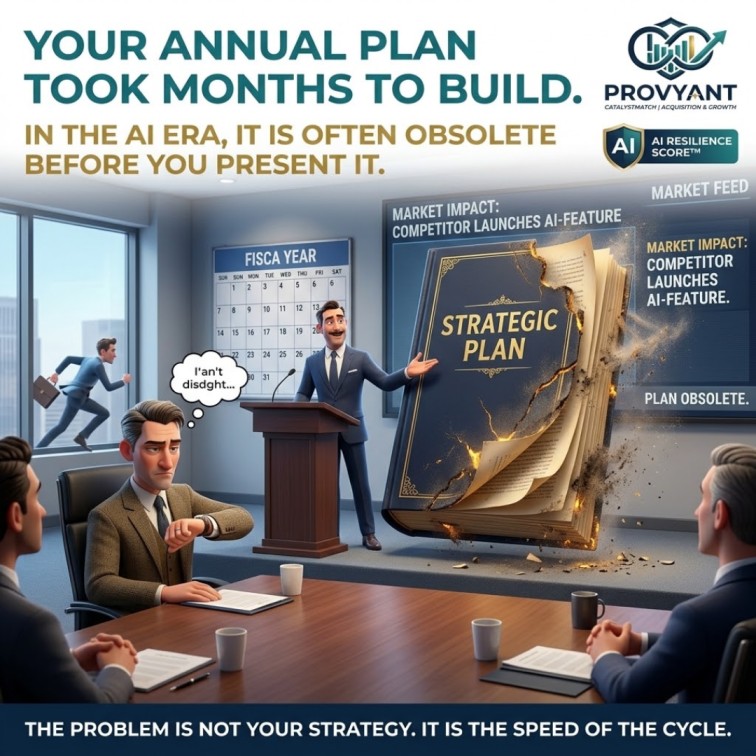
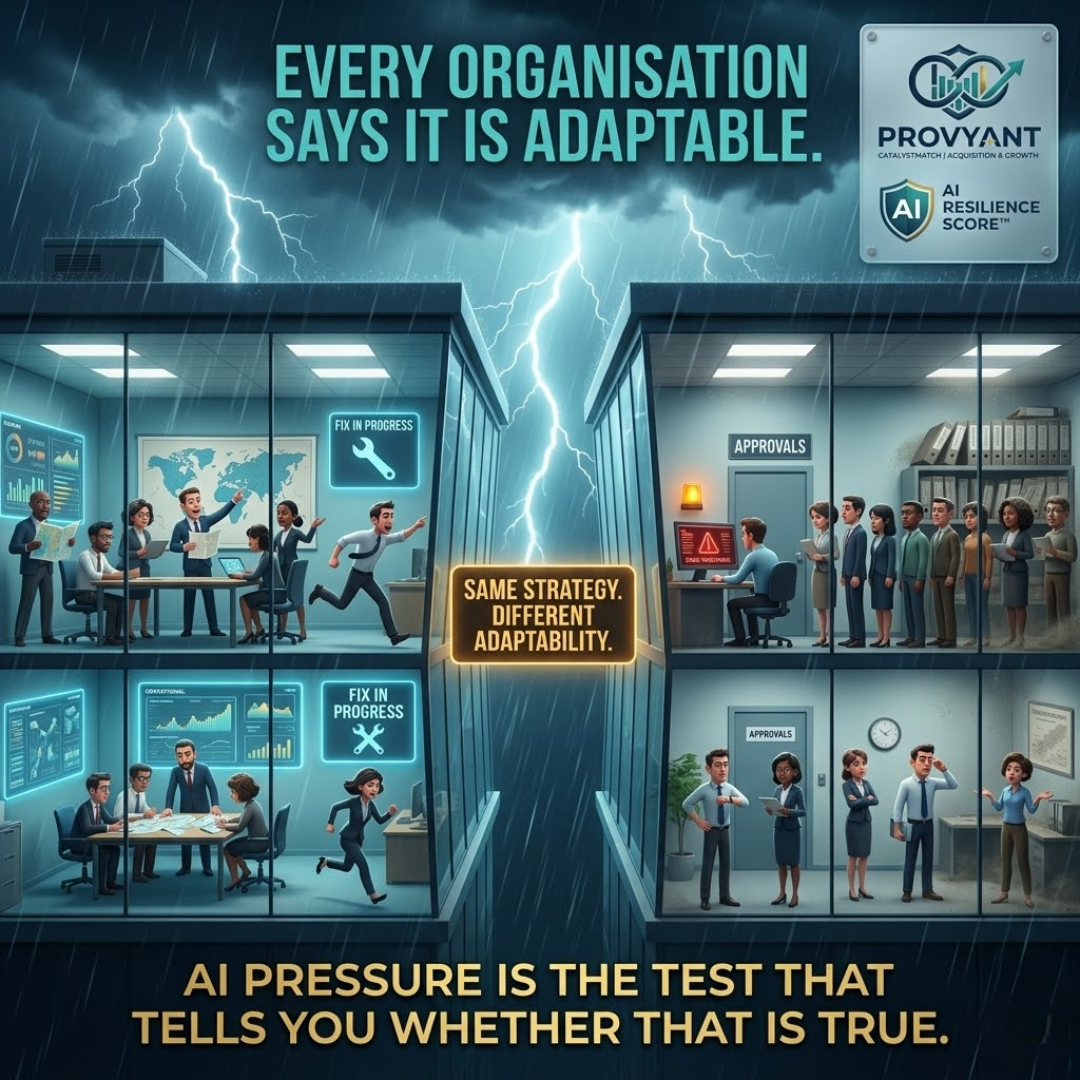
Adaptability has become one of the most frequently used words in AI-era business commentary. Boards call for it. Leadership frameworks reference it. Job descriptions demand it. And yet for most organisations, it remains more of an aspiration than a structured capability, something described in strategy documents but rarely defined with enough precision to actually build.
In 2026, AI has moved beyond curiosity and early experimentation, according to the World Economic Forum. AI works. The opportunity now is to realise its full value by rethinking how work is performed, how decisions are made, and how operating models are designed. That rethinking is exactly what genuine adaptability requires. And as Provyant’s analysis of the AI strategy gap makes clear, most organisations are still confusing the appearance of transformation with the structural reality of it.
The Transformation Paradox
The research on organisational adaptability in the AI era reveals a consistent and uncomfortable pattern.
65% of AI users fear falling behind if they do not use AI to adapt quickly. Yet 45% say it feels safer to focus on current goals than to redesign work with AI. Only 13% of AI users say they are rewarded for reinventing work with AI even when results are not immediately met. Microsoft’s Work Trend Index calls this the Transformation Paradox: employees are ready to reinvent how they work, but the metrics, incentives, and norms around them continue to reinforce the old way.
62% of organisations endured extremely significant strategy and execution impacts due to economic shifts in the first half of 2025, according to Personiv’s Executive Outlook Pulse Survey. The organisations that navigated those impacts most effectively were not the ones with the most sophisticated AI tools. They were the ones that had built structural adaptability into how they operate, how they make decisions, and how they respond when conditions change faster than their planning cycle anticipated.
2026 will mark AI’s put up or shut up moment for large enterprises, according to IMD’s analysis. Firms stuck in proof-of-concept activity with little pilot-to-production conversion will face board and market pressure to retrench. Leading firms will reallocate resources to fewer but deeper transformations, with the bulk of investment directed toward organisational change rather than technology acquisition. The organisations that treated adaptability as a cultural slogan are the ones facing that reckoning hardest.
What Adaptability Is Not
Clarifying what genuine organisational adaptability is requires first being clear about what it is not.
It is not the speed of AI tool adoption. Organisations that deployed AI tools broadly in 2024 and 2025 at pace often produced exactly the shadow AI, governance gaps, and failed initiative patterns that define the least adaptable environments. Speed of adoption without structural alignment is not adaptability. It is reactivity, and the two produce very different outcomes.
It is not the absence of resistance to change. Resistance to AI adoption is frequently a signal from the people closest to operational reality that the implementation is missing something important. Hybrid governance approaches show 41% higher user adoption rates than centralised models, precisely because distributed input produces implementations that actually fit how work gets done. The organisations that dismiss resistance as a cultural problem to be managed rather than a signal to be listened to are the ones that produce the expensive implementations nobody uses.
It is not the language of transformation in executive communications. The organisations narrating their AI journey most enthusiastically in press releases and town halls are not necessarily the ones building the structural capability to operate differently. As Provyant has outlined in its analysis of the executive blind spot, the confidence with which leaders describe their AI readiness is frequently inversely correlated with their actual governance maturity.
What Adaptability Actually Looks Like in Practice
The organisations demonstrating genuine adaptability under AI pressure share a specific set of structural characteristics that are identifiable, measurable, and replicable.
They redesign work before deploying technology. The minority of organisations that successfully scale AI start with redesign, not automation. They map AI to existing employee journeys, identify where automation creates genuine operational improvement rather than displacement of activity, and build the new workflow before deploying the tool. The organisations that deploy the tool first and redesign around it afterwards are the ones generating the pilot purgatory that consumes most enterprise AI budgets without producing returns.
They measure outcomes against real productivity metrics. Adaptable organisations do not track AI adoption rates. They track whether AI deployment produced the operational outcome it was meant to produce. Did cycle times compress? Did error rates decline? Did customer response quality improve? Execution matters more than experimentation in 2026, according to Flexera’s CIO. Organisations that cannot connect AI investment to measurable business outcomes are not adapting. They are spending.
They build upskilling into the transformation itself. Comprehensive upskilling produces 2.7 times higher implementation success rates than technology deployment without capability development. Adaptable organisations treat human readiness as a prerequisite for technology deployment, not an afterthought. The WEF’s analysis of organisational transformation in 2026 identifies data-driven, personalised talent development as one of the five core focuses of the organisations maximising AI’s potential. Talent development that precedes and accompanies deployment is a structural characteristic of adaptability. Talent development that follows a failed deployment is a recovery cost.
They distribute decision-making authority at the pace AI requires. AI-enabled organisations that retain centralised decision-making structures discover that the speed advantage AI creates at the operational level is absorbed by approval processes that were designed for slower environments. Genuine adaptability requires pushing accountability closer to the work, which means redesigning governance structures rather than simply deploying tools within structures that were built for different conditions.
They connect AI governance to operational continuity planning. The most adaptable organisations are the ones that do not treat AI governance as a compliance function separate from their operating model. They embed it into how decisions are made, how risks are escalated, and how the organisation responds when something goes wrong. As Provyant has outlined in its analysis of operational continuity in the AI era, governance embedded in operations produces resilience. Governance added after incidents produces audit trails.
The Commercial Dimension of Adaptability
Organisational adaptability under AI pressure is not only an operational concern. It is a direct determinant of business value and commercial positioning.
A business that can demonstrate structured adaptability, documented operational processes that evolve as AI capabilities change, and leadership accountability for AI-related decisions is fundamentally more durable and more transferable than one that cannot. Buyers and lenders increasingly assess this capability as a component of business quality in acquisition and financing conversations.
As Provyant has outlined in its analysis of what makes a business AI-resilient and why buyers look beyond revenue, organisational agility and operational durability are now measurable dimensions of business value. The organisations building genuine adaptability are the ones holding and growing their value through disruption. The ones performing it are the ones discovering the gap between their stated position and their actual capability when commercial scrutiny arrives.
Building Adaptability That Holds Under Pressure
The organisations navigating AI pressure most effectively are not the ones that declared themselves adaptable in a strategy document. They are the ones that redesigned their operating model around the specific capabilities that AI pressure demands: faster decision cycles, distributed accountability, human-AI workflow integration, and governance structures that evolve as the technology does.
That work is harder and slower than buying a tool. It produces less impressive content for annual reports. And it is the only form of adaptability that actually holds when conditions change faster than the plan anticipated.
The AI Resilience Score at provyant.com provides the structured framework organisations need to assess their actual adaptability across the dimensions that matter most under AI pressure. Because the organisations that survive what is coming are the ones that built something real, not the ones that described it well.